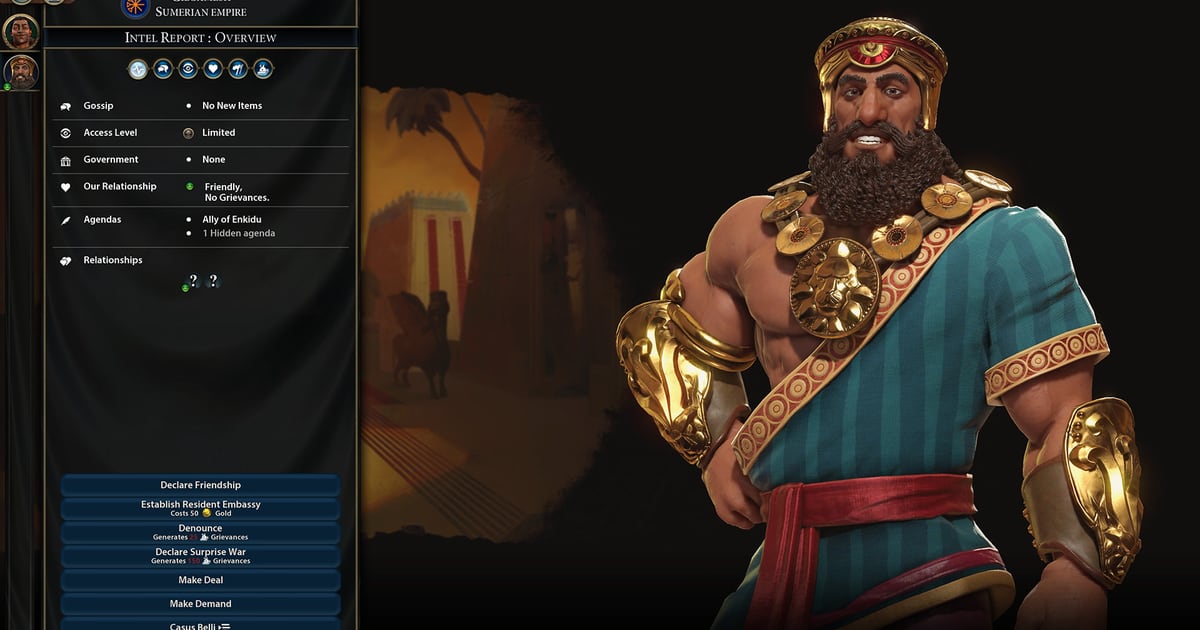
Sid Meier’s Civilization VI and Sid Meier’s Civilization VII are not rivals in the usual sequel sense. Fetching the two Steam Charts pages on 16 October 2026 returns a 24-hour peak of 36,313 concurrent players for Civ VI against 8,807 for Civ VII, and Civ VI’s all-time peak of 162,314 is nearly double Civ VII’s 84,558. Nine years after launch, the older game is running at roughly four times the concurrency of the one that replaced it. That gap is why “which should I play” is a real question in 2026 rather than a formality.
What this covers: Civilization VI and VII side by side in late 2026 — systems, content, price and Steam numbers. Why it matters: Civ VII’s free May 2026 Test of Time update made its Age structure optional, so the easy 2025 answer (“stay on VI”) no longer settles it. Who should care: Newcomers buying into the series around Civilization’s 35th anniversary, and returning players choosing which one to reinstall.
The two games side by side
| Civilization VI | Civilization VII | |
|---|---|---|
| Released | 20 October 2016 | February 2025 |
| Signature system | Cities expand across the map as districts, each on its own hex, with research in Culture as well as Technology | Three Ages — Antiquity, Exploration, Modern — with optional civilization switching at each transition |
| Leaders | Historical leaders, some with several Personas, pursuing agendas based on their traits | Leader chosen separately from the civilization, for the first time in the series |
| Content state | Complete: Rise and Fall, Gathering Storm and the leader passes have shipped | Still being built out, with paid Content Collections and a roadmap running into 2027 |
| Steam reception | Very Positive — 85% of 107,879 English reviews | Mixed — 51% of 29,896 English reviews |
| 24-hour peak, 16 Oct 2026 | 36,313 | 8,807 |
| 35th-anniversary discount | 90% off | 50% off |
The release date, the district-and-civics description and the Personas come from Civ VI’s Steam store page and the official Civilization history page. The Steam ratings and the tracker peaks are from the store and Steam Charts pages fetched for this piece; the discounts are from the 35th-anniversary sale announcement.
Where Civ VI still wins
Civ VI is nine years finished. That is its argument, and it is a strong one.
Steam’s own description is the cleanest summary of what a Civ VI match is: cities “physically expand across the map”, and every “district, wonder, and improvement is built on its own hex”, so city planning is a spatial puzzle rather than a menu. Research runs on two tracks — the Technology tree and a separate Civics tree — and Civ VI’s leaders “pursue their own agendas based on their historical traits”, with some shipped as multiple Personas you can pick between. The official history page frames the same design as the entry that introduced “new ways to engage with your world”. That is the model Civ VII was reacting against, and nine years on it is balanced, documented, and carrying a large Steam Workshop.
The price gap does the rest. In the 35th-anniversary Franchise Sale, which 2K ran from 3 to 17 September 2026, the catalog was discounted by up to 90%, with Civilization VI among the deepest cuts and Civ VII at half price; Firaxis also ran a free play week for Civ VII from 3 to 10 September. For a newcomer, a complete nine-year-old game at a sale price is a lower-risk entry than a newer one still being rebuilt.
Our own Civilization V piece shows the same pattern one game further back: in this franchise the newest release is not automatically the most-played. Civ VI is currently the clearest example of it.
What Civ VII changed — and what Test of Time fixed
Civ VII’s pitch is the opposite of Civ VI’s. Its Steam page leads with “Lead empires that evolve or endure through the Ages”, and the game is built on three of them: Antiquity, Exploration and Modern. Where Civ VI gives you one civilization for a single long arc, Civ VII required you to leave your starting civilization behind and pick a new one at each Age transition — twice per match — and decoupled leaders from civilizations so that, for the first time in franchise history, “leader selection is separate from your civilization”.
That decision is the one that split the audience. Firaxis creative director Ed Beach told Ars Technica the team had warning signs before launch: “We got feedback in some of our focus testing before the game shipped that there was going to be some level of controversy here, but we didn’t realize quite how strongly players identified with the idea of, ‘I need to take some people and grow them and have that specific civilization cultural set be what’s growing to face the challenges of world history.’” Executive producer Dennis Shirk put it more bluntly: “It was like if we were making Madden and we decided they’re going to play with a soccer ball instead of a football.” Beach also conceded that, measured against Civilization creator Sid Meier’s rule that a sequel should keep a third of its systems, improve a third and replace a third, “we still probably violated the 33-33-33 rule by going a little bit heavier into a new approach to everything.”
May 2026 is when Firaxis walked part of that back. The free Update 1.4.0, Test of Time, is the biggest change to Civ VII since launch, and its first headline is the one players had asked for since day one: “You can now start and stay as any civ, in any Age.” Keeping one civilization is now an option rather than a departure — a “Time-Tested” civ keeps a core kit and gains new Civics, and a Syncretism mechanic lets you borrow one unique unit or piece of infrastructure from a civ currently in its Apex Age, or reinforce your own identity with Affirmation instead.
The same update removed the game’s prescribed per-Age objectives. In Firaxis’s words, “Legacy Paths have been replaced with Triumphs” — a more open menu of optional challenges tied to six attributes, from which you pick a handful each Age. It also reworked all four victories around a per-track score: Military runs on Dominion, Cultural on Tourism, Economic on GDP, and Scientific on a flat race to 100 Innovation. Our Age Transitions guide tracks how Triumphs and Dedications now carry between Ages, and the victory comparison breaks down each track. Firaxis is still adding to the game after May too — the Arc of Tomorrow roadmap covers the free 2027 update that pushes Civ VII’s timeline past its current 1950 endpoint.
The Steam numbers, read carefully
Reception is still the gap Civ VII has not closed. Its Steam store page shows Mixed, at 51% of 29,896 English-language reviews; Civ VI is Very Positive at 85% of 107,879. On the tracker, Civ VI averaged 27,804 players over the 30 days to 16 October 2026, against Civ VII’s 8,805 — the same ordering as the single-day peak, which is why the split reads as structural rather than as one sale weekend.
Two caveats belong on those figures. Concurrent players are not owners, and a 24-hour peak is a snapshot, not a census: the anniversary sale and the free play week will have moved both games’ short-term numbers, and Civ VII’s own all-time peak of 84,558 came at its February 2025 launch. Read the averages for direction, not the peaks for verdicts.
Which one to play
| If you are… | Play this |
|---|---|
| New to Civilization entirely | Civ VI — complete, cheaper, and the gentler first campaign |
| A Civ VI veteran who wants a different problem to solve | Civ VII with Test of Time — the Ages and reworked victories are a new puzzle |
| Set on one uninterrupted civilization for a whole game | Civ VI, or Civ VII’s Time-Tested civs now that staying is an option |
| Interested in modding | Civ VI — Firaxis itself says it still has “more to do” on Civ VII’s modding framework |
| Following Firaxis’s plans | Civ VII — the 2027 Arc of Tomorrow and Earthrise content is on its roadmap |
Those are judgement calls, not verdicts the numbers can make for you. What the numbers can say is narrower and clearer: Civ VI remains the most-played Civilization game on Steam, and Civ VII has spent 2026 earning back the players its launch structure cost it.
If you want the deepest, most complete version of the classic Civ loop, Civ VI is still the answer — and it is the cheaper one. If you bounced off Civ VII in 2025 because the Ages system forced you to abandon your civilization, Test of Time addressed exactly that complaint, and the half-price sale window was the moment to re-check it. Either way, the 35th anniversary is a reasonable excuse to start one more game.