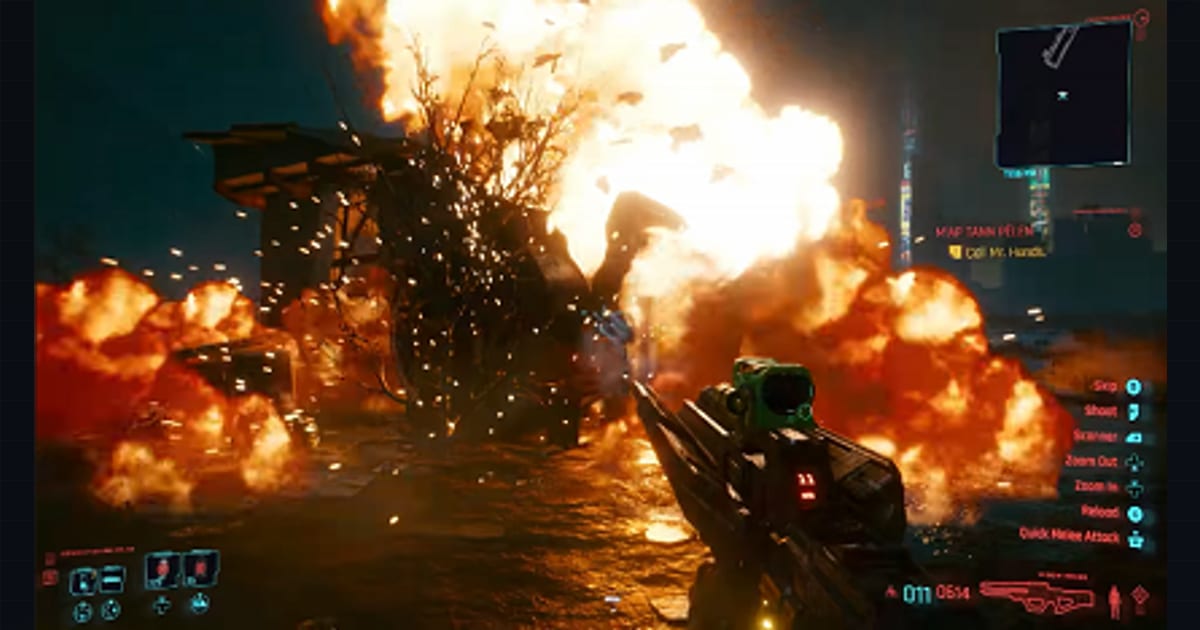
Cyberpunk 2077 has surpassed 40 million copies sold as of July 2026, cementing its status as one of the best-selling video games of all time. The action RPGRPG. Role-Playing Game — a game built around character progression, story, and player choices., developed by CD Projekt Red and based on Mike Pondsmith’s Cyberpunk tabletop series, originally launched on 10 December 2020 for PlayStation 4, Stadia, Windows, and Xbox One.
Forty million units is a number that would have seemed absurd in December 2020, when the game’s own storefront availability was in question. The distance between those two facts — a launch so technically compromised that it was delisted, and a lifetime sales figure that puts it in the industry’s all-time top tier — is the entire story of this generation’s most instructive AAA recovery arc.
Platform Expansion
The game’s platform footprint has grown significantly since its initial release. PlayStation 5 and Xbox Series X/S versions arrived on 15 February 2022, followed by a Nintendo Switch 2 launch title release on 5 June 2025, and a macOS port on 17 July 2025. The Phantom Liberty DLC expansion, which launched in September 2023 for PlayStation 5, Windows, and Xbox Series X/S, was paired with the Switch 2 and macOS releases.
The sequencing here is worth reading closely. CD Projekt did not rush native current-gen versions to market; it waited until February 2022, fourteen months after launch, and used that window to make the PS5 and Series X/S builds the definitive technical baseline rather than another compromised port. That decision established the pattern the studio has followed since: new-platform releases are treated as content events, not SKUs. The 2025 cadence makes that explicit — the Switch 2 launch window and the macOS port within six weeks of each other, both carrying the Phantom Liberty expansion, both positioned as complete editions of a rehabilitated product.
The macOS port is the more strategically interesting of the two. Apple silicon Macs are a small slice of gaming revenue, but the port demonstrates that REDengine 4’s renderer and the game’s tooling now travel cleanly across CPU architectures — x86, ARM — and across vendor graphics stacks. That is not a trivial engineering claim for a game of this density, and it has direct implications for how portable the studio’s tech remains as it builds future titles.
Development and Costs
Development began after the release of The Witcher 3: Wild Hunt – Blood and Wine in 2016, with a team of roughly 500 people working on CD Projekt Red’s REDengine 4. The total cost to develop and market the game — including post-launch updates and DLC — reportedly falls between $436 million and $440 million, placing it among the most expensive video games ever produced.
Put the two headline numbers side by side: ~$440 million spent, 40 million copies sold. Even using conservative blended pricing, the game has generated revenue in the billions of dollars — a return multiple that would have been respectable for a flawless launch and is remarkable for one that spent six months removed from its primary console storefront. The important nuance is what the $440 million actually represents: it includes post-launch updates and the Phantom Liberty expansion. CD Projekt didn’t just fund a game; it funded a multi-year repair and re-launch operation, and the sales trajectory validates that continued investment as a strategy rather than sunk-cost stubbornness.
Reception and Recovery
Critical reception at launch was mixed. While reviewers praised the narrative, setting, and graphics, the game faced widespread criticism for bugs and glitches, particularly on PlayStation 4 and Xbox One. Sony removed Cyberpunk 2077 from the PlayStation Store from December 2020 to June 2021. CD Projekt faced class-action lawsuits related to the severity of technical issues, ultimately settling for $1.85 million. The 2022 anime series Cyberpunk: Edgerunners, the Phantom Liberty expansion, and ongoing patches contributed to a progressive reappraisal of the game.
Why It Matters
The PlayStation Store delisting remains the single most consequential event in this story, and not for the obvious reason. Sony’s refund-and-remove action established a precedent: platform holders will act as quality gatekeepers when a top-tier third-party release fails technically, regardless of that publisher’s commercial weight. Before Cyberpunk, the assumption across the industry was that marketing scale bought launch-window immunity. After it, every major publisher’s QA calculus changed, and “last-gen parity” as a launch promise quietly died — note that CD Projekt itself dropped PS4 and Xbox One for Phantom Liberty in 2023, a decision that would have been unthinkable in 2020 and is now industry standard.
The recovery mechanism matters just as much. Edgerunners was not a patch and it was not a marketing campaign; it was a piece of transmedia fiction that rebuilt the game’s emotional reputation while the engineering team rebuilt its technical one. The patch cadence fixed what was broken; the anime fixed why players should care. Phantom Liberty then converted that restored goodwill into premium revenue and reviewer reassessment. That three-part sequence — fix, re-contextualize, expand — is now the reference template for rehabilitating a damaged AAA property.
The Take
Cyberpunk 2077 is the strongest existing argument that a catastrophic launch is recoverable — and simultaneously the strongest argument that the recovery costs more than the caution would have. The $440 million figure and the forty million figure are the same statement read from opposite ends: the game was rescued by spending, and the spending was justified by the rescue. Neither half works without the other, which is why “they’ll just patch it later” remains a terrible strategy for any studio without CD Projekt’s balance sheet and a decade of stored player goodwill from The Witcher 3.
The more uncomfortable reading is about what the industry learned. The recovery was real, but it was also uniquely resourced — a roughly 500-person core team, one of the largest development budgets ever committed, an anime adaptation of unusual quality, and an expansion developed in parallel with triage. Treating Cyberpunk as proof that broken launches are fine is survivorship bias at industrial scale. It is better read as proof that a great underlying game can be worth saving, and that saving it is a choice you fund for years, not a patch you ship in a quarter.
What It Signals
Two signals stand out going forward. First, the platform expansion pattern — Switch 2 launch title, macOS port, Phantom Liberty bundled at every step — shows CD Projekt operating Cyberpunk as a persistent platform business, seven years past release, rather than a shipped product. That is the same long-tail model that has defined the best-selling catalog titles of the past decade, and it reframes the sequel announcement not as a franchise restart but as a line extension for an asset that is still growing.
Second, the Switch 2 port specifically is a technical proof point the entire industry will study: a REDengine 4 open-world game running on Nintendo’s mobile-class hardware on day one of the platform’s life. If it performs well, it resets expectations for what “impossible ports” mean in the next hardware cycle.
Sequel in Development
A sequel to Cyberpunk 2077 was announced in October 2022 and is currently in development at CD Projekt Red.
The sequel inherits something The Witcher 3’s follow-up never had to: a working, post-mortemed understanding of exactly how a AAA launch fails at scale and exactly how it is repaired. Whatever engine, scope, and platform strategy the team chooses next, it will be chosen by the studio that paid $440 million to learn those lessons firsthand. Forty million copies says the market has forgiven the tuition. The sequel is where we find out what was actually learned.