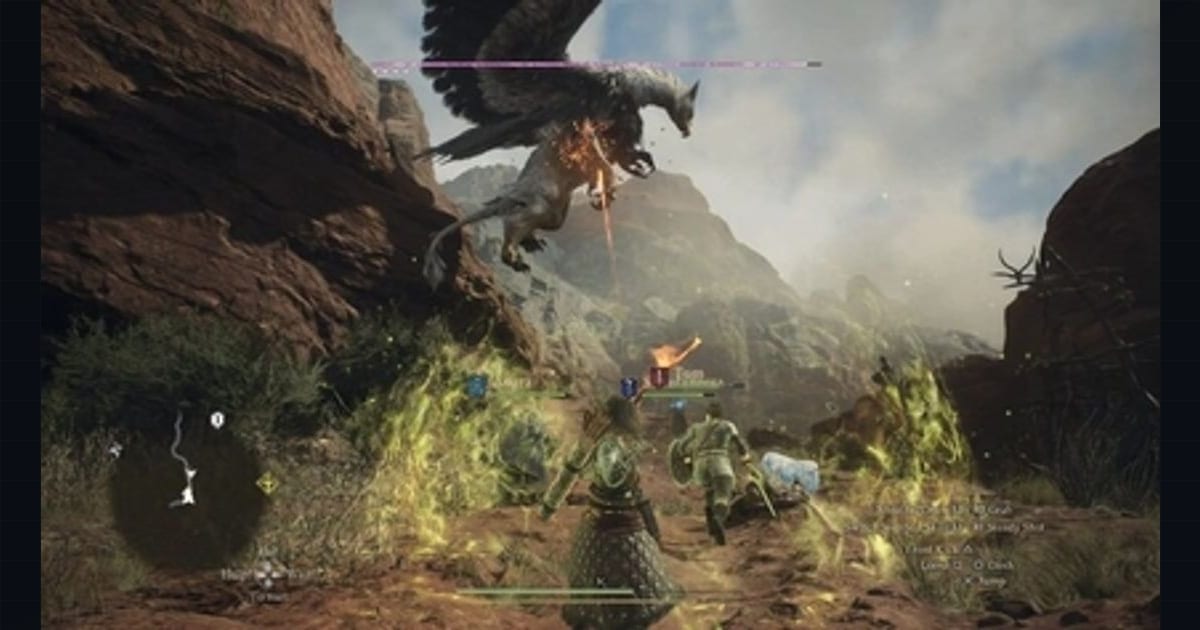
Capcom will release Dragon’s Dogma 2: Dark Arisen, an expanded version of its 2024 action role-playing game, on October 9, 2026. The release brings the title to PlayStation 5, Windows, Xbox Series X/S, and notably adds a Nintendo Switch 2 version to the platform lineup.
Base Game Performance
The original Dragon’s Dogma 2 launched on March 22, 2024 for PS5, Windows, and Xbox Series X/S. Developed and published by Capcom using the RE Engine, the game received generally positive reviews from critics and sold 4 million units by November 2025. The upcoming Dark Arisen version includes additional content, though Capcom has not yet detailed what that content entails.
That sales trajectory matters more than the raw number suggests. Reaching 4 million units over roughly twenty months puts Dragon’s Dogma 2 among Capcom’s stronger-performing properties outside the Resident Evil and Monster Hunter core lines — a genuine breakout for a franchise that spent a decade as a cult curiosity. The first game’s reputation was built disproportionately on the 2013 Dark Arisen re-release, which retrofitted the rough base game into something critics and players could fully recommend. Capcom is now deliberately repeating that playbook, and this time the pattern looks less like salvage and more like strategy.
Gameplay & Vocation System
Dragon’s Dogma 2 is a single-player action RPGRPG. Role-Playing Game — a game built around character progression, story, and player choices. played from a third-person perspective. Players control a customizable character called the “Arisen” who must hunt a dragon that marked them, navigating a geopolitical conflict between two kingdoms: Vermund and Battahl.
The Arisen is aided by AI-controlled allies called “Pawns,” who function similarly to player-controlled avatars. Players create and customize their own main Pawn and can recruit two additional Pawns created by other players. Pawns assist in combat, provide enemy information, and offer quest guidance.
Characters operate under vocations—classes defining available abilities and equipment. Vocations are split between basic, advanced, and hybrid categories, with hybrid vocations only accessible to the Arisen. Returning vocations include Thief (formerly Strider) and Archer (formerly Ranger). New hybrid vocations include the Mystic Spearhand, which uses a duospear weapon, and the Trickster, who deploys spells to confuse enemies and enhance Pawns.
The vocation architecture is where the design intent becomes legible. Restricting hybrid vocations to the Arisen is not a cosmetic choice — it enforces an asymmetric party structure where the player’s build is always the flexible piece, while Pawns anchor the composition in the basic and advanced roles. That creates a soft group-tactics layer in a game with no party menu micromanagement: you are effectively drafting a four-person squad through a class system disguised as an AI companion feature. The Trickster in particular signals Capcom’s confidence in the Pawn-as-party philosophy, since its entire kit is built around buffing allies and directing enemy attention rather than dealing damage — a support archetype that only makes sense when the AI companions are good enough to capitalize on it.
Why the Pawn System Matters
The Pawn system remains the franchise’s only true mechanical moat, and it deserves explicit analysis because nothing else in the genre has replicated it in twelve years. Each main Pawn is a persistent, player-authored character that travels into other players’ worlds, accrues knowledge of quests and enemies its creator has never personally encountered, and returns with that knowledge intact. This is asynchronous multiplayer disguised as single-player AI — a system that makes an offline RPG feel socially alive without any co-op infrastructure, session hosting, or matchmaking.
Strategically, this is the most interesting thing about Dragon’s Dogma as a product. In an era where the RPG genre has consolidated around either live-service multiplayer or fully solitary experiences, Capcom owns a third option: a single-player game whose world is populated by the accumulated presence of its playerbase. It also functions as remarkably efficient marketing — every recruited Pawn is an advertisement for another player’s build, and the knowledge-transfer mechanic gives veteran players’ worlds literal informational value to newcomers. When Dark Arisen launches on a new platform with a fresh player pool, that network effect restarts from zero, which is precisely when the system is most compelling to experience.
World Design
The game features a seamless open world approximately four times larger than the first Dragon’s Dogma, set as a parallel world to the original. The world is populated by humans, the catlike beastrens, and elves. Fast travel operates through ferrystones and oxcarts. Players can establish camps at night, and a day–night cycle affects creature encounters and enemy strength. Emergentemergent. Behavior that wasn't explicitly designed but arises from simpler rules interacting — player-run economies, cartels, surprise tactics. events and destructible environments further shape the experience.
The fast-travel design deserves attention because it is the game’s most contested decision. Ferrystones are consumable resources and oxcarts run on schedules and can be ambushed mid-journey — meaning travel itself carries cost and risk. This is a deliberate rejection of the frictionless waypoint-hopping that defines modern open-world design, and it directly powers the emergent-event layer: roads are dangerous because the game forces you onto them, and campsites matter because nightfall is genuinely threatening. Four times the landmass would be dead space in a game where you teleport past it; Capcom made the traversal the content.
Context: The RE Engine Question
The RE Engine is Capcom’s technical calling card, but Dragon’s Dogma 2 exposed its limits as clearly as it showcased its strengths. The engine was proven on contained, corridor-driven Resident Evil titles and the curated set-pieces of Devil May Cry 5 — a seamless open world with persistent simulation is a categorically different workload. The result at launch was a game celebrated for its systemic density and criticized for uneven performance, particularly CPU-bound framerateframerate. How many images (frames) the game shows per second; higher = smoother motion. 60 fps is a common target. dips in dense settlements where the simulation load spiked.
That context frames what Dark Arisen can actually fix. An expanded release arriving more than two and a half years after launch, on hardware including the Nintendo Switch 2, implies substantial engineering rework — you do not port a CPU-strained simulation to a portable chipset with a content patch. The Switch 2 version is therefore the most telling line in the announcement: it functions as a public bet that Capcom has re-architected enough of the simulation’s performance profile for the game to run credibly on constrained hardware, and that work should benefit every platform.
The Take
Dark Arisen is not a routine Game-of-the-Year repackaging; it is Capcom formalizing a franchise. The original Dragon’s Dogma needed its re-release to become the game people remembered. The sequel needs its re-release for a different reason — the 2024 launch proved the formula has mass-market reach, and October 2026 is about consolidation: an expanded content package, a second chance at the technical reception, and a fourth platform that widens the funnel going into whatever comes next.
The open question is scope. Capcom has committed to additional content without detailing it, and the first game’s Dark Arisen set a high bar with Bitterblack Isle, an entirely new endgame dungeon. If the sequel’s expansion matches that template — new endgame space that pressures the vocation system in ways the base campaign doesn’t — this becomes one of the more consequential RPG releases of late 2026 despite being, on paper, a re-release. If it is a lighter content pass riding the Switch 2 launch, the 4-million-seller momentum likely carries it anyway. Either way, the Pawn system restarting on new hardware is the quiet story here: the best asynchronous party system in the genre is about to get a second, larger network.