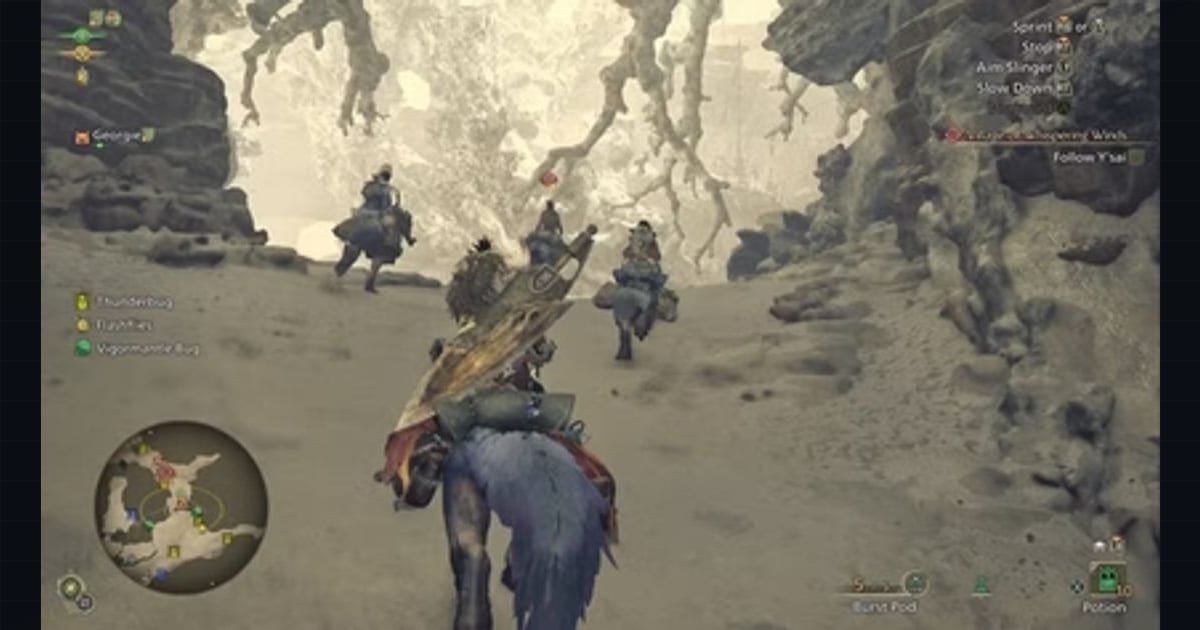
Capcom has released technical developer notes for Monster Hunter Wilds, detailing major upgrades to the RE Engine designed to support dense animal herd behaviors and real-time environmental climate cycles. For a series that has historically leaned on instanced arenas and zone-loading seams, Wilds represents the most structurally ambitious entry in the franchise — and the most technically demanding use of Capcom’s proprietary engine since the Resident Evil remakes.
TL;DR
- What changed: Capcom detailed RE Engine weather phases, herd AI, Focus Mode, and launch hardware specs.
- Why it matters: Difficulty now emerges from ecosystem state, not just monster stats.
- Who should care: Monster Hunter veterans and action-RPGRPG. Role-Playing Game — a game built around character progression, story, and player choices. players comparing open-world simulation fidelity.
1. Dynamic Ecosystem & Weather Phases
The Windward Plains region shifts dynamically between three distinct climate states without loading screens:
| Phase | Conditions | Gameplay effect |
|---|---|---|
| Fallow | Arid, resource-scarce desert | Predators hunt in large, aggressive packs |
| Inclemency | Severe electric sandstorms | Alters monster spawn tables; summons apex lightning predators |
| Plenty | Nutrient-rich climate recovery | Abundant flora gathering nodes; passive monster herds |
These are not cosmetic weather effects bolted on top of a static map. Each phase rewrites the region’s gameplay loop — spawn tables, predator aggression weighting, gathering node density, and the behavioral state of the herds all change in concert. The Fallow-to-Inclemency transition is the load-bearing design decision here: it turns the map itself into a timer, forcing hunters to read the biome the way a sailor reads a barometer. That is a meaningful departure from World’s guiding lands and Rise’s rampage-style set pieces, where scripted sequences drove the drama. Wilds makes the ecosystem the antagonist, not the backdrop.
2. Combat Mechanics & Seikret Mounts
- Focus Mode: Players manually aim attacks and guards, highlighting wounded monster parts to trigger targeted strike follow-ups.
- Seikret Companion: The bipedal Seikret mount automatically navigates terrain while allowing hunters to sharpen weapons, consume potions, and swap secondary weapon loadouts on the fly.
The two systems are deliberately entangled. Focus Mode raises the skill ceiling on target selection and wound-stacking, while the Seikret lowers the friction floor on the logistics between fights — weapon swapping, sharpening, healing all become mobile rather than stationary actions. Together they compress the “downtime tax” that has historically padded Monster Hunter’s hunt-to-hunt rhythm. That is not a casualization concern; it is a pacing recalibration. The action economy now favors sustained engagement over zoning out to a camp tent between every encounter.
Why it matters: RE Engine grows a simulation layer
The headline technical story is that RE Engine is now doing work it was never architected for. Built originally for enclosed, linear survival-horror spaces, the engine has been progressively stretched — first into open-area action with Rise, now into a genuine open-world simulation with herd AI, streaming climate states, and apex predator conditional spawning. Driving dozens of simultaneously active creatures across a seamless biome is a categorically different workload than rendering a single Tyrant in a corridor, and it shows up directly in the PC spec sheet.
| Tier | CPU | RAM | GPUGPU. Graphics Processing Unit — the chip that renders the game's visuals; the main driver of framerate and image quality. |
|---|---|---|---|
| Minimum | Intel Core i5-10600K / AMD Ryzen 5 3600 | 16 GB | NVIDIA GTX 1660 Super |
| Recommended | Intel Core i7-12700K / AMD Ryzen 7 5700X3D | 16 GB | NVIDIA RTX 4070 |
The recommended configuration is telling. The 5700X3D inclusion is not a generic “good CPU” placeholder — its 3D V-Cache3D V-Cache. AMD's stacked L3 cache that gives the CPU very fast access to data, notably boosting game framerates. is specifically valuable for workloads dominated by unpredictable, data-dependent access patterns, which is precisely what large-scale entity simulation produces. When herd pathfinding, aggression state machines, and dynamic spawn logic all run concurrently, the cache-friendly X3D part earns its recommendation over higher-clocked, lower-cache alternatives. The GTX 1660 Super minimum and RTX 4070 recommended pairing, meanwhile, signals that Wilds scales hard on GPU when the density cranks up — the gap between floor and ceiling is a full two GPU tiers, which is consistent with a game whose visual load varies with how many creatures are on screen at once.
The take: simulation-driven difficulty is the real evolution
The riskiest and most interesting design choice in Wilds is not Focus Mode or the Seikret. It is the decision to make difficulty emerge from ecosystem state rather than from monster stats alone. An apex lightning predator summoned during an Inclemency sandstorm is not simply a tougher fight — it is a fight that only exists because the player did not plan around the weather window. That reframes the genre’s encounter design from “react to the monster in front of you” to “read the system and pick your moment.”
This is the same conceptual move that distinguished the best survival-craft titles from their imitators, and it is a strong fit for Monster Hunter specifically because the franchise’s core fantasy has always been the hunt — preparation, tracking, and exploitation of weakness — rather than the duel. By embedding the preparation phase into the environment itself, Wilds closes the gap between narrative fantasy and mechanical reality. If Capcom lands the tuning, the Inclemency-to-Plenty cycle will be remembered as the franchise’s most consequential structural change since World went global.
What it signals for the genre
Two signals are worth tracking beyond Wilds itself. First, Capcom is treating RE Engine as a general-purpose platform rather than a horror-specific tool, which has downstream implications for the company’s pipeline — any future Capcom RPG or open-world title inherits this simulation plumbing without a re-platform. Second, the herd-and-weather model raises the bar for what players will expect from “living world” claims in competing action-RPGs. A static open world with fixed spawn points now reads as dated against a biome that visibly cycles through ecological states mid-session. The genre’s benchmark for immersion has shifted, and anyone shipping a creature-driven action game in 2026 and beyond will be measured against it.
The honest caveat is that all of this hinges on Capcom shipping the seamless transitions and herd fidelity shown in the developer notes at scale, across the full map roster, on the minimum-spec hardware. Simulation-heavy open worlds are exactly the category where vertical slices and final performance diverge. The technical intent is clearly the right one; the execution is what the February 28 launch will actually judge.
That launch has come and gone, and the ecosystem model is now a shipping baseline rather than a promise. The next checkpoint is the Master Rank expansion cycle, where Capcom’s support cadence will show whether the simulation layer scales with new content.
Next read
- For the expansion outlook, see what Capcom said about the Monster Hunter Wilds Master Rank expansion.
- For matchup planning, see the Monster Hunter Wilds weapon class tier list.
- The full franchise file sits at the Monster Hunter Wilds coverage hub.