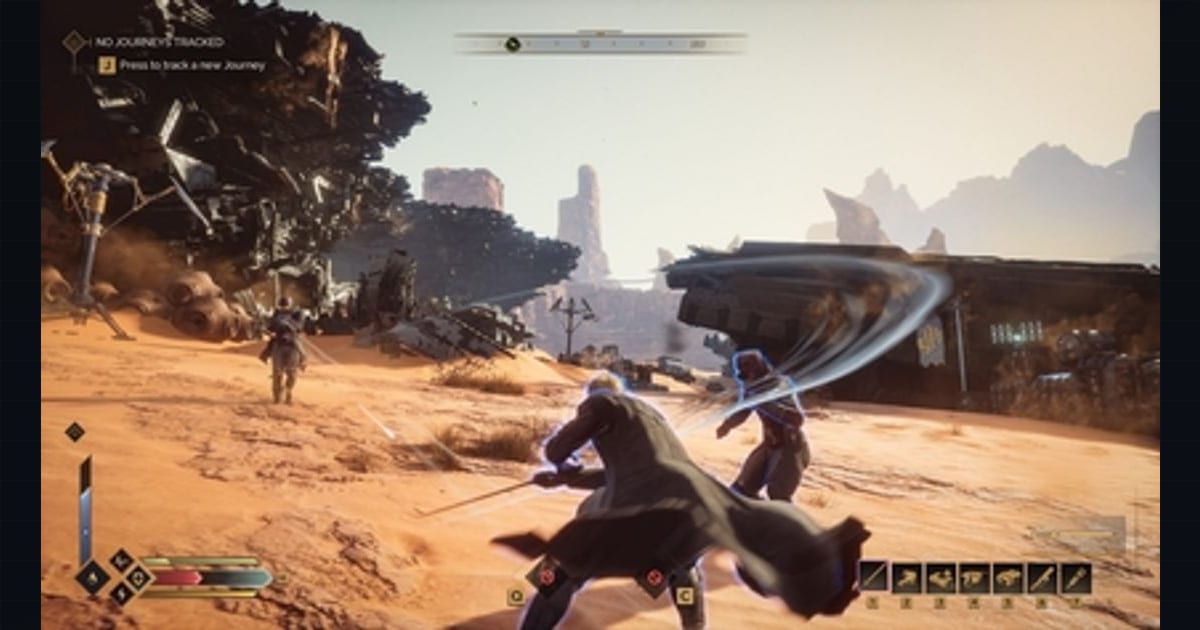
Dune: Awakening — Crafting, Schematics & Vehicle Economy Guide
Funcom’s Dune: Awakening is a survival MMOMMO. Massively Multiplayer Online — a game that hosts very large numbers of players together in one shared, persistent world. built around one central tension: the planet Arrakis rewards preparation and punishes overextension. Progression is not gated by a traditional level curve so much as by a schematic discovery chain and a vehicle cost curve that determines how far you can push into the deep desert before the spice, the sandworms, or rival guilds force you back. This guide maps those two systems and explains how they interact to structure the game’s economy.
What it covers: The schematic discovery chain and the vehicle cost curve — the two systems that gate Arrakis. Why it matters: Progression is not levels; it is how far into the deep desert your logistics carry you. Who should pick this: Dune players planning deep-desert excursions.
Why Schematics Gate Everything
Unlike survival games that hand you a linear tech tree, Dune: Awakening distributes its crafting knowledge through schematic fragments scattered across the map. You do not “level up” into a higher tier — you find, trade, or steal the knowledge required to build it.
The Discovery Loop
The core progression loop works in four stages:
- Gather base materials (stone, fiber, water, basic metal) in the starting biomes near the shield wall.
- Craft starter tools and shelter from unlocked Tier 1 schematics.
- Excavate or trade for schematic fragments at POIs, ruins, and factionfaction. An in-game group or nation players can align with or fight against, with its own goals and reputation system. vendors.
- Combine fragments at a research bench to unlock higher-tier recipes.
This means your effective “tech level” is a function of how much of the map you’ve exposed and how much trade you’ve engaged in, not how many rocks you’ve hammered. A player who raids one ruined research station can leapfrog weeks of grinding — which is exactly why those POIs are contested.
Schematic Tiers at a Glance
| Tier | Typical Source | Unlocks | Risk Profile |
|---|---|---|---|
| Tier 1 | Starter zone vendors, basic salvage | Simple tools, woven fiber armor, stillsuit Mk I | Low — safe zones |
| Tier 2 | Ruined outposts, faction reputation vendors | Metal tools, reinforced shelters, basic firearms | Medium — border zones |
| Tier 3 | Deep-shield POIs, guild trade, black market | Powered stillsuits, light vehicles, advanced weapons | High — PvP-enabled |
| Tier 4 | Deep desert caches, raid boss drops, alliance crafting | Heavy vehicles, shielded bases, orbital-tier gear | Extreme — full loot risk |
(The live game organizes tiers by material grade — Copper, Iron, Steel, Aluminum, Duraluminum, Plastanium — rather than the simplified Tier 1–4 framework above, and vendor placement continues to be adjusted post-launch; check current patch notes for specific labels.)
The Crafting Economy
Crafting in Dune: Awakening is not a solo minigame. The material costs and bench requirements are designed so that mid-to-high tier production benefits from guild-scale coordination. A single player can sustain Tier 1-2 output, but Tier 3+ vehicles and bases require material throughput that pushes you toward either a guild or a trade-network playstyle.
Material Categories
The economy runs on four broad resource classes:
- Bulk organics — fiber, plant matter, spice residue. Used for stillsuits, filters, and trade goods.
- Minerals & metal — stone, iron, copper, refined alloys. The backbone of construction and vehicle frames.
- Water — the universal currency of Arrakis. Spent on survival, crafting hydration, and as a trade medium. Water scarcity is the primary economic pressure on solo players.
- Spice (Melange) — the high-value resource that draws players into the deep desert. Required for advanced schematics, fuel refining, and the most valuable trade loops.
The design intent is clear: water keeps you alive, spice makes you rich, and metal lets you build the things that keep both flowing. Imbalance in any one strand breaks the chain.
Specialization Pressure
Because bench slots, power, and storage are limited, most players specialize. A base that tries to produce everything ends up underproducing everything. The efficient pattern is a hub-and-spoke guild base: one central hub handles vehicles and high-tier assembly, while satellite outposts funnel bulk materials inward. Solo players typically pick one strand — stillsuit production, weapon crafting, or vehicle repair — and trade for the rest.
The Vehicle Cost Curve
Vehicles are the single largest material sink in the game and the hard gate on deep-desert access. You can walk into the shallow desert on foot. You cannot meaningfully operate in the deep desert without a vehicle, and the cost curve is steep enough that losing one hurts.
Vehicle Tiers and Roles
| Vehicle Class | Fuel | Primary Use | Approximate Cost Order | Loss Penalty |
|---|---|---|---|---|
| Scout bike / sand-skiff | Spice fuel | Recon, fast spice runs | Low-mid (Tier 2-3 mats) | Recoverable if insured |
| Light transport | Spice fuel | Crew + cargo haul | Mid (Tier 3 mats + schematic) | Significant |
| Heavy hauler / harvester carrier | Refined spice | Industrial spice collection | High (Tier 3-4, multi-bench) | Severe — weeks of throughput |
| Combat vehicle / raider rig | Refined spice + ammo | Guild raids, convoy escort | Very high (Tier 4 + guild mats) | Catastrophic if wiped |
(Fuel names, exact material lists, and recovery mechanics have shifted across patches — Funcom has iterated on vehicle durability and fuel economy, and added a Vehicle Recovery System for destroyed vehicles, through early updates.)
Why the Curve Matters
The cost curve does two things for the game’s structure:
First, it creates a natural risk gradient. A scout bike is cheap enough to lose and replace in an evening. A heavy harvester carrier represents a guild’s collective effort over days. This means deep-desert engagements aren’t symmetric — the side with more to lose fights more cautiously, and guilds weigh convoy escort as a real strategic decision, not a formality.
Second, it makes spice refinement infrastructure the true long-term investment. Raw spice gets you trade value; refined fuel keeps your vehicles moving. A guild that controls a reliable refinery pipeline can sustain deep-desert operations indefinitely. A guild that relies on bought fuel operates on a timer.
The Deep Desert Gate
The schematic chain and the vehicle curve converge at one point: entry into the deep desert. This is where Dune: Awakening transitions from a survival crafting game into a territory-control economy.
What Changes Past the Shield Wall
- Sandworm risk becomes constant. Static bases are viable only with thumper discipline and chosen ground. Most deep-desert operations are mobile.
- PvP is fully enabled. Loot rules shift, and vehicle losses are real.
- Spice density spikes. The reward curve justifies the risk, but only for groups that can extract and retreat efficiently.
- Coriolis storms periodically reset the map. The deep desert is not permanent real estate. Bases and caches get wiped on a storm cycle, which is the game’s hard counter to entrenched monopolies.
(The Deep Desert resets on a weekly Coriolis storm cycle that wipes bases, vehicles, and caches; exact timing varies by server region, so check the current schedule before committing deep-desert infrastructure.)
The Progression Funnel
A typical guild progression arc looks like this:
- Weeks 1-2 — Tier 1-2 crafting, shallow desert farming, water-positive operations, basic vehicles.
- Weeks 3-4 — Tier 3 schematics secured, light vehicles online, first escorted spice runs.
- Week 5+ — Refinery pipeline established, heavy vehicles built, deep-desert raiding and harvesting begins.
Solo players can reach step 2 reliably. Step 3 is where the game’s economy starts actively selecting for coordinated groups — not because solo play is forbidden, but because the material throughput and escort requirements make it inefficient.
Economic Pressure Points
Three mechanics do most of the work in shaping player behavior:
Water as Currency
Water is the one resource every player needs constantly. It functions as a soft currency underneath the harder spice economy. Solo players who can’t secure a water-positive base are forced into trade dependency, which is the game’s way of pushing even lone wolves into the market.
Schematic Scarcity
Because high-tier schematics aren’t universally available, they function as temporary monopolies. The first guild to unlock a Tier 4 vehicle schematic has a window where they can sell the vehicle, the schematic, or protection — until rivals catch up. This is the primary driver of early-server political dynamics.
Storm Resets
The periodic deep-desert wipes prevent any single group from permanently cornering the spice market. Every storm cycle is a soft economic reset, which keeps the server population rotating through the risk gradient rather than ossifying into a static hierarchy.
Practical Guidance
For Solo Players
- Prioritize water infrastructure before spice. A water-positive base is the foundation everything else stands on.
- Specialize in one trade good. Generalist solo crafters underproduce; specialists trade up.
- Use scout vehicles for spice runs. Do not commit a vehicle you can’t replace to the deep desert.
- Treat schematics as your real progression metric. Chasing gear before schematics is a common trap.
For Guilds
- Centralize vehicle production. Distribute material gathering.
- Secure a refinery pipeline before scaling deep-desert operations. Fuel throughput, not spice stock, is the long pole.
- Run escorted convoys. Unescorted harvesters are the most common catastrophic loss in the game.
- Plan around storm cycles. Build deep-desert infrastructure with an exit timeline, not as permanent investment.
For Traders
- The highest-margin trades are schematics and refined fuel, not raw spice. Raw spice is abundant during active harvesting; knowledge and processed fuel are scarce.
- Watch the storm cycle. Prices spike in the days before a reset as groups stockpile; prices drop after as inventories wipe.
Glossary
- Schematic fragment — A partial recipe piece; combined at a research bench to unlock a full crafting schematic.
- Stillsuit — Water-reclamation gear; the single most important survival item on Arrakis.
- Shield wall — The geographic boundary between the safer starting zones and the deep desert; the practical PvP-onset line.
- Coriolis storm — Periodic map-wide weather event that resets deep-desert terrain and structures.
- Spice fuel — Refined Melange used to power vehicles; the bottleneck resource for sustained deep-desert operations.
- Thumper — Device that summons sandworms; used tactically to clear ground or deny area to enemies.
- Convoy escort — The practice of assigning combat vehicles to protect harvester carriers during extraction.
Sources & further reading
- Funcom — Dune: Awakening official site: https://www.duneawakening.com/
- Funcom developer updates and patch notes: https://www.duneawakening.com/news
- Dune: Awakening on Steam: https://store.steampowered.com/app/1172710/Dune_Awakening/
- Dune: Awakening community wiki (player-maintained): https://awakening.wiki/ — community-sourced, may lag behind patches
- Funcom investor / roadmap communications: https://www.funcom.com/
This guide reflects mechanics as understood from official Funcom communications and community documentation. Dune: Awakening is a live game with iterative balance changes — specific numbers, tier labels, and storm-cycle timings may shift between patches, so consult the current patch notes before committing major resources.
Next read
- For the survival layer underneath, see Dune: Awakening Faction, Spice, and Water Primer.
- For the genre frame, see Survival-Craft in 2026: The Genre Core Loop.
- All our coverage lives on the Dune: Awakening hub.