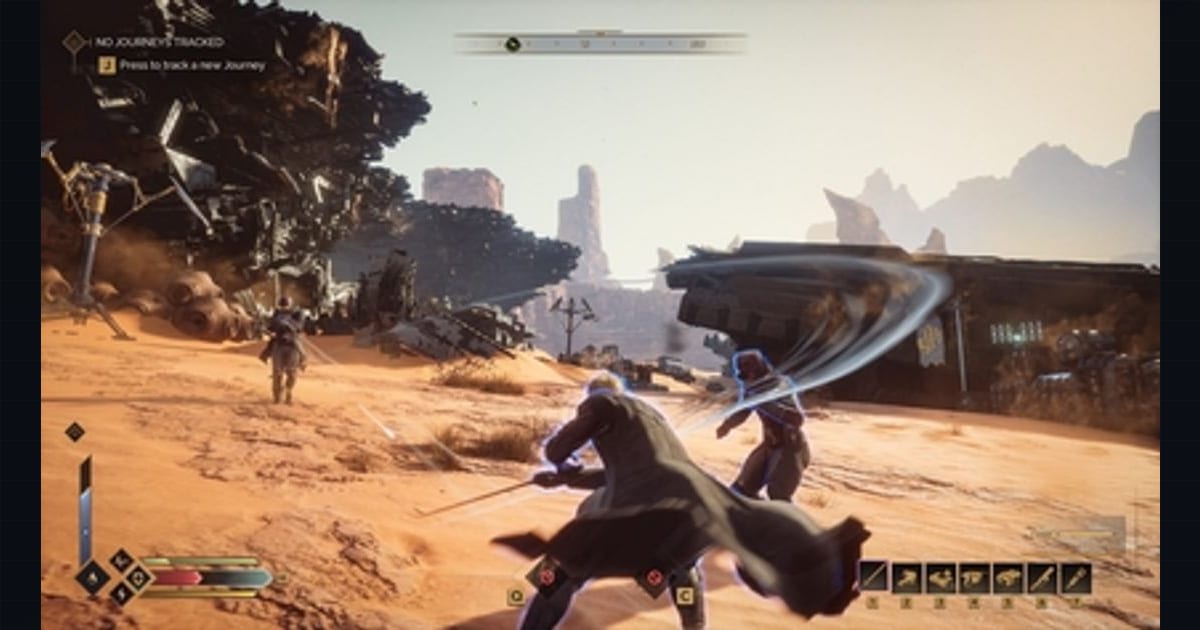
Arrakis does not ease you in. Within the first hour of Dune: Awakening, you are managing thirst, watching the sun for heat stroke, listening for sandworm tremors, and deciding which of two rival houses will define your progression arc. Funcom’s survival MMOMMO. Massively Multiplayer Online — a game that hosts very large numbers of players together in one shared, persistent world. treats scarcity as the core ruleset rather than backdrop, which means the decisions you make in the opening phases — factionfaction. An in-game group or nation players can align with or fight against, with its own goals and reputation system., mentor, where you spend your first spice, how disciplined you are with water — compound for the rest of your playthrough. This primer covers the three systems that most often sink new players: faction choice, spice management, and water discipline.
What it covers: The three systems that sink new players — faction and mentor choice, spice spending, and water discipline. Why it matters: Arrakis treats scarcity as the ruleset, not backdrop — opening decisions compound for the whole playthrough. Who should pick this: New arrivals in their first hours on Arrakis.
Before the Desert: Background & Mentor
Character creation runs through two decisions that gate your early build: a background and a mentor. Background sets starting stats and minor passive bonuses; mentor determines your first unlocked ability and the questline that teaches it. A Bene Gesserit mentor, for example, grants access to the Voice — a command that can taunt enemies — and routes you through the Bene Gesserit quest chain.
The mentor choice is the more consequential of the two because the first ability you unlock is the one you will rely on while you are still poor on spice and water. Pick a mentor whose kit matches how you intend to play the first 10–15 hours: stealth and scouting, frontline combat, or support/utility. You can expand into other trees later, but that first ability shapes your opening stretch.
Faction Choice: Atreides vs. Harkonnen
After the tutorial area, you reach the point where you align with either House Atreides or House Harkonnen. This is not cosmetic. Faction determines your questline, your access to faction-specific recipes and vendors, and which side of the Landsraad influence endgame you feed into.
What Each Faction Actually Changes
| Dimension | House Atreides | House Harkonnen |
|---|---|---|
| Quest tone | Coalition-building, Fremen-adjacent diplomacy | Dominance, extraction, intimidation |
| Vendor emphasis | Faction-styled vehicles, armor, and construction sets | Faction-styled vehicles, armor, and construction sets |
| Landsraad alignment | Votes toward Atreides-led resolutions | Votes toward Harkonnen-led resolutions |
| PvP posture in Deep Deserts | Typically defensive / coalition play | Typically aggressive / territorial play |
The practical takeaway: Atreides tends to reward disciplined solo and small-group survival — better stillsuit and shelter efficiency means lower overhead, which matters when you are broke. Harkonnen tends to reward coordinated guild play and spice-max strategies — higher yield and offensive tooling, but you burn more water and resources keeping a Harkonnen operation fed.
Choosing for Solo vs. Guild Play
If you are arriving alone, Atreides’ lower operational overhead is the safer pick for the first cycle. The efficiency bonuses compound: less water spent on upkeep means less time farming dew and trading, which means more time on spice and progression. If you are joining a guild that already has a Harkonnen footprint, matching the house is usually correct — faction-locked recipes and Landsraad voting power matter more at the guild scale than individual efficiency does.
Faction is not strictly permanent, but switching is a one-way betrayal: you cannot rejoin the house you left, you are barred from its territories, and your contracts with that house are canceled. Treat the choice as a season-length commitment, not a daily toggle.
Spice Management: Currency, Progression, and Trap
Spice is the central economic and progression resource in Dune: Awakening, and it is the system most new players mismanage. Spice does three things simultaneously:
- It is currency. Spice sells for Solaris and underpins the player economy. Running out of spice means running out of buying power for water, schematics, and vehicle fuel.
- It is a crafting and fuel input. High-tier recipes and vehicle/ornithopter operations consume spice directly.
- It is a progression drug. Accumulating spice in your bloodstream unlocks spice-related powers, but pushes you toward spice overdose — a debuff state with vision distortion and stat penalties that escalates with continued exposure.
The Spice Discipline Loop
The trap is treating spice as free progression. Every harvest pulls you closer to overdose, and overdose at the wrong moment — mid-sandworm crossing, mid-PvP engagement — is lethal. The disciplined loop:
- Harvest in controlled bursts, then offload or bank spice rather than sitting on a full load.
- Carry spice only as much as you intend to spend on the immediate objective. A full hold during a Deep Deserts crossing is risk you do not need to take — sandworm loss is permanent.
- Track your overdose threshold. Spice powers are strong, but the cost curve is steep. Use the power spike for a defined objective (a boss, a contested harvest, a Landsraad-related task) and then let the withdrawal subside before your next dose.
Sandworm Risk Changes the Math
Spice fields attract sandworms. The richest deposits are the most dangerous, which means spice farming is a risk-adjusted activity, not a brute-force one. Two operational rules:
- Use a thumper tactically, not casually. Thumpers can draw a sandworm to a controlled location — useful for clearing a field or diverting a worm from a convoy — but they are a finite, loud tool that signals your position to other players as much as to the worm.
- Never load your best vehicle for a spice run you cannot afford to lose. Sandworm consumption is permanent loss of the items and vehicle swallowed. Run cheap harvesters on rich fields and keep your ornithopter and combat kit in reserve.
Water Discipline: The Resource That Quietly Bankrupts You
Water is the survival resource new players underestimate because it drains slowly and silently. Every exertion — sprinting, climbing, combat, daytime heat exposure — costs water. Lose your water supply and the rest of the game unravels fast: no water means no sustained exploration, no outpost upkeep, no trading leverage with NPCs who deal in water rather than Solaris.
Stillsuit Maintenance Is Not Optional
Your stillsuit is the single most important piece of gear you own. It recycles a portion of expended water back into your supply, which is the only reason long excursions are feasible at all. A damaged or unmaintained stillsuit drops your recovery rate, and the loss compounds: less recovery means more intake needed, means more time at dew collectors or trading, means less time on spice and progression.
Maintenance rules:
- Repair stillsuits at every outpost return. Do not push a second excursion on a damaged suit.
- Upgrade the stillsuit before upgrading weapons. The efficiency gain on a better suit pays for itself in saved water across every future session; a marginal weapon upgrade pays for itself only in the fights you actually take.
- Carry a backup water reserve sized to your round trip, not your current thirst bar. The bar tells you what you need now; the reserve is what gets you home when the plan goes wrong.
Water as Currency and Upkeep
Water is not just personal survival — it is an economic unit. NPC traders and certain faction transactions deal in water, and outpost construction requires ongoing tax payments to the Emperor. An outpost you cannot keep watered is an outpost you cannot keep.
This is where faction choice and water discipline intersect. Atreides’ efficiency tilt reduces the water cost of staying operational, which directly lowers your upkeep burden. Harkonnen operations, with their heavier vehicle and combat footprint, burn more water per unit of output — sustainable for a coordinated guild, punishing for a solo player who has not built a water surplus.
Day/Night Hazard Swap
Survival discipline is inseparable from the day/night cycle, because Arrakis swaps its dominant hazard rather than relaxing it.
- Daytime: Heat stroke is the active threat. Extended surface exposure drains water faster and stacks a debuff that eventually forces you under cover or into shade. Plan long crossings for the cooler edges of the day.
- Nighttime: Heat risk drops, but Sardaukar patrols become the active threat. The desert is not safer at night — it trades an environmental kill for a hostile-AI kill.
The implication for water discipline: nighttime travel saves water on heat but costs water on combat and evasion if you aggro a patrol. Route planning should account for which hazard you are better equipped to absorb.
The Four-Phase Progression Arc
Dune: Awakening structures progression through four phases — Survive → Protect → Expand → Control — and the three systems in this primer map directly onto the first two.
- Survive is where water discipline and stillsuit maintenance dominate. Get efficient before you get ambitious.
- Protect is where faction choice and spice management start to matter. Your outpost needs defending, and your spice income funds the defenses.
- Expand opens the Overland and ornithopter travel; your water reserve and spice bank determine how far you can reach.
- Control is the Landsraad endgame, where guild-level faction voting reshapes the shared world. Everything before this phase is preparation.
Sources & further reading
- Official site — Dune: Awakening: https://www.duneawakening.com/
- Steam store page: https://store.steampowered.com/app/2089920/Dune_Awakening/
- Funcom developer blog and patch notes: https://www.duneawakening.com/news
- Dune: Awakening Wikipedia overview: https://en.wikipedia.org/wiki/Dune:_Awakening
- Community wiki: https://www.awakening.wiki/
Next read
- For the economy those systems feed, see Dune: Awakening Crafting, Schematics, and Vehicle Economy.
- For the genre frame, see Survival-Craft in 2026: The Genre Core Loop.
- All our coverage lives on the Dune: Awakening hub.