Elden Ring, the 2022 action role-playing game directed by Hidetaka Miyazaki with worldbuilding by George R. R. Martin, is officially coming to Nintendo Switch 2. Developed by FromSoftware and published by Bandai Namco Entertainment, the Switch 2 version is scheduled for release on August 28, 2026. The game originally launched on February 25, 2022 for PlayStation 4, PlayStation 5, Windows, Xbox One, and Xbox Series X/S.
Core Gameplay & World Design
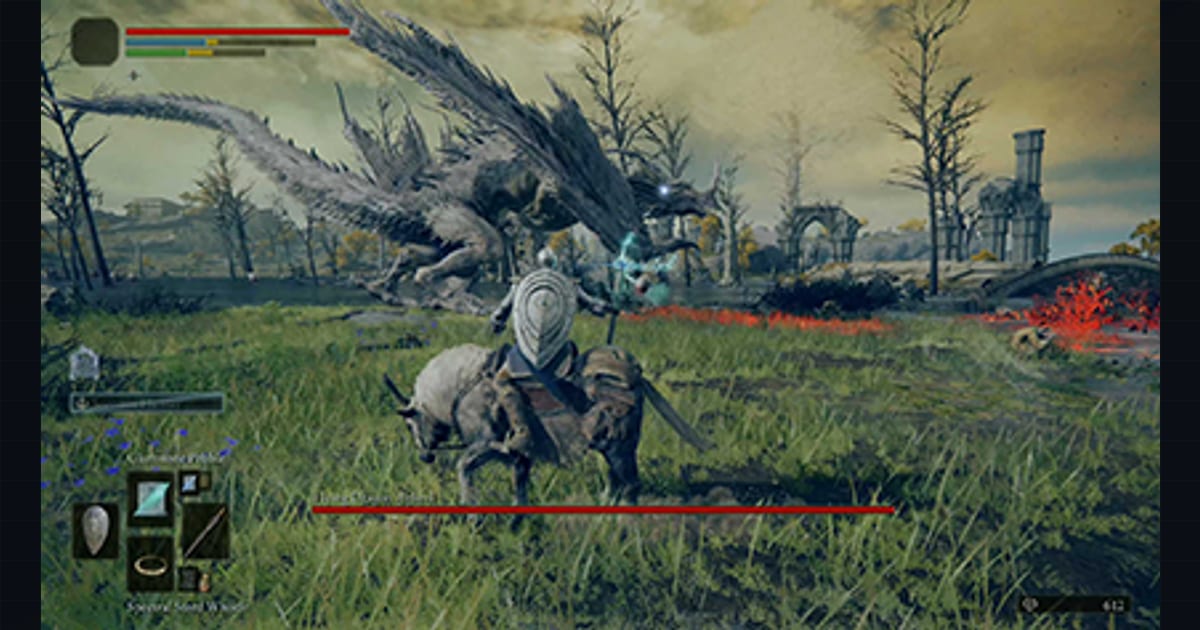
Elden Ring is a third-person action RPGRPG. Role-Playing Game — a game built around character progression, story, and player choices. set in an open world called the Lands Between. Players control a customizable character on a quest to repair the Elden Ring and become the new Elden Lord. The world comprises six main areas, including Limgrave’s grassy plains and the undead-infested wasteland of Caelid. Players traverse the environment using their steed, Torrent, and can fast travel between checkpoints called sites of grace outside of combat.
Combat includes melee weapons, ranged attacks, magic spells, shields, and stealth mechanics. Players can dodge, block, or parry enemy attacks, with parries and stealth enabling critical hits. Weapons can be modified using Ashes of War, which grant special abilities called weapon arts. Runes serve as the in-game currency for leveling attributes, purchasing items, and upgrading gear. Death drops all held runes at the location of death, and a second death before retrieval permanently loses them.
The game also features hidden dungeons, catacombs, tunnels, and caves where players fight bosses and collect items. An online multiplayer mode supports cooperative boss fights and player-versus-player combat.
Sales, Reception, & Future Projects
Elden Ring sold over 30 million copies and won several Game of the Year awards, earning recognition as one of the best-selling and most acclaimed games of all time. The downloadable content Shadow of the Erdtree launched in June 2024 and sold over ten million copies. A multiplayer-focused spinoff, Elden Ring Nightreign, released in 2025. A film adaptation is currently in production, slated for 2028.
Why a 2026 Switch 2 Port Matters More Than It Looks
On paper, a four-year-old game arriving on a new console is a routine catalogue fill-out. In Elden Ring’s case the move is more consequential than that framing suggests. The Lands Between is one of the few open worlds from the current generation that genuinely leans on sustained memory bandwidth and streaming throughput — six contiguous regions stitched together with minimal loading seams, dense foliage in Limgrave, particle-heavy volumetrics in Caelid, and a draw distance that the original PS4 and Xbox One versions visibly struggled to hold. The fact that FromSoftware is committing to a Switch 2 build rather than another last-gen downport tells us the platform’s portable profile has crossed a threshold the original Switch never could: enough unified memory and enough GPUGPU. Graphics Processing Unit — the chip that renders the game's visuals; the main driver of framerate and image quality. headroom to keep the studio’s streaming model intact rather than masking it behind aggressive fog walls and corridor routing.
That distinction is the whole story. A portable that can run Elden Ring without restructuring its world is a portable that can host the next wave of open-world RPGs as peers, not as compromised ports. For FromSoftware specifically, it reopens a platform they effectively skipped — Sekiro, the Dark Souls catalogue, and Elden Ring itself never meaningfully reached Nintendo’s audience. The 2026 date closes that gap in a single move.
The Take: Portability Rewrites the Difficulty Conversation
The most underrated effect of a Switch 2 Elden Ring isn’t technical, it’s behavioral. FromSoftware’s difficulty curve has always been a function of where you play as much as how you play. A soulslike played on a handheld in twenty-minute transit sessions is a fundamentally different pacing proposition than the same game played in a three-hour focused sitting at a desk. The original release leaned into the latter: long boss runs, punishing checkpoint spacing, and rune-recovery runs that demand you re-enter the zone where you died. On a portable, those design choices hit differently. A death that costs you your rune stash on a commute is more disruptive than the same loss at home, and the recovery loop is harder to complete when you might need to close the system mid-run.
This is not a flaw — it’s an interesting stress test of the formula. Switch 2 owners will either adapt by playing in shorter, safer loops (farming, dungeon-crawling, exploration over boss progression) or treat the device as a second screen for the world and keep the hard encounters for a docked session. Both modes are valid, and both are things the game already supports through its open structure and grace-based fast travel. The fact that Elden Ring’s design bends this gracefully to intermittent play is a quiet argument for why it has aged better than its more linear, corridor-driven peers.
What the 30-Million Baseline Signals
Thirty million copies plus a ten-million-selling expansion is the kind of installed base that changes how a publisher thinks about a franchise’s ceiling. Bandai Namco and FromSoftware now have a title whose DLC outsold most standalone games, plus a multiplayer spinoff (Nightreign) and a 2028 film — a three-pronged expansion across DLC, genre spinoff, and transmedia that very few RPG properties ever achieve. The Switch 2 port slots into that strategy as the long-tail platform: it doesn’t need to move new copies at launch-day intensity, it needs to keep the property present on the fastest-growing install base in handheld gaming and feed the film’s 2028 marketing window.
The risk to watch is whether the port is treated as a maintenance release or as a genuine engineering effort. If FromSoftware ships it with stable performance, intact draw distance, and the full multiplayer stack, it sets a credible floor for what “current-gen portable” means going forward. If it arrives as a blurry, framey compromise, it undercuts the very argument the announcement is trying to make. Given the August 2026 window — comfortably after the Switch 2’s own launch — there’s reason to expect the former rather than a rushed launch-window filler.
Context: Where Elden Ring Sits in FromSoftware’s Arc
Stepping back, the Switch 2 announcement is the latest data point in a clear trajectory: FromSoftware is no longer treating Elden Ring as a single release but as a platform property. The base game, Shadow of the Erdtree, Nightreign, the film, and now a fourth console generation — each extends the Lands Between as a durable setting rather than a one-off. For a studio historically defined by discrete, self-contained titles, that’s a meaningful shift, and it’s one players should factor into expectations for whatever Miyazaki’s next original project turns out to be. The genre-defining open world isn’t being abandoned; it’s being industrialized.