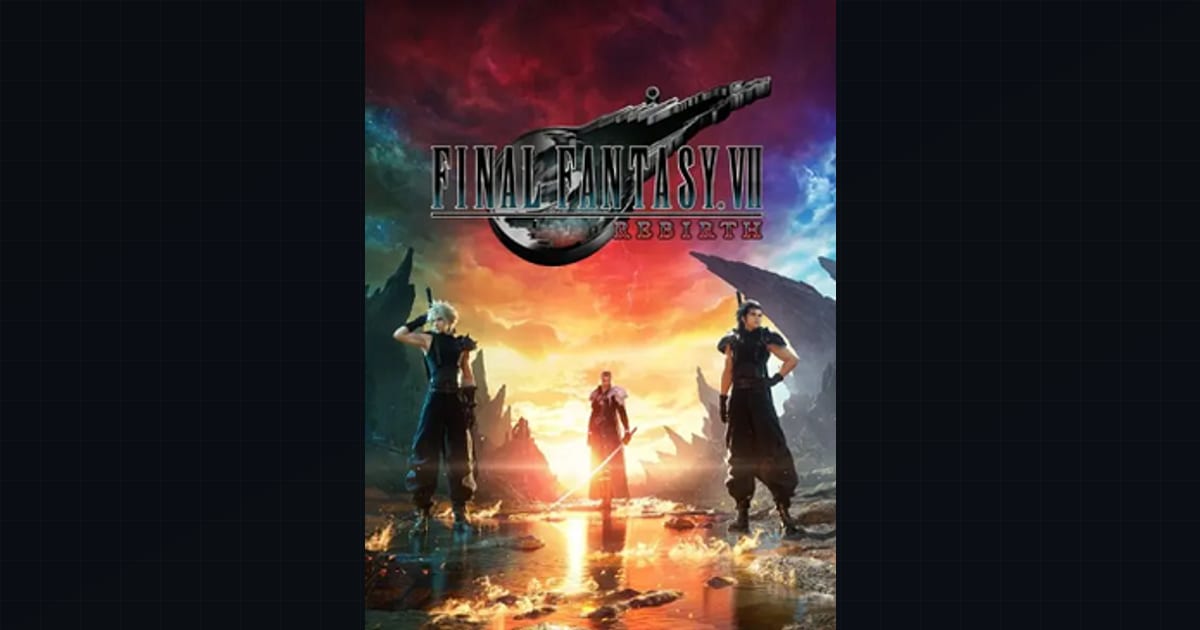
Final Fantasy VII Rebirth, the second entry in Square Enix’s planned trilogy remaking the 1997 PlayStation classic, is now available on Nintendo Switch 2 and Xbox Series X/S as of June 3, 2026. The action role-playing game was developed by Square Enix Creative Business Unit I and originally launched on PlayStation 5 on February 29, 2024, followed by a Windows release on January 23, 2025.
Release Timeline & Platforms
The multiplatform rollout spans roughly two and a half years. The PS5 version served as the initial release, with the Windows port arriving roughly eleven months later. The Switch 2 and Xbox Series X/S versions mark the final confirmed platforms, bringing the game to all current-generation hardware. A third entry, Final Fantasy VII Revelation, is set to conclude the remake trilogy in 2027.
Gameplay & Structure
Rebirth picks up immediately after the events of Final Fantasy VII Remake (2020), following the party’s escape from Midgar. The game shifts away from the linear progression of its predecessor toward a more open-ended overworld. Objective markers in the heads-up display track main story quests, sidequests, and their distances from the party. Traversal options include both foot travel and Chocobo mounts.
Combat retains the hybrid real-time action and Active Time Battle (ATB) system from Remake. Players freely switch between party members during combat, executing physical attacks, magic, and items through a pause-based menu. The “Synergized” mechanic, originating from the “Episode INTERmission” DLC for Final Fantasy VII Remake Intergrade (2021), returns and enables synchronized attacks between party members.
Narrative Scope
The story covers events from the departure from Midgar through the Forgotten Capital, though the order of locations differs from the original 1997 release. Notably, the Wutai segment is reserved for the third installment. The core conflict follows Cloud Strife and AVALANCHE opposing the Shinra Electric Power Company’s exploitation of the Planet’s Lifestream while confronting Sephiroth.
Critical Reception
Upon release, Rebirth received critical acclaim and was nominated for and won multiple end-of-year awards, including Game of the Year. The lead development staff from Remake returned, with Tetsuya Nomura shifting to creative director and Naoki Hamaguchi assuming the director role.
Why the Multiplatform Endgame Matters
Rebirth’s arrival on Switch 2 and Xbox Series X/S closes a chapter that, for the franchise, is genuinely new. Historically, mainline Final Fantasy has treated platform exclusivity as a structural pillar rather than a marketing convenience — from the PlayStation-era lock-ins through the PS4/PS5 timed exclusivity of Remake and Rebirth’s PS5 launch. Seeing the second trilogy installment land on every current-generation platform within a single console cycle signals a meaningful shift in how Square Enix positions its flagship RPGRPG. Role-Playing Game — a game built around character progression, story, and player choices. relative to the install base it needs to reach.
The economics are straightforward and unforgiving. AAA JRPG development at this fidelity is expensive enough that a single platform’s attach rate, even a healthy one, strains the break-even curve. Rebirth’s staggered release — PS5 first, Windows nearly a year later, Switch 2 and Xbox in June 2026 — maps cleanly onto a revenue-extension strategy: capture the premium early-adopter spend where exclusivity cashes out, then progressively unlock lower-friction audiences as porting investment amortizes. The fact that the ports arrive before the trilogy concludes with Revelation in 2027 is not incidental; it maximizes the carry-over audience for the third game.
The Take: A Trilogic Remake as a Live-Service Substitute
What makes Rebirth more than a conventional remaster is that Square Enix has effectively productized the remake itself as a multi-year engagement surface. Rather than shipping one definitive reinterpretation of the 1997 original, the studio has fractured the narrative across three full-priced releases spaced over roughly seven years — Remake (2020), Rebirth (2024), Revelation (2027) — each one large enough to stand alone and structured to end on a hook. This is the live-service retention loop applied to a single-player JRPG: no seasons, no battle pass, but the same underlying mechanic of keeping the audience committed to a continuing product rather than a discrete purchase.
That structure carries real design consequences, and Rebirth is where they become most visible. By spreading the source material thin, the team had to inflate the middle act — the overworld traversal, the sidequest density, the minigame sprawl — to justify a full game’s runtime and price. The pivot from Remake’s corridor-driven Midgar to Rebirth’s open-ended objective-marker overworld is the clearest expression of this: the second installment needed bulk, and open-world bloat is the most economical way to produce it. Whether that bulk reads as generous world-building or as padding depends heavily on the player’s tolerance for checklist RPG design.
What the Combat Evolution Signals
The retained ATB-plus-real-time hybrid is the franchise’s most important technical decision of the last decade, and Rebirth’s refinement of it — particularly the return of the Synergized mechanic from Episode INTERmission — points at where Square Enix thinks party-based action RPG combat should go. The design tension is between the immediacy of action combat and the deliberation that turn-based ATB historically provided. By layering a pause-menu command system on top of real-time melee, Rebirth keeps both audiences: players who want kinetic encounter flow get it, while players who want to plan a synergy chain across two characters keep a structured interface to do so.
The Synergized attacks are the load-bearing addition. They convert the party-swap system from a positioning convenience into a combo engine, rewarding players who manage ATB gauge across multiple characters simultaneously rather than treating each one as an independent damage dealer. This is the same design philosophy that propelled the genre’s recent combat renaissance — the party-as-unit thinking that distinguishes a CRPG encounter from a solo action brawler — ported into a real-time wrapper. It is also, quietly, a hedge against the criticism that Remake’s combat felt too solo-centric despite the party framing.
Context: The Remake Trilogy as a Decade-Long Platform Bet
Step back, and the Rebirth multiplatform drop is best read as the operational manifestation of a decade-long platform bet. Square Enix committed, somewhere around 2015, to spend roughly twelve years rebuilding its most valuable single property across three console generations and four platforms, with creative leadership continuity (Nomura, Hamaguchi) preserved across the whole arc. That is a level of institutional patience rare in modern AAA publishing, where a single underperforming release typically triggers a pivot.
The risk is that the trilogy format punishes the middle entry hardest. Rebirth is the installment that cannot rely on the novelty of “Final Fantasy VII, remade” (Remake’s entire hook) nor the climactic payoff of a trilogy conclusion (Revelation’s). It has to justify itself on structural ambition and combat depth alone — which is roughly what the critical reception and Game of the Year recognition confirmed it managed to do. The June 2026 port is, in that sense, less a platform expansion than a confidence vote: Square Enix shipping Rebirth to two more platforms three years on is an admission that the middle game earned its permanence rather than fading as a transitional release.
For players who skipped the PS5 generation or held out for the Xbox ecosystem, that permanence is now accessible. For the genre, it confirms that the hybrid-ATB model and the trilogic remake format are both viable enough to extend into Revelation — and, presumably, to influence whatever Square Enix builds next.