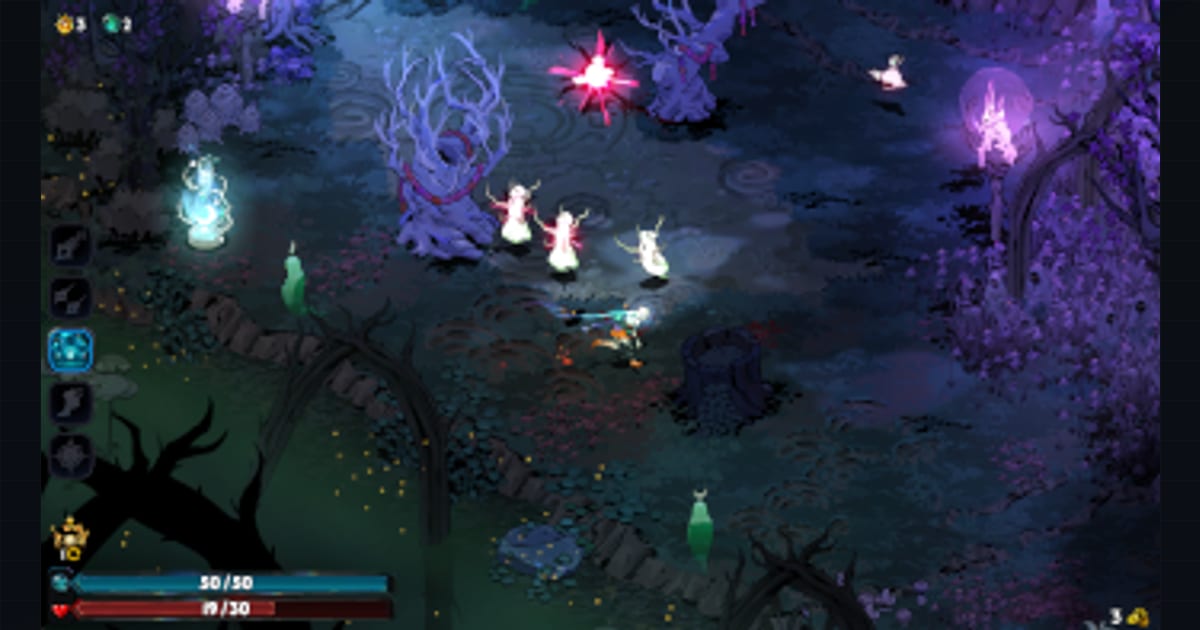
Supergiant Games shipped Hades II, its first sequel, as a roguelike action RPGRPG. Role-Playing Game — a game built around character progression, story, and player choices. across two platform waves. The game launched September 25, 2025 on macOS, Windows, Nintendo Switch, and Nintendo Switch 2, with PlayStation 5 and Xbox Series X/S versions following on April 14, 2026. Early access began on Windows in May 2024 and macOS in October 2024. Greg Kasavin directed, with art by Jen Zee and a score from Darren Korb and Austin Wintory.
Plot & Protagonist
Players control Melinoë, Princess of the Underworld and sister to Zagreus, the protagonist of the 2020 original. Chronos, the Titan of Time, returns after being overthrown by his children, seizes the Underworld, and imprisons Hades, Persephone, and Zagreus. Hecate escapes with the newborn Melinoë to the Crossroads in Erebus, raises her, and trains her for revenge. Melinoë descends to Tartarus with Olympian Boons to defeat Chronos, though Chronos uses his time powers to resurrect after each defeat. The narrative eventually splits into an Underworld path and a Surface path, with Melinoë coordinating with a past-timeline Zagreus via Nyx’s Mirror to destroy Chronos permanently and slay Typhon.
Core Mechanical Updates
Like the original, Hades II is a roguelike dungeon crawler with primary attacks, weapon-specific specials, and a dash. New systems include a revised magic “cast” that locks enemies in place and a “Magick Bar,” a combat resource that recharges through attacking. Olympian Boons return, offering three persistent choices per encounter. The game adds Hexes—summon attacks tied to the goddess Selene, enhanced via a per-run skill tree.
Structure & Progression
The sequel introduces two distinct routes. The Underworld path runs through Erebus, Oceanus, the Fields of Mourning, and Tartarus, with bosses Hecate, Scylla, Cerberus, and Chronos. The Surface path covers the City of Ephyra, the Rift of Thessaly, Mount Olympus, and the Summit, with bosses Polyphemus, Eris, Prometheus, and Typhon. Each region unlocks after clearing the previous one.
The Crossroads serves as the overworld hub. Players spend run-derived resources to upgrade abilities, craft incantations that introduce new features, and unlock weapons. NPC bonds and romance options progress alongside the plot. “God Mode” returns, granting increasing damage resistance per failed run—20% base, plus 2% per failure, capped at 80%.
Why it matters
Hades II matters less as “another roguelike” and more as a proof point for what a small studio can do when it commits to a single design language across two full games. Supergiant is roughly thirty people; the fact that a team that size can field a simultaneous launch across Windows, macOS, Switch, Switch 2, and later the full current-gen console lineup—and ship it feature-complete rather than as a content-trickle live service—is the rare event in a market that has otherwise decided only blockbuster budgets can reach every screen at once. For players, the practical consequence is parity: the build you play on a handheld is the build reviewed on a PS5, not a compromised port months later.
The sequel also matters because it reframes what “progression” means in a roguelike. The genre’s default contract is that death resets your run and carries over only meta-currency. Hades II keeps that loop but layers a second axis on top of it: two parallel route structures, a per-run Hex skill tree, and a meta hub (the Crossroads) where crafting incantations gates new mechanics rather than just new numbers. That doubles the surface area a returning player has to learn without doubling the friction, which is the central design problem every follow-up roguelike faces.
The take
The most consequential mechanical bet here is the Magick Bar. In the original Hades, the “cast” was a situational resource you hoarded for burst windows; here it is a renewable combat economy that recharges by attacking, which inverts the incentive. Aggression now refuels your control tools instead of depleting them, and the revised cast that locks enemies in place gives that aggression a payoff: you pin a target, keep swinging, and the bar fills back. That is a deliberate answer to the most common criticism of the first game’s late biomes—that optimal play drifted toward passive, dash-heavy kiting. By making the resource regenerate through offense, Supergiant is essentially taxing avoidance and subsidizing pressure.
The two-route structure is the second bet, and it is riskier. Splitting the campaign into an Underworld path and a Surface path means the game no longer has one difficulty ramp; it has two, and the boss roster (Hecate, Scylla, Cerberus, Chronos versus Polyphemus, Eris, Prometheus, Typhon) has to teach overlapping-but-distinct lessons. The payoff is replayability and a story that can’t be summarized as a single descent, but the cost is balance surface area: a returning player who outpaces one route’s curve can trivialize it while stalling on the other. God Mode—the escalating damage-resistance safety net—is the safety valve that lets Supergiant keep both routes tuned sharply without exiling players who hit that stall.
What it signals
The platform cadence is the quiet headline. A Windows/macOS early access in 2024, a full September 2025 launch including Nintendo’s new Switch 2, and a separate April 2026 wave for PS5 and Xbox Series X/S is not the schedule of a studio chasing a single marketing moment. It is the schedule of a studio that treats each platform wave as a discrete release with its own certification, its own QA, and its own review cycle—and that is willing to leave console revenue on the table for six months to ship the platforms it can stand behind first. In a year where several high-profile releases shipped broken on one platform to hit a shared date, that sequencing is a signal about how Supergiant weights platform trust against launch optics.
It also signals where the roguelike genre is consolidating. The blueprint—short runs, meta progression, character-driven narrative that acknowledges repeated death as canon—is now mature enough that the differentiation has moved from “is it a roguelike” to “what does the second loop look like.” Hades II’s answer (parallel routes, renewable combat economy, a per-run summon tree) is one version of that answer; the genre will spend the next two years arguing about which version scales.
Context
Hades II follows a 2020 original that turned roguelike structure into a character study—Zagreus’s repeated deaths were not a failure state but the vehicle for the plot. The sequel inherits that premise but swaps its dramatic engine: where the first game was about a son trying to leave a father, this one is about a sister trying to rescue a family that has already been captured, with Chronos’s time-resurrection mechanic providing the in-fiction reason the run loop restarts. The narrative split into Underworld and Surface paths, and the device of coordinating with a past-timeline Zagreus through Nyx’s Mirror, are the structural consequences of that swap—time travel is not a gimmick here, it is the mechanic that lets the story justify two simultaneous campaigns. For a first sequel from a studio that had never made one, that is a notably disciplined way to expand scope: every new system is load-bearing for the plot, not bolted on for content volume.