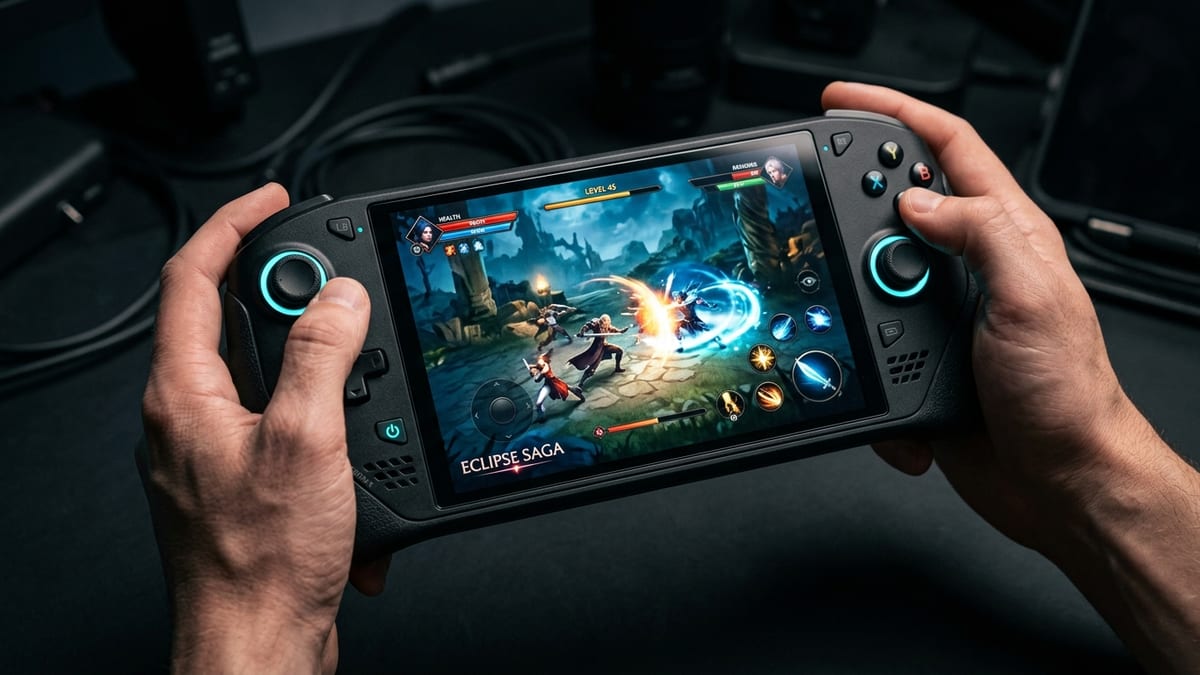
The handheld gaming PC category in 2026 is defined by three converging trends: AMD’s Ryzen Z2 family replacing the Z1, OLED variable-refresh-rate displays becoming the flagship panel, and a real operating-system split between Windows 11 handhelds and Valve’s SteamOS. Against that backdrop, Nintendo’s Switch 2 occupies a different lane entirely, and the comparison that matters is not raw specs but the trade-offs across game compatibility, battery life, emulation, and the day-to-day experience of living with each platform.
The 2026 hardware landscape
ASUS has pushed the ROG Ally line forward across multiple hardware generations spanning the 2023 ROG Ally, the 2024 ROG Ally X, the 2025 ROG Xbox Ally and Xbox Ally X, and the 2026 ROG Xbox Ally X20 Bundle. The original 2023 ROG Ally shipped with AMD’s Ryzen Z1 or Z1 Extreme, 16GB of LPDDR5-6400 memory, a 7-inch 1080p 120Hz FreeSync Premium IPS panel at 500 nits, and a 512GB PCIe 4.0 SSD, running Windows 11 with three operating modes from a 10W Silent mode to a 30W Turbo mode on AC power. ASUS measured that platform at roughly 41 fpsframerate. How many images (frames) the game shows per second; higher = smoother motion. 60 fps is a common target. in Cyberpunk 2077 at 1080p low and 109 fps in Monster Hunter Rise on the Z1 Extreme in Turbo.
The 2025 refresh, the ROG Xbox Ally X, moves to the AMD Ryzen AI Z2 Extreme with 24GB of LPDDR5X, up to 1TB of storage, and a 7-inch 1080p 120Hz panel. The 2026 ROG Xbox Ally X20 Bundle keeps that Z2 Extreme platform but adds a 7.4-inch OLED panel at up to 1400 nits HDR peak with VESA DisplayHDR 1000 certification, Gorilla Glass DXC anti-reflection coating, TMR sensor joysticks, a transforming D-pad, 24GB of LPDDR5X, and a 80Wh battery. It is bundled with ROG XREAL R1 Edition 20 AR glasses that present a 171-inch virtual display over a single USB-C connection.
Lenovo’s Legion Go line follows a similar trajectory. The original Legion Go used the Ryzen Z1 Series with an 8.8-inch QHD+ 144Hz touchscreen, 16GB of LPDDR5X-7500, a 49.2Wh battery, and detachable Switch-style controllers with a built-in kickstand and an optical FPS mouse mode. The Legion Go 2, announced for October 2025 availability, moves to the AMD Ryzen Z2 or Z2 Extreme, offers 16GB or 32GB of RAM, and crucially drops the resolution to 1920x1200 on an OLED panel with a true 30-144Hz variable refresh rate. Its battery grows to 74 watt-hours, roughly 50% more than the original, and pricing starts at $1,099.
Valve’s Steam Deck remains the third pillar, and its differentiator is not the silicon but the operating system. The SteamOS handhelds, including Lenovo’s own Legion Go S with SteamOS, offer a console-like curated experience, while the Windows handhelds from ASUS and Lenovo offer full PC compatibility at the cost of a desktop OS shoehorned into a 7-to-9-inch touchscreen.
Game compatibility
This is where the categories diverge most sharply. The Windows handhelds are full PCs. ASUS emphasizes that the ROG Ally is fully compatible with Steam, Xbox Game Pass, Epic, GOG, and more, ensuring that no matter where you buy your games, you can play them on the Ally. That is the entire premise of the “#playALLYourgames” campaign: any storefront, any launcher, any PC game that runs on Windows, with no porting or curation gate. The trade-off is that Windows on a handheld still requires dealing with desktop idioms, controller mapping per game, and the Armoury Crate or Legion Space overlays that try to tame it.
SteamOS handhelds trade breadth for polish. A SteamOS device runs games that are Steam Deck Verified or otherwise Steam-compatible, with Proton handling Windows games on Linux, but a curated compatibility tier means some titles simply do not work or work poorly, especially those with aggressive anti-cheat. The Legion Go S with SteamOS exists precisely because Lenovo recognized that some buyers want the console-like predictability more than they want every launcher.
Switch 2 is a closed console. Its game compatibility is exactly what Nintendo publishes and what third parties port to it, with no access to PC storefronts at all. The advantage is zero-friction first-party Nintendo titles and optimized third-party ports; the disadvantage is that the entire PC library, the emulation scene, and modding are off the table by design.
Battery and the efficiency question
Battery life is the area where the operating-system choice and the silicon choice interact most. AMD itself has acknowledged to press that the Ryzen Z2 is a match for the Z1 Extreme rather than a generational leap, with software enhancements carrying most of the apparent improvement. That means the realistic battery story for 2026 handheld PCs is less about a new chip saving power and more about how the platform spends it: OLED panels that are more efficient at typical handheld brightness, larger batteries in the newer chassis, and power modes that cap TDP.
Lenovo’s jump from a 49.2Wh to a 74Wh battery on the Legion Go 2, and ASUS’s 80Wh cell on the Ally X20, are the most direct battery improvements, and they matter because handheld gaming PCs have historically struggled to exceed roughly 1.5 to 3 hours of heavy AAA play. The OLED shift helps in a second way: OLED’s per-pixel dimming means dark scenes draw less power than a constant-backlight IPS, which can extend real-world battery in games with dark UI or night scenes.
Switch 2’s battery advantage, when it exists, is structural rather than absolute. A closed console with a fixed game suite is tuned as a system, and Nintendo’s official battery estimate for Switch 2 ranges from roughly 2 to 6.5 hours depending on the title. In light multiplatform games a Switch 2 can outlast a Windows handheld running the same title because the handheld is spending power on a general-purpose OS and a higher-resolution panel, but in heavy multiplatform AAA the Windows handhelds’ much larger batteries (74-80Wh versus the Switch 2’s 5220mAh cell) can flip the result.
Emulation
Emulation is the category where handheld PCs pull clearly ahead of Switch 2, and where the Windows-versus-OS split matters within the PC group. Windows handhelds run emulators with no friction: RPCS3, Ryujinx, Citra, RetroArch, and the broader PC emulation ecosystem install and run as on any desktop, with the handheld’s controls mapped via the overlay. ASUS’s own marketing leans into this, with reviewer quotes calling the ROG Ally an “emulator beast.” The Legion Go’s detachable controllers and kickstand make it particularly well-suited to couch emulation sessions.
SteamOS handhelds can emulate, but it requires desktop mode and a willingness to manage Linux-side installation, and some emulators run less well under Proton than natively on Windows. The practical reality is that serious emulation enthusiasts still skew toward Windows handhelds for maximum compatibility, while SteamOS users accept a slightly more involved setup for the convenience of the curated gaming mode.
Switch 2, of course, does not officially run emulators at all. Its unofficial emulation capacity is irrelevant to a buyer comparing it as a product, and Nintendo’s legal posture toward emulation is well documented.
The Windows-versus-OS experience
This is the deciding axis for most buyers, and it is where 2026 brought the most change. ASUS has committed that the ROG Xbox Ally line will get the Xbox full-screen experience in spring 2026, an overlay that turns the Windows handheld into something closer to a console dashboard. Lenovo has confirmed the same Xbox experience will come to the Legion Go 2 in spring 2026. Both moves are an admission that running stock Windows 11 on a handheld is a friction point, and that the fix is a console-like shell on top rather than a new OS underneath.
Valve’s bet is the opposite: that the fix is a new OS underneath, with SteamOS built for handhelds from the start. The result is that 2026 offers a genuine three-way choice. A Windows handheld gives you every PC game and every emulator with the cost of desktop friction and shorter battery. A SteamOS handheld gives you a curated, efficient, console-feeling experience with the cost of a narrower game library. A Switch 2 gives you a closed, perfectly tuned console with the cost of no PC library and no emulation.
The hardware is converging. The Legion Go 2 and the ROG Xbox Ally X20 both land on Z2 Extreme-class silicon, OLED VRR panels in the 7-to-9-inch range, and 24-to-32GB of memory. The decision in 2026 is less about which handheld is fastest and more about which operating-system bargain you accept.