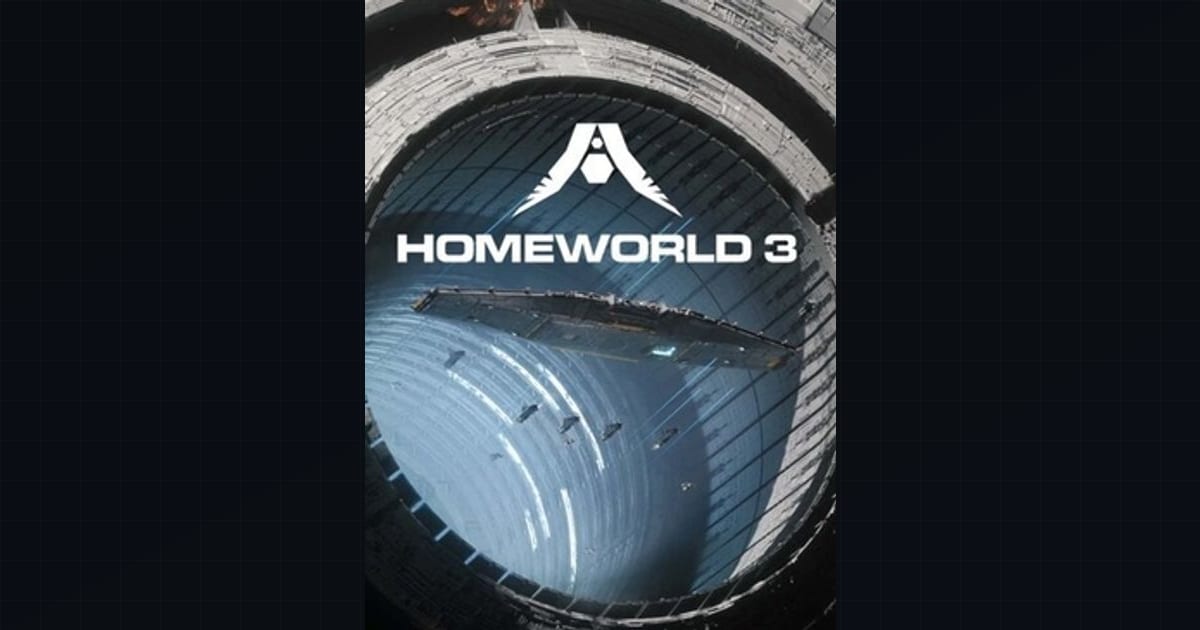
Blackbird Interactive and Gearbox Publishing have released technical post-launch documentation for Homeworld 3, detailing the 3D space ballistics engine and Megalith terrain mechanics that modernize the space RTSRTS. Real-Time Strategy — a strategy game where everyone plays at the same time, continuously, instead of taking turns. genre. The documentation is unusually granular for an RTS release — less a marketing beat and more an engineering post-mortem — and it reveals a game trying to resolve a tension the space-RTS subgenre has wrestled with for two decades: how do you make the “void” tactically interesting?
TL;DR
- What changed: Blackbird documented Megalith cover, per-weapon ballistics, and the Unreal graphics pipeline.
- Why it matters: True 3D cover makes positioning the dominant skill over build-order execution.
- Who should care: Space RTS veterans and sim-depth players on mid-range hardware.
1. Megalith Terrain & Ballistic Line-of-Sight
Unlike traditional 3D space battles fought in open voids, Homeworld 3 introduces massive ancient space structures known as Megaliths:
- Line-of-Sight Cover Mechanics: Strike craft and frigates hide inside hollow Megalith trenches, breaking enemy target locks and ambushing enemy battlecruisers. The LOS check runs per-weapon, not per-ship, meaning a battlecruiser’s dorsal turret can lose lock while its ventral battery still fires — a granularity that matters when you’re trying to peek-and-poke around a debris spine.
- Physical Projectile Ballistics: Kinetic railgun slugs, plasma bursts, and torpedoes calculate collision hitboxes dynamically, allowing terrain to physically absorb stray fire. There is no “cover bonus” abstraction; a slug that intersects a Megalith hull simply stops, and the energy is gone. This makes formation geometry and firing arcs deterministic rather than stat-driven.
- Formation Pathfinding: Strike craft squadrons execute 3D maneuvers (barrel rolls, high-G turns, dive-bombing) while adjusting formation spacing around obstacles. Squadron AI reflows spacing in real time so a wing threading a trench doesn’t clump into a single torpedo kill.
2. Engine & Graphics Pipeline
Built on Unreal EngineUnreal Engine. A widely-used commercial game engine from Epic Games; powers many large-studio (AAA) games. UE5 is the current generation. 4.27, Homeworld 3 features real-time ray-traced shadows, physically based hull scorch shaders, and persistent debris fields that remain floating in space throughout lengthy skirmish matches. The persistent debris is not purely cosmetic — it feeds back into the ballistic model, meaning wrecks from an early engagement become cover (or chokepoints) an hour later. The hull scorch system decals burn marks at impact resolution, so a sustained railgun barrage leaves a readable record of where fire converged, useful for replay analysis even if the match itself never emphasizes it.
Why It Matters: Cover in Three Dimensions Is a Genre First
Space RTS games have historically treated terrain as an inconvenience to abstract away. Homeworld and Homeworld 2 gave you the Z-axis but rarely rewarded using it; Sins of a Solar Empire flattened combat to a plane; Nexus: The Jupiter Incident leaned on scripted set pieces. By making cover a function of true 3D geometry — and by coupling it to a per-weapon LOS and physical projectile model — Homeworld 3 does something the genre has avoided because it’s expensive to compute and harder to teach: it makes positioning the dominant skill again, not build-order execution.
The implication for players is real. A frigatefrigate. A player-built warship used to protect naval trade routes from pirates. wolfpack that learns to stage inside a Megalith trench can blunt a battlecruiser push at a fraction of the cost, which inverts the usual RTS economy logic where bigger ships win by attrition. It also shifts the skill ceiling from APM toward spatial reasoning — reading a battlefield, predicting firing arcs, choosing an approach vector. That is the Homeworld identity distilled: chess in three dimensions, not Starcraft with spaceships.
The Take: Engineering Granularity as a Design Philosophy
The most telling detail in Blackbird’s documentation isn’t any single feature — it’s the resolution at which the simulation operates. Per-weapon LOS, per-projectile collision, per-impact scorch decals, persistent debris that persists as a tactical object. This is a team that chose simulation fidelity over abstraction, and that choice has compounding consequences for both performance and design.
| Tier | CPU | RAM | GPUGPU. Graphics Processing Unit — the chip that renders the game's visuals; the main driver of framerate and image quality. |
|---|---|---|---|
| Minimum | Intel Core i5-8600K / AMD Ryzen 5 3600X | 16 GB | NVIDIA GTX 1060 (6 GB) |
| Recommended | Intel Core i7-12700K / AMD Ryzen 7 5800X | 16 GB | NVIDIA RTX 3080 |
The recommended-spec RTX 3080 and i7-12700K tell the story: a full fleet engagement with ray-traced shadows and a live ballistic solver is genuinely heavy, and the minimum-spec GTX 1060 is there to set a floor, not a target. Players on mid hardware should expect to dial shadow quality and debris persistence before fleet counts climb. The trade-off is that the fidelity is load-bearing — turn the ballistic model down to “cover bonus” abstractions and you’ve removed the game’s central mechanic. Blackbird bet on the simulation, and the hardware curve is the price of admission.
What It Signals: The RTS Genre Is Quietly Re-Centering on Simulation
Homeworld 3’s technical post-mortem lands in a moment where the RTS genre is bifurcating. One branch chases accessibility — auto-everything, shorter matches, console-first inputs. The other branch, exemplified by Homeworld 3 and the broader “simulation RTS” impulse, is re-investing in depth and fidelity, betting that a niche of players will pay for hardware and learning curve to get a tactically richer experience. The fact that Blackbird is publishing engine-level documentation at all signals which market they’re courting: the player who reads patch notes for the physics, not the meta.
It also signals a shift in how post-launch support works for a niche RTS. Documentation like this used to be modder-facing wiki material; here it’s part of the value proposition for the base player, an implicit contract that the simulation is the product and will be tuned as such. For a genre that has spent a decade being declared dead, that’s a meaningful posture — and one worth watching as the next wave of space-RTS projects choose whether to abstract or to simulate.
Context: Where This Sits in the Homeworld Lineage
Mechanically, Homeworld 3’s Megalith cover system is the logical endpoint of a thread Homeworld 2 only half-pulled: that game had debris and formations but never made terrain a tactical object. By committing to physical projectiles and per-weapon LOS, Blackbird closes the gap between the series’ 3D-nav ambition and its 2D-feeling combat outcomes. The risk is teachability — a cover system that lives in geometry is harder to communicate than a “+20% defense in cover” tooltip, and the documentation push is partly an answer to that, giving players the mental model the UI can only sketch.
For the player deciding whether to invest now: the engine is the reason to. Homeworld 3 is one of the few modern RTS titles where understanding the simulation directly improves your play, and where the hardware you run it on changes which tactics are even viable. That’s a rare combination, and the documentation makes it legible — which is itself the quiet thesis of the whole release.
From here, the simulation itself becomes the tuning surface — the next balance patches will effectively be physics patches. Watch how the cover-and-ballistics model holds up once the competitive player base starts mining it for exploits.
Next read
- For why simulation-heavy strategy games stress CPUs, see our MMO/RTS sim-speed breakdown.
- For another modernized classic RTS, see the Age of Mythology: Retold engine redesign.