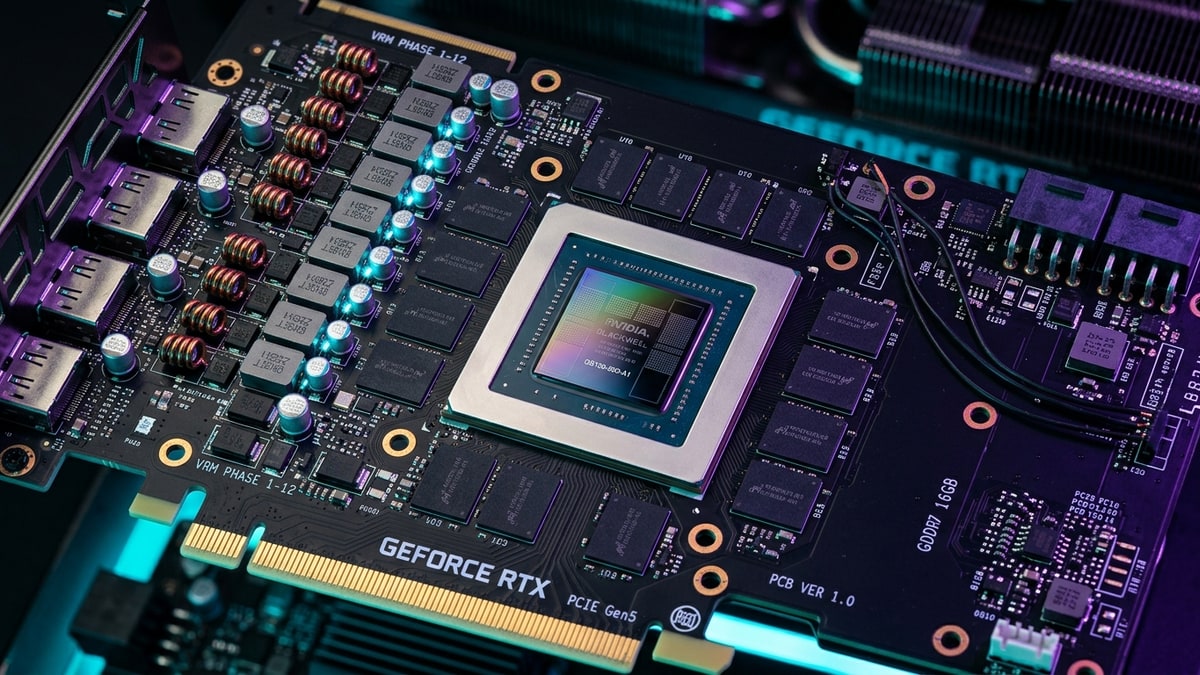
Intel’s Arc Battlemage lineup is the company’s second generation of discrete gaming GPUs, and 2026 is the year its software ecosystem caught up to the silicon. The B580 and B570 launched into a market that had every right to be skeptical after Alchemist’s rough first year, but repeated WHQL-certified driver releases and a coherent XeSS 2 feature stack have shifted the conversation from “will it work?” to “how well does it hold a frame-time line at 1440p?”
What changed
The single most important change is not a transistor count or a clock speed. It is the driver. Intel’s graphics driver page now lists a string of WHQL-certified releases through 2026, culminating in version 32.0.101.8974, dated August 14, 2026. WHQL certification is not a marketing badge; it means the driver passed Microsoft’s hardware quality labs, which requires stability and compatibility testing across a defined test matrix. For a GPUGPU. Graphics Processing Unit — the chip that renders the game's visuals; the main driver of framerate and image quality. line that once fought shader compilation stutters and day-one title breakage, a sustained cadence of certified releases is the structural fix that makes everything else viable.
The release notes for that driver quantify the gains in concrete terms. On Intel Core Ultra Series 3 systems with built-in Arc graphics, Intel reports up to a 7% average FPSframerate. How many images (frames) the game shows per second; higher = smoother motion. 60 fps is a common target. uplift at 1080p Medium and up to 11% at 1080p High in Assassin’s Creed Valhalla, and up to 13% at 1080p Medium in Farming Simulator 2022, each measured against the prior 31.0.101.8864 driver. For the discrete Arc B-series specifically, Kingdom Come: Deliverance II sees up to a 5% average FPS uplift at 1080p Ultra. These are small, honest numbers, and they matter precisely because they are measured against Intel’s own previous driver rather than a cherry-picked competitor. The shape of a maturing driver program is incremental, documented, and reproducible.
The platform support list in the same driver confirms Battlemage (and Alchemist) sit alongside Intel’s Core Ultra integrated graphics, Arrow Lake, Lunar Lake, and Panther Lake parts. That breadth matters because it means Intel is maintaining one driver across a wide silicon family rather than fragmenting support, which is the precondition for the consistency the B-series needs.
How XeSS 2 works
XeSS 2 is not a single technology. Intel documents it as a bundle of three cooperating pieces, and understanding them is the key to evaluating Battlemage at 1440p.
XeSS Super Resolution (XeSS-SR) is the AI upscaler. It reconstructs a higher-resolution image from a lower internal render, trading a fraction of native pixel count for headroom. Intel offers a fixed set of presets mapped to resolution scaling factors: Quality at 1.7x, Balanced at 2.0x, Performance at 2.3x, and an Ultra Performance preset at 3.0x, down to a Native anti-aliasing mode at 1.0x for maximum image quality. The practical implication is that a 1440p target output can be fed from a roughly 1080p-class internal render at the Quality preset, which is where most of the perceptual quality is retained.
A notable engineering choice is the dispatcher. XeSS-SR can load the Intel implementation shipped with the game, the version provided by the installed Intel graphics driver, or a cross-vendor fallback that runs on any GPU supporting Shader Model 6.4. That fallback path is what lets XeSS-SR run on NVIDIA RTX 3000-series and AMD RX 6000-series hardware and above, per Intel’s documented hardware support table, broadening the install base for titles that ship with the SDK.
XeSS Frame Generation (XeSS-FG) interpolates generated frames between rendered ones to raise displayed FPS. XeSS 3 extends this to Multi Frame Generation, inserting up to three generated frames between two rendered frames for a 3:1 ratio on Intel hardware. Frame generation is the tool that makes a “1440p 120Hz” experience feel achievable on a mid-range card, because it decouples the rendered frame rate from the displayed one.
Xe Low Latency (XeLL) is the connective tissue. Intel describes XeLL as a prerequisite for XeSS-FG integration, because frame generation needs frame-pacing support to avoid the input lag and judder that interpolation can introduce. XeLL uses per-frame timing data to calculate an optimal CPU delay before starting the next frame, minimizing input-to-screen latency. The framing matters: a smooth-but-laggy frame generation pipeline is a common failure mode, and Intel explicitly engineered XeLL to be the guardrail that prevents it.
When all three are enabled together, Intel’s pitch is that Battlemage can run at a lower internal resolution, generate intermediate frames, and keep the input response tight. That is the architecture that underpins the 1440p viability claim.
What it means for players
The honest framing is that Battlemage’s 2026 position is “competent mid-range with a real feature stack,” not “category leader.” When the angle is comparing the B580 against NVIDIA’s RTX 5060 and AMD’s RX 9060 at 1080p and 1440p, the relevant facts from Intel’s own materials are these.
At 1080p, the B580’s documented driver uplifts and XeSS 2 stack make it a stable performer in the titles Intel optimizes for, with the caveat that the cross-vendor XeSS-SR fallback means image quality on competing GPUs is comparable enough that Battlemage’s advantage there is modest. The differentiator is not raw raster throughput, which Intel does not claim to lead; it is the combination of XeLL plus XeSS-FG giving a smoother feel in supported games, and the price-to-VRAMVRAM. Video RAM — memory on the graphics card used for textures and frames; more of it lets you run higher settings. ratio (12GB on the B580) which matters as texture budgets grow.
At 1440p, the viability argument is almost entirely an upscaling and frame-generation argument. Running native 1440p on a B580 in a modern AAA title is a stretch; running 1440p output via XeSS-SR Quality from a roughly 1080p internal render, with XeSS-FG filling frames, is the realistic path. Intel’s Endurance Gaming Mode, which offers performance, balanced, and efficiency tiers, is aimed at the laptop side of the family, but it reflects the same philosophy of trading headroom for battery or frame-time stability.
The frame-time consistency question is where driver maturity pays off most visibly. Shader compilation stutter was the original Alchemist story; the Precompiled Shader Distribution system, which downloads pre-optimized files from Intel cloud storage for select games, directly targets launch-time smoothness. A driver that has been through multiple WHQL cycles is one where the long tail of per-game fixes has had time to accumulate, and that is exactly the work that turns a benchmark number into a stable frame-time graph.
What the driver cadence actually buys
The cadence matters more than any single release. The driver download page lists a chain of WHQL-certified builds through 2026, each layered on the last. The value of that accumulation is not in the headline uplift percentages, which are modest by design; it is in the long tail of game-specific fixes that only becomes visible over months. A title that shipped broken on Battlemage at launch, or that regressed after a Windows update, gets folded back into the working set as each certified build lands. That is the structural difference between a GPU line that is new and one that is mature, and Battlemage has crossed into the second category by virtue of sustained shipping rather than any one dramatic fix.
It is also worth noting what the driver does not fix. WHQL certification confirms stability and compatibility across a test matrix; it does not guarantee performance in every title, and it does not retroactively add features the hardware lacks. Battlemage’s ray tracingray tracing. A rendering technique that simulates how light bounces, for realistic shadows, reflections, and lighting — costly to compute. throughput, for example, is fixed by the silicon, and no driver release will change the underlying compute-unit count or RT core design. What the driver can do is ensure the existing hardware runs the games it can run as cleanly as possible, and that is the bargain a maturing platform offers.
The limits of the comparison
Intel’s published materials are careful about what they claim. The performance uplift numbers are measured against Intel’s own prior driver, not against the RTX 5060 or RX 9060, and Intel does not publish head-to-head benchmark figures on its gaming-technologies page. Any specific FPS comparison to those two competitor cards would require third-party testing that is outside what the official source supports. What the official source does establish is that Battlemage has a coherent, documented, and now WHQL-certified software foundation, which is the precondition for any fair comparison in the first place.
The other honest limit is feature parity. XeSS-FG and XeLL run most efficiently on Arc A-series and B-series discrete GPUs and on Core Ultra Series 2 and 3 with Arc 100 and B300 integrated graphics, per Intel’s hardware support table. Multi Frame Generation is explicitly an Intel-only feature. That means the “XeSS 2 advantage” is real but bounded: it applies where the game integrates the SDK and where the GPU is Intel hardware.