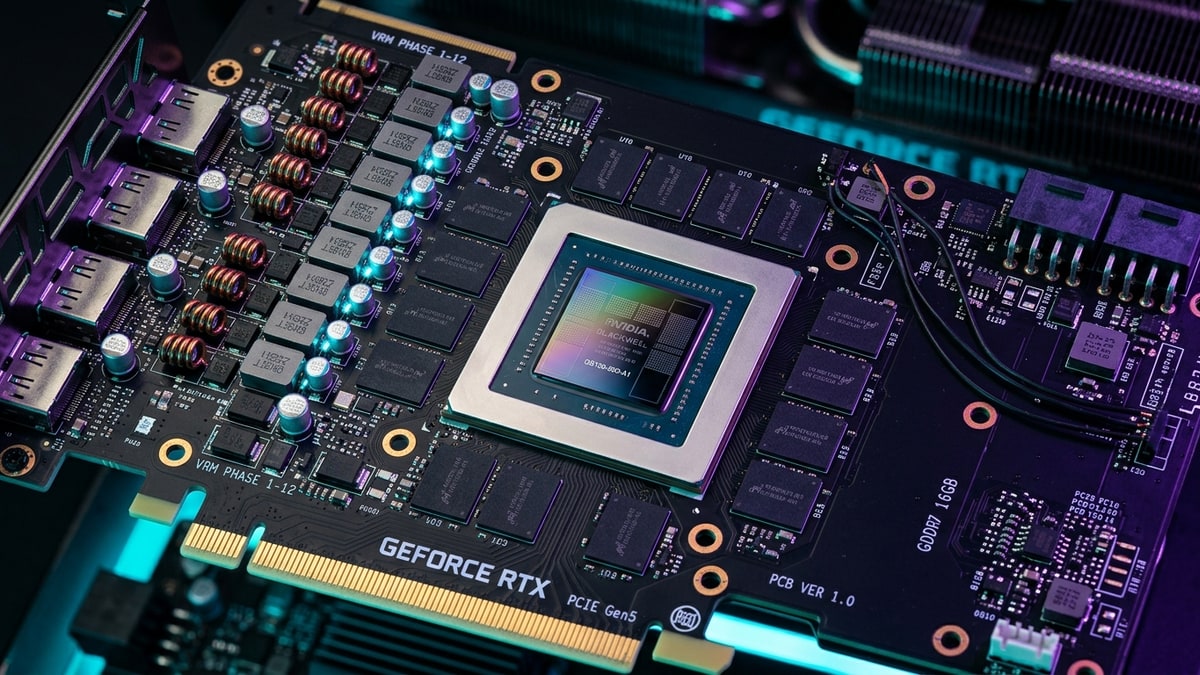
Nvidia officially announced the GeForce RTX 50 series on January 6, 2025, at its CES keynote in Las Vegas, with the first cards — the RTX 5070, RTX 5080, and RTX 5090 — launching on January 30, 2025. The lineup spans entry-level (RTX 5050, RTX 5060), mid-range (RTX 5060 Ti 8GB/16GB), high-end (RTX 5070, RTX 5070 Ti, RTX 5080), and enthusiast (RTX 5090, RTX 5090D) tiers across both desktop and laptop platforms. The breadth of the stack — eight distinct SKUs shipping across two form factors inside a single launch window — is itself the headline for the market: this is a full top-to-bottom refresh in one stroke, not the staggered cadence Nvidia used through much of the RTX 40 cycle.
Blackwell Architecture & Core Specifications
The RTX 50 series is built on Nvidia’s Blackwell microarchitecture, manufactured by TSMC on a custom 4N process node. Unlike the prior generation where consumer and datacenter GPUs used separate architectures (Ada Lovelace and Hopper respectively), Blackwell is shared across both segments. The architecture introduces fourth-generation RT cores for hardware-accelerated real-time ray tracingray tracing. A rendering technique that simulates how light bounces, for realistic shadows, reflections, and lighting — costly to compute. and fifth-generation Tensor Cores for AI compute and floating-point operations. Specifications include up to 21,760 CUDA cores, a PCIe 5.0 interface, and DisplayPort 2.1b alongside HDMI 2.1a.
The convergence matters beyond branding. When the consumer and datacenter lines diverged, the gaming stack was effectively subsidized research: features Nvidia pioneered for Hopper’s compute workloads (transformer acceleration, FP8 paths, structured sparsity) landed in Ada a generation later, already battle-tested. Sharing the Blackwell fabric between the two closes that lag. The fifth-gen Tensor Cores and the transformer-native execution paths that DLSS 4 leans on are not ports from the datacenter part — they are the same silicon lineage, which means the gaming GPUs inherit a maturation curve the datacenter paid to accelerate.
GDDR7 Memory
RTX 50 series GPUs are the first consumer graphics cards to use GDDR7 video memory, delivering greater bandwidth over the same bus width compared to the GDDR6 and GDDR6X memory found in the RTX 40 series. At 384-bit bus width, GDDR7 at 32 Gbps reaches 1,536 GB/s versus 1,008 GB/s for GDDR6X at 21 Gbps. Desktop RTX 50 series cards use GDDR7 modules sourced from Samsung, selected for earlier validation availability.
That 1,536 GB/s figure on the RTX 5090 is the most under-discussed number in the launch. Memory bandwidth, not raw CUDA core count, has been the binding constraint on high-resolution ray-traced rendering for two generations — the RTX 4090 was rarely compute-limited at 4K, it was feeding the cores fast enough that mattered. A ~52% bandwidth uplift over the 4090’s 1,008 GB/s is what actually enables the multi-billion-parameter upscaler DLSS 4 runs in real time, and it is what keeps the 21,760-core flagship from starving on the kind of asset-heavy, fully-path-traced workloads that Unreal EngineUnreal Engine. A widely-used commercial game engine from Epic Games; powers many large-studio (AAA) games. UE5 is the current generation. 5 titles are shipping toward.
DLSS 4 & Multi Frame Generation
Nvidia unveiled DLSS 4 alongside the RTX 50 series. DLSS 4 uses a transformer-based vision model for improved image quality, reducing ghosting and improving temporal stability over the previous convolutional approach. Multi Frame Generation, exclusive to the RTX 50 series, extends frame generation from 2× up to 3–6×. Nvidia’s claim that the RTX 5070 achieves “RTX 4090 performance” drew criticism, as the figure depends on DLSS 4 upscaling rather than raw rasterization throughput.
The transformer shift is the real architectural event inside DLSS 4, and it deserves to be separated from the marketing math around it. The previous convolutional model was efficient but structurally local — it could not weigh distant frame context, which is exactly the regime where ghosting and temporal instability live (thin wires, particle trails, fast-moving foliage). A transformer with attention over the temporal history can reason about what a pixel was across frames, not just what its neighbors are. That is the same conceptual leap that moved language models from CNN-era translation to GPT-style long-context reasoning, applied to pixels. For players it means upscaling artifacts move out of the high-frequency detail that draws the eye, which is where they have been most visible since DLSS 1.
Multi Frame Generation, and the “RTX 4090 performance” framing, is where the criticism is warranted and the analysis gets uncomfortable. Generating 3–6 interpolated frames per rendered frame means the displayed image is increasingly synthesized rather than rendered. Latency does not scale with the frame count — the engine still produces one real frame per cycle, and the generated frames are speculative replays of already-shown state. Nvidia’s reflex pipeline offsets this, but the headline frame-rate number and the responsiveness the player feels have never been more decoupled. Calling a 5070 a “4090” on a metric that is mostly interpolation is a defensible engineering claim and an indefensible marketing one, and the industry pushback was the correct reaction.
Power Connector Changes
All RTX 50 series cards mandate the revised 16-pin 12V-2×6 connector, which shortens sense pins to prevent power delivery unless fully seated — addressing melting issues reported with the 12VHPWR connector on RTX 4090 cards.
This is the quiet, unglamorous fix that actually affects every owner. The 12VHPWR failures on the 4090 were not a connector that could not carry the current — they were a connector that would carry the current even when improperly mated, because the sense pins were long enough to report “seated” before the power pins truly were. 12V-2×6 shortens those sense pins so the card refuses to draw until the connection is mechanically complete. It is the correct, minimal engineering response: do not redesign the power delivery, redesign the failure mode. Enforcing it across the entire stack, including the entry-level 5050 that will never approach the current limit, is Nvidia admitting this is a platform-trust issue, not a wattage issue.
What It Signals for the Next Generation of Games
Read the RTX 50 series as a statement about where Nvidia thinks rendering is going, not just where it is today. The three load-bearing bets are: that AI upscaling becomes the default render path rather than an optional enhancement; that memory bandwidth, not fill rate, gates visual fidelity at 4K and above; and that the consumer/datacenter architecture split no longer pays for itself. Each of those has a direct consequence for the games on this site.
For RTSRTS. Real-Time Strategy — a strategy game where everyone plays at the same time, continuously, instead of taking turns. and large-scale MMOMMO. Massively Multiplayer Online — a game that hosts very large numbers of players together in one shared, persistent world. titles — genres that have historically lagged on ray tracing because screen-space effects broke under huge entity counts and dynamic cameras — transformer-based temporal upscaling with proper long-context stability is the feature that finally makes RT viable. The reason RTS engines kept rasterized lighting was not a philosophical choice; it was that reconstruction artifacts on a camera that pans across a thousand animated units were unacceptable. A model that can attend across that history changes the calculus. For RPGRPG. Role-Playing Game — a game built around character progression, story, and player choices. and open-world workloads running fully path-traced lighting through UE5’s Lumen, the GDDR7 bandwidth uplift is what lets the flagship hold 4K without falling back to aggressive internal resolution scaling. The 50 series is, in effect, the first generation where the silicon is explicitly shaped around the rendering model Epic and the AAA studios have been building toward for three years.
The Take
The RTX 50 series is a genuinely strong architecture wrapped in a marketing campaign that undersells the engineering and oversells the frame rates. Blackwell’s convergence with the datacenter, GDDR7’s bandwidth, the transformer DLSS model, and the 12V-2×6 fix are each, on their own, the kind of foundational improvement that justifies a generation. Together they describe a coherent thesis: render less, reconstruct more, and make the reconstruction good enough that the player cannot tell — while building the memory and compute budget to keep that promise at 4K.
The thesis is sound. The communication of it is not. Leading the launch with an “RTX 4090 performance” claim that rests on speculative frame interpolation invites exactly the skepticism it received, and it obscures the parts of the generation that do not need a footnote. A buyer evaluating a 5070 against a used 4080, or a 5090 against the 4090 they already own, should ignore the generated-frame headline entirely and look at two numbers: native 4K bandwidth headroom and the DLSS 4 transformer’s image-quality delta. On those metrics the generation earns its place. On the metric Nvidia chose to advertise, it does not — and that is a self-inflicted wound on an otherwise defensible launch.