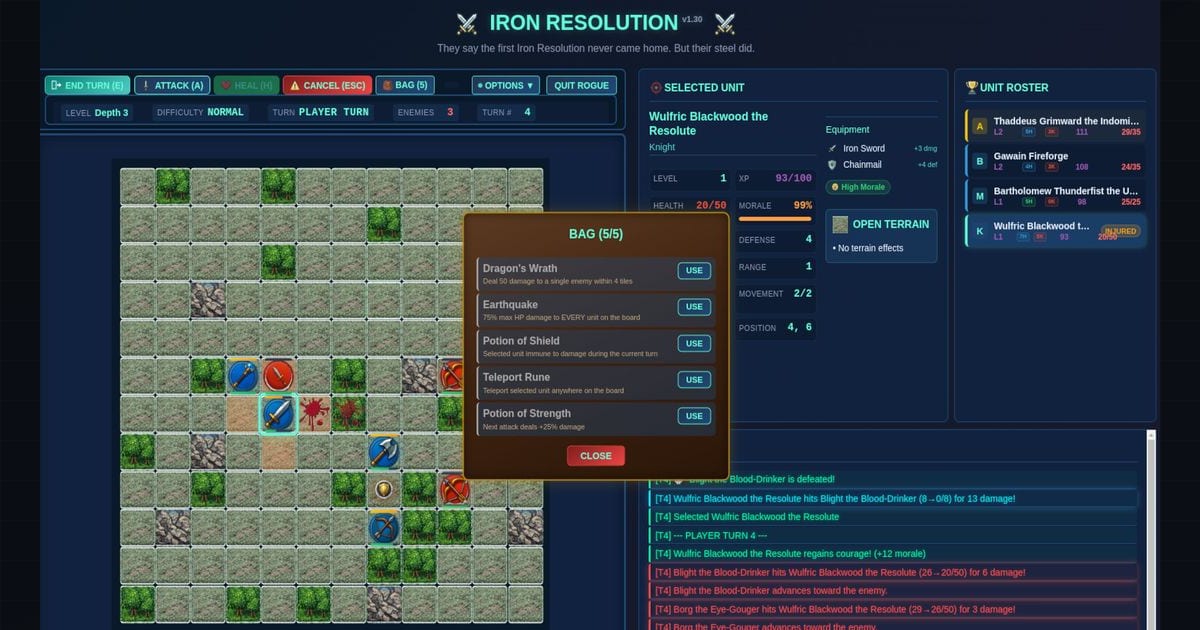
The Ironlands remember every fallen warrior. Iron Resolution, the brutal tactical RPGRPG. Role-Playing Game — a game built around character progression, story, and player choices. from solo developer Martin at Harish Games Official, launched on April 12, 2026, challenging commanders to lead mercenary companies through a world where death is permanent, injuries linger, and morale breaks even the strongest veterans. The June 22, 2026 expansion (version 1.60) transformed the game by adding four new units that fundamentally reshape tactical possibilities across both the 10-level campaign and 100+ depth Rogue mode.
Priced at just $6.99 on Steam, Iron Resolution delivers exceptional value through three distinct game modes: a hand-crafted campaign, an endless rogue descent, and head-to-head PvP duels. The June expansion introduced the Paladin, Trebuchet, Wolf, and Geomancer—each bringing unique mechanics that reward careful planning over reckless aggression. For commanders seeking to conquer the deepest levels, understanding these new units isn’t optional; it’s essential for survival.
The Four New Units Explained
Paladin – Holy Warrior
“The light guides my hand. Once per battle, they also mend.”
The Paladin fills a crucial gap in Iron Resolution’s roster: a hybrid fighter-healer who can hold the front line while providing emergency medical support. Unlike the Mage, who specializes in healing but lacks combat prowess, the Paladin combines respectable damage output with a powerful once-per-battle heal.
This single-use healing ability creates meaningful tactical decisions. Use it early to save a wounded veteran, or hold it for a desperate last stand? The Paladin’s dual nature means they can fight effectively while keeping the option to mend open, but committing to either role fully requires understanding when that single heal matters most.
In Rogue mode, the Paladin excels at extending company longevity. Their ability to self-sustain reduces dependence on the Mage between battles, allowing more flexible company compositions. The June expansion notes emphasize that the Paladin’s healing is a “powerful burst” that can turn the tide when used wisely—suggesting it restores significant health rather than minor topping.
Trebuchet – Siegesiege. A timed, large-scale attack on a settlement — attackers try to destroy it, defenders try to hold it. Engine
“One shot. Make it count.”
The Trebuchet brings artillery-level firepower to Iron Resolution’s tactical battles. With longer range and higher damage than the Archer, this siege unit demands careful positioning due to its limited mobility—one attack and one move per turn maximum.
This constraint transforms the Trebuchet into a strategic asset rather than a frontline combatant. Successful commanders position Trebuchets behind protective terrain, using forests for cover and mountains for elevation bonuses. The expanded battlefield visuals in version 1.60 make it easier to assess Trebuchet firing lines, with health bars now color-coded (green, yellow, orange, red) based on remaining HP.
In Rogue mode, the Trebuchet’s value increases with depth. As enemy numbers swell and battlefields grow more hostile, having a unit that can eliminate high-value targets from safety becomes invaluable. The expansion notes specify that Trebuchet attacks deal “devastating damage”—positioning them as elite elimination tools rather than general-purpose damage dealers.
Wolf – Feral Hunter
“The pack is gone. The hunt remains.”
The Wolf represents pure disruption—a swift, relentless unit that attacks up to three times per turn. This multi-attack capability makes Wolves devastating against unarmored targets and excellent for breaking enemy formations.
Movement speed distinguishes the Wolf from other units. The expansion describes them as moving with “savage speed,” suggesting they can close distances faster than traditional units. This mobility, combined with triple attacks, makes Wolves ideal for flanking maneuvers, eliminating enemy support units, and punishing poor positioning.
The Wolf’s fragility requires careful management. Three attacks per turn mean nothing if the Wolf dies before acting. Successful Wolf deployment involves using terrain to approach safely, striking at vulnerable targets, and retreating before counterattacks land. In Rogue mode’s deeper levels where enemy numbers increase, Wolves excel at thinning weaker foes before they can overwhelm your formation.
Geomancer – Terrain Shaper
“The earth remembers. I merely remind it.”
The Geomancer represents Iron Resolution’s most innovative addition—a unit that doesn’t fight directly but reshapes the battlefield itself. By creating forests, mountains, swamps, mountain passes, and water, the Geomancer controls enemy movement, creates choke points, and denies ground entirely.
This unit unlocks new terrain types as it levels up, rewarding long-term investment. The expansion notes emphasize that Geomancers “reward strategic positioning over brute force”—their value lies entirely in how well you understand terrain mechanics.
In Rogue mode, the Geomancer becomes increasingly powerful with depth. Early levels might not justify dedicating a slot to terrain manipulation, but deeper levels with swarming enemies benefit enormously from created choke points. A well-placed forest can provide cover for your entire company; a strategically positioned swamp can slow enemy advances to a crawl; a mountain pass can funnel enemies into your Trebuchet’s firing line.
Terrain Mastery Fundamentals
Iron Resolution’s terrain system forms the foundation of all tactical success. The June expansion’s enhanced battlefield visuals make terrain effects clearer than ever, with color-coded health bars and injury indicators showing exactly how the environment affects your company.
Forests provide essential cover, reducing enemy accuracy against units positioned within them. The Geomancer can create forests to establish defensive positions or block enemy sightlines. However, forests also limit your own units’ firing arcs—understanding when cover matters more than offense is crucial.
Mountains boost accuracy for units positioned on elevated ground. This elevation advantage compounds with range bonuses, making mountain positions highly contested. The Geomancer’s ability to create mountains mid-battle can instantly transform a disadvantageous position into a fortified stronghold.
Rivers carve through battlefields with limited crossings, creating natural choke points. Units crossing rivers suffer movement penalties and vulnerability. Smart commanders use rivers as defensive barriers, forcing enemies into predictable crossing points where they can be eliminated.
Swamps bog down movement and expose units to danger. The June 7, 2026 patch (version 1.48) corrected swamp behavior to properly slow movement: Knights and Mages lose 1 tile per turn, Archers and Berserkers lose 2 tiles, while Gremlins remain unaffected. The Geomancer can create swamps to trap enemy formations or deny area access.
Mountain Passes created by the Geomancer provide controlled routes through otherwise impassable terrain. These passes can funnel enemies into kill zones or create escape routes for wounded units.
Rogue Mode Survival Strategies
The 100+ depth Rogue Iron Run represents Iron Resolution’s ultimate challenge. A single company, a single chance—descend through ever-darkening battlefields where terrain grows hostile, enemy numbers swell, and safe ground shrinks with every step.
Company Composition for Deep Runs
Successful deep runs require balanced company composition. The four new units integrate into established strategies as follows:
Early depths (1-25): Focus on establishing core synergies. A typical starting company might include Knight (tank), Archer (ranged damage), Mage (healing), and Berserker (melee damage). Add the Paladin once available to reduce healing pressure on the Mage.
Mid depths (26-50): Introduce specialized units. The Trebuchet provides elimination capability for high-threat enemies. The Wolf offers disruption and flank attacks. Begin transitioning to a more flexible composition that can handle varied enemy types.
Late depths (51-75): Maximize synergy. The Geomancer becomes essential for controlling increasingly crowded battlefields. Use terrain creation to compensate for being outnumbered. Your company should now include at least one terrain manipulator, one artillery unit, and balanced melee/ranged support.
Endgame depths (76-100+): Perfect your strategy. By this point, you should have multiple high-level units with complementary abilities. The Geomancer’s terrain control becomes the difference between survival and overwhelming. Every positioning decision matters; every ability use must count.
Item Management
Items appear every three depths in Rogue mode, with your bag holding only five items at a time. The June expansion overhauled the Rogue bag to display item rarity (Common, Rare, Epic, Legendary) and collection depth.
Prioritize survival items early: teleport scrolls for emergency escapes, heal potions for emergency recovery, and bandages for injury management. As depths increase, add offensive items like throwing daggers (which now scale with Mage level and depth) and area-effect scrolls.
The bag’s keyboard navigation improvements in version 1.40 make item management faster during combat. Arrow keys select items, Enter confirms use on the currently selected unit—no extra targeting mode required.
Difficulty Scaling
Version 1.45 added selectable Rogue difficulty from Super Easy to Super Hard. This setting impacts how quickly enemies grow stronger without changing enemy numbers, XP gains, or loot frequency.
For first-time players, Normal difficulty provides the intended experience. Veterans seeking maximum challenge should attempt Super Hard, where enemy strength scales aggressively. The difficulty setting allows players to customize their experience without affecting leaderboard eligibility.
Campaign Mode Tactics
The 10 hand-crafted campaign levels ramp up in difficulty from desperate village defenses to treacherous mountain strongholds, gremlin mazes, and epic boss battles. Campaign mode allows controlling up to 16 units on larger maps, with five difficulty options adjusting enemy strength and numbers.
Integrating New Units into Campaign
The four expansion units shine in specific campaign scenarios:
Paladins excel in extended engagements where healing resources are stretched thin. Levels with multiple sequential battles benefit from the Paladin’s once-per-battle heal, reducing dependence on limited Mage actions.
Trebuchets dominate siege scenarios and boss battles. Their long-range, high-damage attacks eliminate priority targets before they can threaten your formation. Campaign levels with fixed enemy positions allow optimal Trebuchet placement.
Wolves excel in levels with scattered enemy formations. Their multi-attack capability and speed make them ideal for eliminating isolated enemies before they can coordinate. Boss levels with adds (additional enemies) benefit from Wolf disruption.
Geomancers transform defensive levels. Campaign scenarios where you defend a position benefit enormously from created terrain—forests for cover, mountains for elevation, swamps to slow advances. The Geomancer turns static defense into active battlefield control.
Keyboard Controls
Version 1.40 introduced comprehensive keyboard controls, making campaign play faster and more accessible:
- Tab cycles through living, able units
- Shift+Tab cycles backward
- Arrow keys move selected unit one tile (step into enemy to auto-attack)
- A enters ranged attack mode
- H enters heal mode
- E ends your turn
- B opens/closes Rogue bag
- Enter confirms actions
- Escape cancels selection
The Geomancer has dedicated controls: G enters Geomancy mode, Tab cycles terrain types. These keyboard improvements reduce mouse dependency and speed up turn execution.
Persistent Injuries and Company Management
Iron Resolution’s injury system creates lasting consequences for combat decisions. Critical hits inflict permanent wounds: concussions reduce accuracy, broken arms reduce strength, broken legs slow movement. Multiple attacks reduce morale, lowering accuracy and damage for both your troops and enemies.
The June expansion enhanced injury visibility with color-coded injury dots: yellow (1 injury), orange (2), orange-red (3), red (4), dark red (5+). This visual improvement lets commanders assess unit condition at a glance.
Your Mage has a chance to heal injuries between levels, but this isn’t guaranteed. This uncertainty makes the Paladin’s reliable in-battle heal even more valuable. Smart commanders retreat heavily wounded units rather than risking permanent loss.
The Unit Hall of Fame, introduced in version 1.45 and corrected in 1.48, tracks total run XP rather than level XP. Units are now ranked by cumulative experience across the entire descent. Renamed units (a version 1.60 feature) persist across saves and appear in the Hall of Fame, allowing you to commemorate legendary warriors.
What It Means for Players
Iron Resolution appeals to players who appreciate tactical depth with permanent consequences. The June 2026 expansion significantly enriched the game’s strategic possibilities through four distinct new units that each enable unique playstyles.
At $6.99, Iron Resolution offers exceptional value. The combination of campaign, rogue, and PvP modes provides varied experiences that cater to different play preferences. The solo developer’s commitment to ongoing improvement—evidenced by frequent updates addressing balance, visuals, and quality of life—suggests a game that will continue evolving.
The Ironlands remember every fallen warrior. With the four new units from the June expansion, commanders have more tools than ever to ensure their company’s legend endures. Whether descending through 100+ rogue depths or conquering the campaign’s epic boss battles, success requires mastering terrain, understanding unit synergies, and making every decision count.