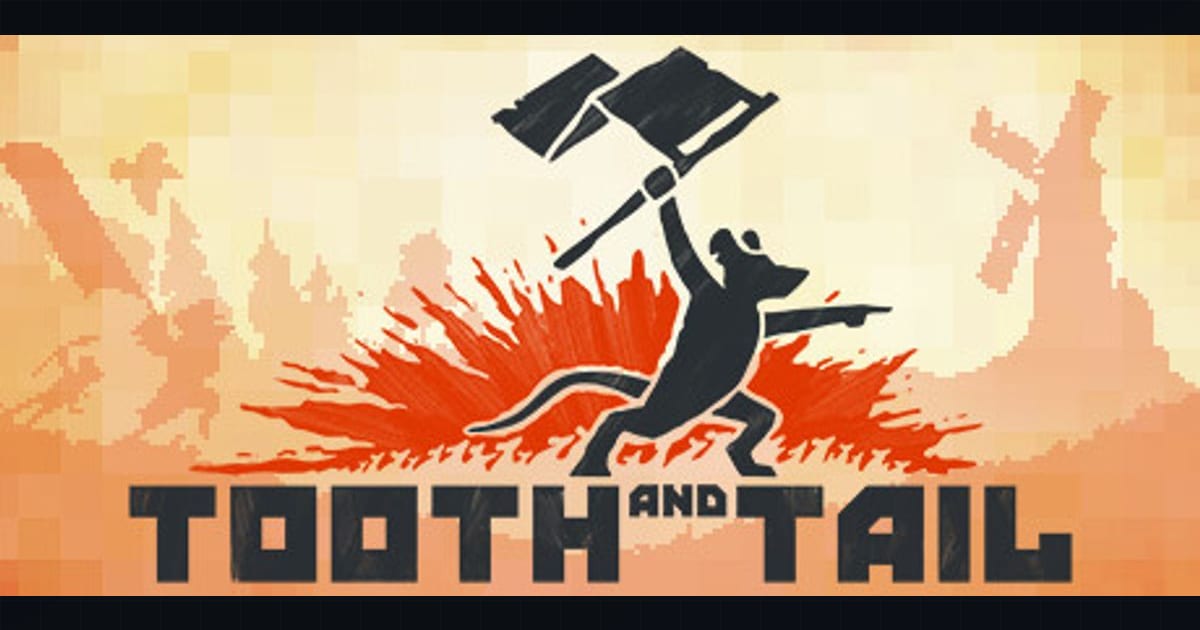
Tooth and Tail is a distilled real-time strategy game built around matches that last between five and twelve minutes. Where most RTSRTS. Real-Time Strategy — a strategy game where everyone plays at the same time, continuously, instead of taking turns. games hand you a fixed factionfaction. An in-game group or nation players can align with or fight against, with its own goals and reputation system. with a fixed tech tree, Tooth and Tail hands you a faction that is largely cosmetic and a deck of six units that you pick yourself each round. Understanding that distinction is the key to reading the game.
The four factions and what actually differs
The game’s fiction frames a civil war over who gets to eat and who becomes the meat. Four factions are caught in it: the Longcoats, the Commonfolk, the KSR, and the Civilized. Each has its own banner-hero commander, its own color, its own voice acting, its own music, and its own flavor text for in-game events.
What they do not have is mechanical differences. Pocketwatch Games has been explicit about this in the community discussions: the differences are color, voice, and music, with no stat or unit differences between factions. The design intent, as the developer put it, is to stimulate improvisation rather than force players into preset paradigms. You pick a faction for identity and aesthetics, not for an advantage.
This is the part that trips up players arriving from StarCraft or Age of Empires, where faction choice predicts strategy. In Tooth and Tail, the only way to know what your opponent is capable of is to see their army. Your strategy is defined by the six units you select, not by the banner you fly.
The six-unit deck and the rush archetype
The real faction is your unit selection. Before a match, you choose six units from a roster that includes flamethrowing Boars, mustard gas-lobbing Skunks, paratrooper-puking Owls, and the rest of the roster’s assorted animals. That six-unit loadout is your entire tech tree for the round, and it is what defines your rush archetype.
The number six is not arbitrary. Pocketwatch settled on six units per loadout as the sweet spot after experimenting with different loadout sizes. With more, you simply slot the hard counter to whatever your opponent tends to build and retech to it. With fewer, everyone picks whatever covers the widest range. At six, the developer’s reasoning goes, you are constrained enough that a clean optimal counter usually does not exist, which forces you to improvise your way back into a losing position.
The practical result is that your rush archetype is something you build, not something you inherit. A fast ground swarm, a gas-and-siegesiege. A timed, large-scale attack on a settlement — attackers try to destroy it, defenders try to hold it. composition, a paratrooper drop strategy, a turtling tower-and-skirmish setup: all of these are achievable on the same faction, because the units do the differentiation. That means matchup reading in Tooth and Tail is reading the enemy’s six units, not reading their faction color.
The 12-minute economy
Matches are short by design, and that brevity reshapes the economy. There is no time for the long economic ramp of a classic RTS, so the game condenses the base-building and resource loop into something you can resolve in a single sitting.
You build a base, lead your army, and try to eat your enemies, as the store page puts it. The core economic building is the Grist Mill, which is your production anchor and the thing map control is fought around. Food is the resource that fuels your army, and because matches are short, the difference between an efficient Grist Mill layout and a sloppy one compounds fast. A player who secures more mills and protects them controls more food, and more food means more units in a window where every unit matters.
The short clock also changes what economy means. In a forty-minute RTS you can absorb a slow start and recover. In a twelve-minute RTS, a bad opening is close to fatal, because there is not enough game left to climb back through macro alone. The result is that economic decisions and combat decisions happen almost simultaneously, which is the core of the game’s pick-up-and-play appeal.
Map control decisions that decide rounds
Tooth and Tail uses procedurally generated maps, so the store page’s promise of endless replayability rests on the idea that you must strategize rather than memorize. Map control is therefore read fresh every round.
A few decisions recur and tend to decide close games.
Grist Mill placement and protection. Because mills are the economic spine, where you place them and how quickly you defend them sets your unit output. Leaving a mill undefended is the fastest way to fall behind in a short match.
Scouting the enemy’s six units. Since you cannot infer the enemy plan from their faction, the first priority after economy is seeing what they actually brought. If they skimped on anti-air and you have Owl paratroopers, that is information you act on immediately.
Chokepoints and engagement selection. Proceduralprocedural. Generated by rules or algorithms rather than hand-placed — e.g. terrain or quests that the game builds itself. maps still produce terrain features, and forcing fights where your composition is favored, while avoiding fights where theirs is, is how a worse economy can still win a short round.
Committing to a plan. Because you lock six units before the match, you cannot fully retech mid-game the way a full-faction RTS allows. The discipline is in building a flexible six rather than a gimmicky six, and then playing to that six’s strengths rather than wishing you had picked differently.
Game modes and replay tools
Beyond the competitive core, Tooth and Tail supports the formats that keep a short RTS alive. The store page lists single-player, online competitive play, shared and split-screen PvP, replays, a level editor, and Steam Workshop support. Split-screen and controller-first controls make it a couch game as much as a competitive one, and the workshop and level editor mean the procedural map pool can be supplemented by community content.
The single-player campaign tells the civil war story across all four factions, which is where the faction identity actually lands. Playing the campaign is also the most efficient way to learn the unit roster before you start building competitive six-unit decks, because you encounter units in a paced context rather than under match pressure.
What it means for new and returning RTS players
For players coming from traditional asymmetric RTS games, the adjustment is to stop looking for faction tells. Pick the faction you like the look and sound of, then spend your energy on the six-unit deck, because that is where your strategy actually lives. A new player’s first goal should be a safe six-unit loadout: three or four broadly useful units and two flexible picks, which is the shape experienced players converge on to avoid being caught with a deck that has no answer to a common threat.
For returning Tooth and Tail players, the primer’s takeaway is the same as it has always been: the game rewards reading six units fast and improvising a counter more than it rewards any single meta loadout. The procedural maps and the customizable decks exist precisely to keep that skill sharp.
How to practice the short-clock format
Because rounds resolve in under twelve minutes, Tooth and Tail is unusually suited to deliberate practice. The replay system is the single best tool here: watching your own losses back, with attention to the moment you committed your army, is faster for improvement than grinding more matches blind. The split-screen mode lets you sit next to a friend and talk through decisions in real time, which is a more honest classroom than online ladder where you cannot ask your opponent what they saw.
A useful drill is to lock one six-unit deck for a session and resist the urge to reselect. Sticking with a fixed composition forces you to find answers inside that deck rather than dodging bad matchups by swapping units, which is the exact improvisation muscle the design is built to train. Once you can win from behind with a fixed deck, rotating compositions to exploit the meta becomes a choice rather than a crutch.
The level editor and Steam Workshop extend the practice surface. Community maps and modifiers let you stage specific scenarios, like defending a contested mill against a known composition, so you can rehearse the exact decisions that decide twelve-minute rounds before they cost you a ranked game.