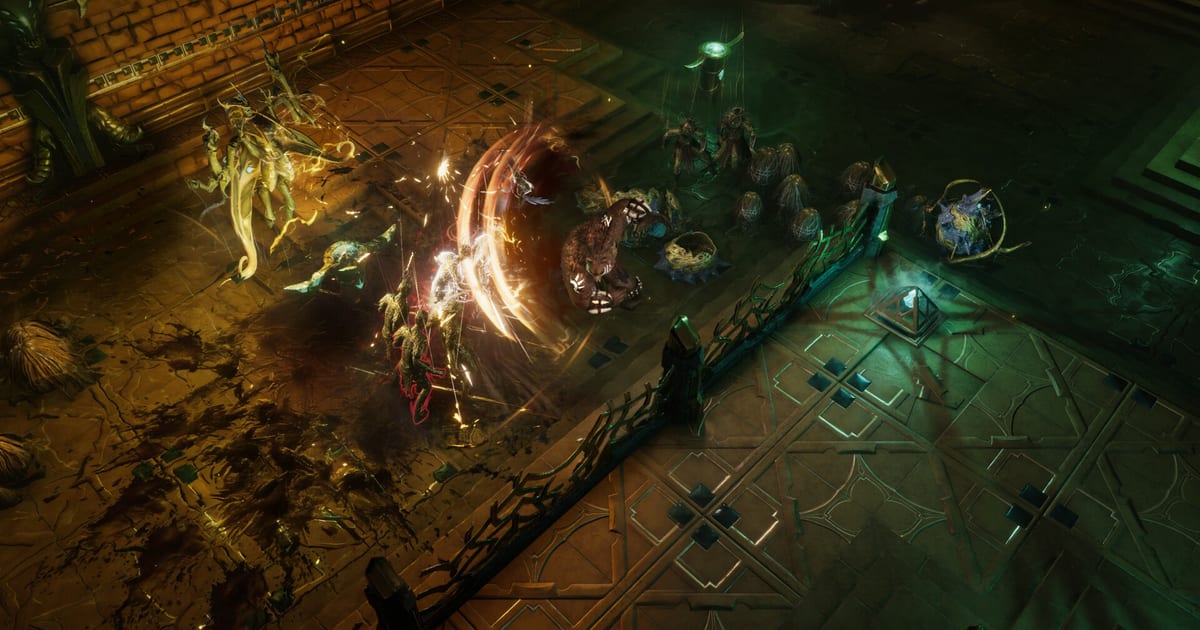
Last Epoch’s endgame does not start when the campaign ends — it starts at the End of Time, where the Monolith of Fate opens into branching Timelines that scale without a hard ceiling. With cycle updates adding systems like Woven Echoes, the loop has become more targetable, but the spine of progression is still the same: clear Timelines, push Corruption, and farm the dungeons that produce Legendary items.
What the Monolith of Fate is
The Monolith of Fate is the primary endgame system. From the End of Time hub, you enter alternate Timelines, each representing a different version of Eterra. Each Timeline has a fixed area level, its own layouts, enemies, and a set of Quest Echoes. Pursuing the Quest Echoes leads to the Timeline’s boss; killing that boss guarantees an item from its unique drop pool and lets you choose one of three Blessings — permanent buffs that apply inside and outside the Monolith.
A Timeline contains ordinary Echoes (individual maps) that build Stability, and the further an Echo sits from the starting point on the web, the more Stability it grants. The goal is to accumulate enough Stability to unlock the Quest Echoes and the Timeline Boss. Each boss offers two common unique or set drops, one that scales with item rarity, and a very rare one available only in Empowered Timelines.
Normal Timelines cap at level 90 and 50 Corruption. To unlock the true endgame, you complete the level 90 Timelines and activate the crystal in the center of the islands, which unlocks Empowered Timelines. Empowered Timelines start at level 100 with a baseline of 100 Corruption and scale from there.
How Corruption drives progression
Corruption is the central difficulty and reward scaler. As it rises, enemies gain health and damage, and loot rarity and the chance for high Legendary Potential items scale with it. The mechanic that pushes Corruption is the Shade of Orobyss, an encounter found at the edges of the Echo web. Defeating the Shade consumes your accumulated stacks of Gaze of Orobyss — earned by killing Timeline Bosses — and converts them into a large Corruption gain.
The risk is asymmetric: dying to the Shade costs a stack of Gaze, so the encounter rewards builds that can survive its patterns. The catch-up mechanic helps players with uneven Timelines: if one Timeline sits far ahead of another, the lower one receives a large Bonus Corruption boost when you defeat the Shade, letting it catch up in one or two kills.
Each Timeline also specializes in specific Exclusive Echo Rewards, so target-farming a gear slot means running the right Timeline — body armor in Blood, Frost, and Death, gloves in Ending the Storm, rings and amulets in Age of Winter, relics in The Last Ruin, and so on.
Reliable build archetypes for cycle play
Last Epoch’s class base splits into five masteries, each with three subclasses. Cycle resets mean players want archetypes that scale cleanly with crafting rather than relying on a single chase drop. The following archetypes are consistently workhorses in Empowered Monoliths.
Ward and minion Necromancer / Lich (Acolyte). Builds that lean on Ward retention and minions scale well because their defenses come from Ward rather than raw health, and Ward refreshes on kill. Necromancer’s summons provide steady single-target and clear, and Lich’s damage-over-time and Ward-scaling tools handle both trash and Shade phases. The build check is minion survival at high Corruption, where a dead minion army stalls output.
Smite and two-handed Paladin (Sentinel). Paladin’s Smite builds pair strong single-target damage with stacking resistances and block. Two-handed variants trade defensive flexibility for burst that deletes Timeline Bosses quickly, which matters because faster boss kills mean more Gaze stacks per hour and safer Shade attempts. The build check is Crit avoidance and block uptime.
Forge Guard and Void Knight melee (Sentinel). Armor-stacking Forge Guard builds use the Forge Guard’s identity to convert armor into damage and survive physical bursts. Void Knight adds void damage and shred. These are durable melee archetypes that handle Echo modifiers well but ask for capped resistances and endurance before Empowered.
Spellblade and Runemaster casters (Mage). Spellblade hybrids mana-stacking and elemental damage output; Runemaster leans into stacking spell ranks for multiplicative scaling. Both reward crafted gear with specific Tier 5 affixes, which makes them strong in cycles where you control your own loot through crafting rather than drops.
Marksman and Falconer ranged (Rogue). Marksman’s ranged physical builds provide safe uptime from a distance, and Falconer’s falcon companion adds free single-target pressure. Both reward movement speed and Crit stacking, and they are forgiving against the Shade because distance buys reaction time.
Druid and Swarmblade shapeshifters (Primalist). Druid Werebear builds are tanky and self-sufficient; Swarmblade’s swarm provides AoE clear. Both scale well with crafted idols and are forgiving on gear, which makes them reliable first-cycle characters.
Corruption targets and boss progression
Progression targets are best set by band rather than by a single number, because the right stopping point depends on your build’s clear speed.
- 100–150 Corruption: the entry band after unlocking Empowered. Goal is capped resistances, 100% Crit avoidance, and a working damage rotation. The Shade is survivable but slow.
- 200–300 Corruption: the farming band where Legendary Potential drops become reliable and Shade-exclusive uniques enter the pool. Most builds can hold here comfortably; 300–400 is a common sweet spot where the risk-to-reward ratio is strong.
- 400–600 Corruption: the push band. Enemies hit hard enough that Echo modifiers start deciding runs. This is where a build with a defensive weakness gets exposed.
- 700+ and beyond: the optimization band for builds with crafted Legendaries, near-max Blessings, and tuned idols. Only push past this if your build is exceptional, because the Shade’s patterns do not forgive mistakes at this level.
The boss progression target is the Shade of Orobyss on a Timeline you are farming for its rewards, followed by the Timeline Boss for Gaze stacks. The dungeon bosses — the Eternity Cache boss in Temporal Sanctum, the Lightless Arbor boss, and the Soulfire Bastion boss — are separate progression targets tied to crafting rather than Corruption.
Dungeons and the crafting loop
The three dungeons are where the gear that pushes Corruption actually gets made.
Temporal Sanctum houses the Eternity Cache, which combines a Unique with Legendary Potential and an Exalted item of the same type. A Unique with 1 Legendary Potential pulls one random affix from the Exalted item; a 4-LP Unique pulls all four, producing a near-perfect item. This is the single most important dungeon for character progression because crafted Legendaries are how most builds cross from farming-tier to push-tier Corruption.
Lightless Arbor is the gold sink: after its boss, you spend gold on modifiers that generate a Loot Explosion of Exalted items, Uniques, and crafting glyphs. It is the destination when you have accumulated gold through trading or farming and need raw crafting materials.
Soulfire Bastion runs a soul-collection and gambling loop. You collect souls from enemies and trade them to the Soul Gambler for a shot at items with specific Tier 5 affixes, which is the targeted-affix path that Eternity Cache crafting depends on.
Cycle systems and Woven Echoes
Recent cycle updates added the Woven Factionfaction. An in-game group or nation players can align with or fight against, with its own goals and reputation system. and Woven Echoes — specialized nodes you place on the Monolith web to alter the rewards of surrounding Echoes. Clearing Tombs of the Erased inside standard Echoes earns Memory Amber, which buys these upgrades. Woven Echoes do not replace the Corruption loop; they layer on top of it, letting you bias a web toward the rewards your build is chasing. Treat them as a targeting tool, not a substitute for pushing Corruption.
What it means for players
The Monolith of Fate rewards builds that scale with crafting, and the cycle systems add targeting on top of the base loop. Lock your build before entering Empowered, cap resistances at 75% and Crit avoidance at 100%, fill your idol slots with rolls that fix weaknesses, and treat Blessings as a power budget worth rerolling for. Push Corruption at the pace your build’s defenses allow, farm Temporal Sanctum for the Legendaries that carry you past 400 Corruption, and let the Shade of Orobyss set your stopping point: if you are dying to it, you have pushed too far for your current gear.