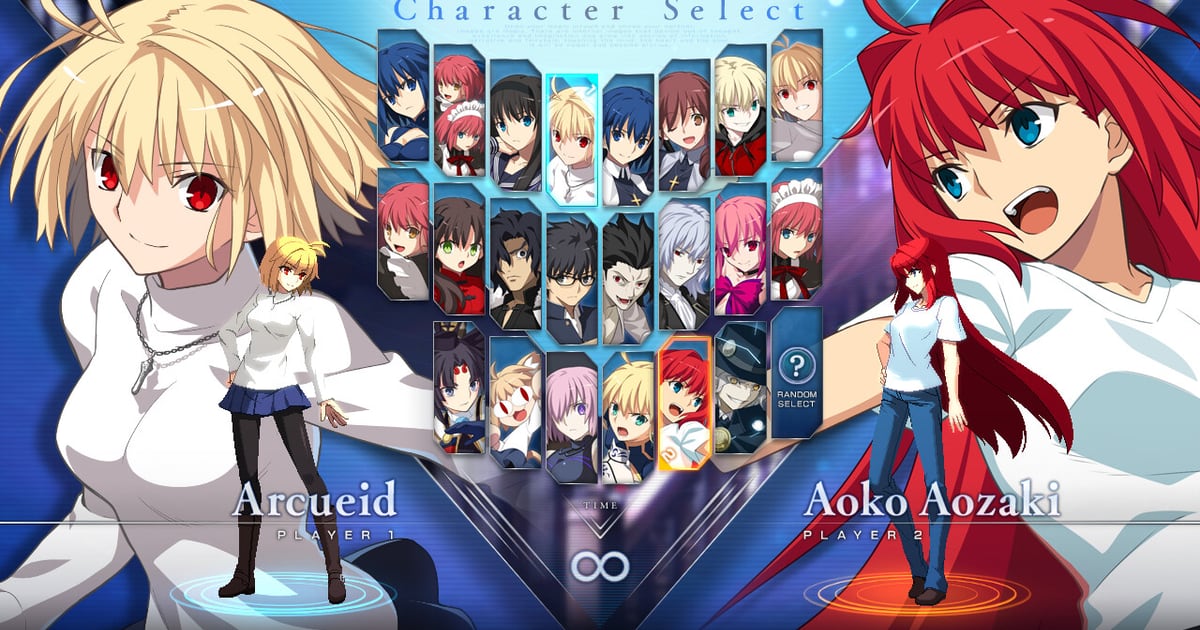
Melty Blood: Type Lumina gives a new player two meters and never says which one the round is about. The publisher does price the Moon Drive and the Magic Circuit — but the pricing is split across a HOW TO PLAY section, a Japanese-language version of that same page that is more specific than the English one, and a FAQ that answers the questions the store copy skips. This piece assembles that record: what a Moon Skill is documented to cost, what a Moon Drive costs, what the Magic Circuit buys instead, and exactly where the official pages stop talking.
It is a deliberately different job from our Under Night In-Birth II GRD and Vorpal primer, which reads French-Bread’s other fighter through two years of patch notes because the product page would not price the gauge. Type Lumina does price its resources, in plain sentences, on one page — the interesting part is what those sentences leave out. As with that piece, nothing below rests on a community wiki: the two wikis documenting this game return bot challenges, not pages.
What this covers: the Moon Icons, Moon Skill, Moon Drive, Shield and Magic Circuit rules as printed on Project LUMINA’s own system page in both languages, plus the FAQ limits that decide whether you can use them against anyone. Why it matters: the Moon pool is the only resource in the game you can spend two ways, and the two spends are priced against each other — a Moon Skill takes a set amount of icons, a Moon Drive takes all of them and is only legal above half. Every round is a choice between the two. Who should care: players coming from Strive or Under Night who expect one super meter, anyone deciding whether to start Type Lumina in the gap before its 2027 successor, and anyone whose “how does the moon gauge work” search returned community shorthand instead of the publisher’s page.
The Moon pool is two purchases, not one
The first correction to make is positional. The Moon Icons are not the bar at the bottom of the screen. The English system page places them “next to the Life Gauge”. The Japanese version of the same page adds the cost detail the English one skips: a Moon Skill consumes “a certain amount” (一定量) of them. The bar along the bottom is the Magic Circuit, and it pays for a completely separate list of things.
The two pools do not do the same job. The Magic Circuit buys power at a known price — an EX version of a Special, a Heat activation, an Arc Drive, a Last Arc. The Moon pool buys two things only, and the second one spends the first one’s ammunition.
The publisher’s page names exactly two Moon systems, in both languages: Moon Skill and Moon Drive. If you have seen a third “Moon” term in circulation, it is not on the system page, and this piece does not use it.
Moon Skill and Moon Drive, priced
| Moon Skill | Moon Drive | |
|---|---|---|
| Documented cost | “a certain amount” of Moon Icons (Japanese page); “consuming the Moon Icons” (English page) | “all of your Moon Icons” |
| Availability clause | none printed beyond the icon cost | only “any time you have more than one half full” |
| Documented payoff | greater damage than a regular Special, on “simple controls using combinations of the directional buttons and attack buttons” | a temporary state that “boosts your Moon Skill, increases your Magic Circuit or number of possible Jumps/Dashes, as well as providing various other effects” |
| What it competes with | the Moon Drive you could have bought instead | every Moon Skill you had already spent |
Read the availability clause carefully, because it is the whole mechanic. Moon Drive is not gated on a full pool — it is gated on a pool that is more than half full, and it then consumes the lot. A player who has been spending Moon Skills on cooldown arrives at that moment holding less than half a pool and cannot activate at all. The page does not print how much a Moon Skill costs, so the arithmetic behind “how many Skills can I spend and still Drive” is not on the publisher’s record; what is on the record is the direction of the trade.
The Moon Drive payoff is also worth reading as written rather than as remembered. The English page lists a Moon Skill boost, increased Magic Circuit, and more jumps or dashes — and then adds “various other effects” without enumerating them. That trailing clause is doing real work: it means the page is telling you the shape of the state, not its frame data. No duration, no stack behaviour, no numbers.
The Magic Circuit is the second clock
Everything the Moon pool does not pay for lands on the bar at the bottom. The system page’s Magic Circuit entry and its Heat, Arc Drive and Last Arc entries stack into a single spend table, and the Japanese page adds a condition the English one omits.
| Spend | Documented cost | Documented payoff |
|---|---|---|
| EX Special | Magic Circuit, amount not stated | a stronger version of a Special |
| Heat | the gauge — “a heat status uses your Magic Circuit” | ability boost, HP recovery, and access to Arc Drive |
| Arc Drive | 3 full gauges — or, per the Japanese page, Heat status itself | “an extremely powerful Special” |
| Last Arc | 4 full Magic Circuit gauges — or Blood Heat status | “incredible damage”, the top of the damage ladder |
Two things follow that a one-meter player will get wrong.
First, Heat is not a free stance. It consumes the resource that also pays for EX Specials, so activating Heat converts a stack of EX opportunities into one persistent state plus a route to Arc Drive. The page says the state recovers HP, making it the only printed way to turn meter back into health.
Second, Arc Drive and Last Arc are printed with an alternative entry condition, not a discount. The English page prices Arc Drive at 3 full gauges and Last Arc at 4 full gauges, then notes Last Arc is “also usable under Blood Heat status”. The Japanese page spells out the pair: Arc Drive can be released in Heat status or with the Magic Circuit filled to 3 gauges; Last Arc in Blood Heat or at 4 gauges. That is why an opponent who popped Heat can threaten an Arc Drive without visibly holding three gauges. The route through the state and the route through raw meter reach the same place.
The page never states how many gauges the Circuit holds at maximum, so any quoted total arrived from somewhere other than the publisher.
Shield is the option that costs neither pool
Shield is the mechanic this game is most often described badly, and the official record is thinner than the reputation.
What the page does say is two sentences’ worth. In English: “Use Shield to block your opponent’s attack, and then press an attack button to follow up with a Shield Counter!” In Japanese the framing is stronger — the Shield deploys something that can nullify (無効化) the incoming attack, and a successful Shield converts into the counterattack on the attack button. Shield sits on its own button, and the FAQ prints the defaults: cross on PlayStation 4, B on Switch, A on Xbox One, J on a Steam keyboard.
What the page does not print is any matrix of what beats Shield. There is no line about throws, no line about a second Shield strength, no line about guard meter. If you have been taught a rock-paper-scissors triangle for this game — and most players have — understand that it is not documented on the publisher’s system page in either language. This piece will not reconstruct it from memory and present it as sourced, because that is how a primer becomes folklore.
What can be said from the pages, and flagged as a reading rather than a quotation, is where Shield sits in the economy. It is the only defensive option on the system page priced in neither Moon Icons nor Magic Circuit. Moon Skills and Moon Drives compete for a pool that refills on some unstated schedule; Heat and EX Specials compete for the Circuit. Shield competes for nothing except the decision to press it and the follow-up window that turns a successful block into damage. In a game whose two documented resources both gate offence, the option that spends no resource is the one that lets you keep holding.
That reading also explains why Shield shows up in the version history. Ver.1.30 (19 August 2022) is the one update in the entire anniversary timeline whose description names shields, folded into a line about “adjusting the battle system including shields”. The publisher does not say what changed.
What the pages do not state
Worth listing plainly, because these are the gaps that generate bad guides:
- How Moon Icons refill. Neither language version of the system page describes the refill rule, the rate, or whether taking damage affects it.
- How many icons a Moon Skill consumes. The Japanese page says “a certain amount” and stops. So does the English page.
- The size of the Moon pool. No count of icons is printed anywhere on the page.
- What Moon Drive’s “various other effects” are. The phrase is as far as the page goes.
- How you enter Blood Heat. The page treats it as a state you reach and a condition under which Last Arc unlocks, but does not print the entry condition the way it prints Heat’s.
- What beats Shield. Covered above, and worth repeating, because the absence is the single largest thing missing from the official document.
That is not a complaint about the page — it is a page written to sell a game. It is a problem for anyone learning it without a community wiki’s version of events.
Which build this advice assumes
This piece assumes Ver.1.46. Reason: the game’s Steam announcement feed carries a post titled “Patch 1.46” dated 24 May 2024, and no later post on that feed is a patch. The 1.45 post before it (7 May 2024) describes that update as “mainly with balance in mind, with some new content and bug fixes”. If a newer revision shipped after those posts, this advice is one revision stale, and the sections above that quote the system page are unaffected either way, because the system page is undated and does not carry version numbers.
The anniversary timeline on the official site is the best available list of what each revision actually did, and its one-line summaries are revealing:
| Version | Date | Documented system-level work |
|---|---|---|
| 1.10 | 13 Jan 2022 | per-character strengthening, bug fixes, mode features, three new stages |
| 1.20 | 14 Apr 2022 | “adjust some of the battle system” |
| 1.30 | 19 Aug 2022 | “adjusting the battle system including shields” |
| 1.40 | 15 Dec 2022 | stages, BGM, character stories, Spanish/French/Portuguese support — no system line |
| 1.43 | 31 May 2023 | “Adjustments to each character and the battle system” |
| 1.45 | 7 May 2024 | seven new VERSUS stages, customisation items, “adjustments … to the system and characters” |
| 1.46 | 24 May 2024 | Steam post exists; its body is images, so no text claim is made here |
The pattern in that table is the practical point: four of the named revisions explicitly describe system-level adjustment, and the last of those is from 2024. A guide written against a 2022 build is not merely old, it is old against a mechanic that has been re-tuned at least twice since — 1.30 for the Shield, 1.43 and 1.45 for the system generally.
Buying in during the Type Lumina–TWI-LUMINA gap
The reason this piece is worth writing in November 2026 rather than 2022 is that the game has a dated successor and an unusually clear handover.
MELTY BLOOD: TWI-LUMINA, the next entry, is listed on its official site for 22 April 2027, published by Aniplex Inc. with French-Bread developing, on PlayStation 5, PlayStation 4, Nintendo Switch 2, Nintendo Switch, Xbox One and Steam. Its Steam page describes the battle mechanics only as “refined” and says the cast of Type Lumina “enjoys an upgrade”, with a new main story and new characters “such as Len”. So: the roster carries forward, and the mechanics are claimed to be refined rather than replaced — which is the argument for learning Moon Skill and Moon Drive vocabulary now rather than waiting.
The counter-argument is the FAQ, and it is the reason to check your platform before your inputs. It states flatly that “cross-platform battles are not supported”. PlayStation 4 and PlayStation 5 can play each other over NETWORK, because the FAQ treats them as one platform. Steam users cannot reach console users at all, and Steam’s Remote Play Together is not supported either. If your reason for buying is a friend on another box, the Moon system is not the obstacle.
Two smaller purchase facts, both from the official pages rather than a store blurb: the game shipped on 30 September 2021 with 14 playable characters and four free two-character additions through 2022, and the publisher announced worldwide sales of 600,000 copies on 26 December 2025. Steam listed a 70% discount at the time of writing; the store’s minimum is a Core i5 at 3.2 GHz, 4 GB of RAM, a GTX 680 or HD 7970 and 12 GB of space.
One last note for anyone who bounces off the controls before reaching the meter. Rapid Beat — the mash-to-combo system the FAQ describes as generating combos when you mash attack buttons — can be turned off, set to fire only in the air, or remapped to a simultaneous A+B press. The FAQ adds that the Tutorial and Missions stay locked to the original setting. Learning what a Moon Skill costs is easier when your button presses are not being converted into something else.