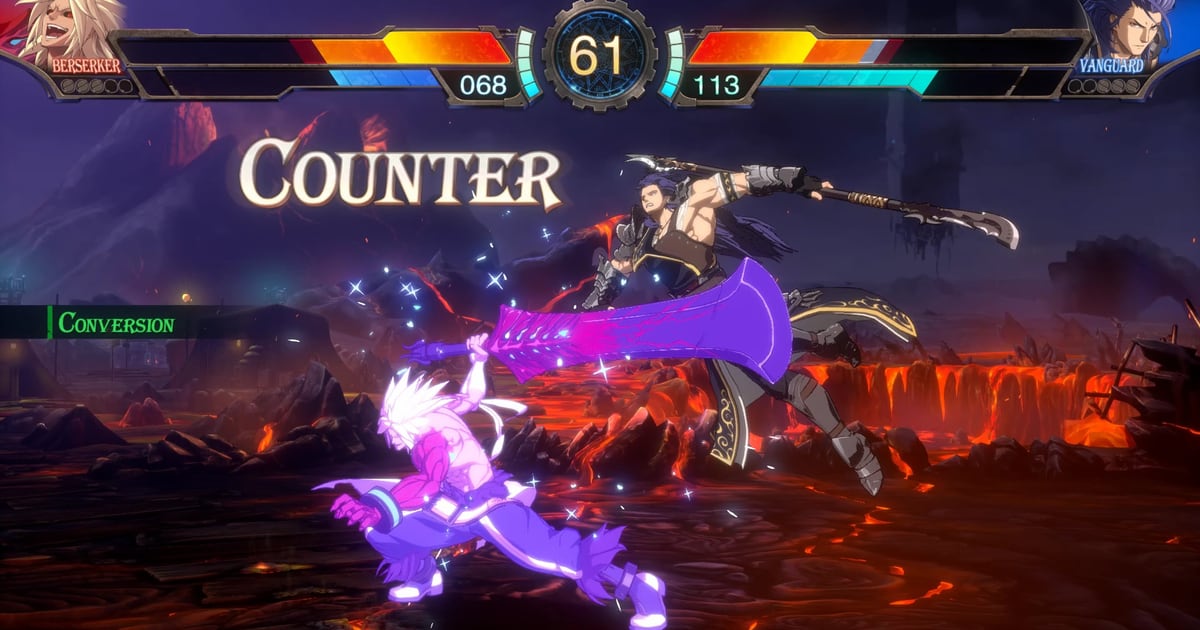
This site has already written about meter in Street Fighter 6, Tekken 8 and The King of Fighters XV, and the KOF XV MAX Mode piece makes the point that in that game “blocking is income” — the Power Gauge fills from guarding as well as from hitting. DNF Duel runs the opposite rule, and it has had no coverage here at all. In DNF Duel, blocked attacks pay you nothing: the wiki’s summary of MP gain states plainly that “MP is not gained by attacks that are blocked.” What defence costs you is not the gauge in the middle of the screen but the white section of your health bar, and a second system — Conversion — turns that white section back into MP at a price.
This piece maps the loop the game’s own materials never lay out in order: how MP is earned, what each defensive option actually charges, how white damage is cashed, and what Awakening does to the value of the health you have left. It assumes the v1.80 build (18 June 2024). Per the v1.80 patch page, “Steam version and Epic Games Store version will be updated to 1.81, while other platforms will be updated to version 1.80. There are no differences in content,” and that page lists no later version.
What this covers: the four places MP comes from, the real price of blocking, Guard Cancel and Indomitable Spirit, the Conversion exchange, Exhaustion, and the Gold/Clear Awakening split. Why it matters: blocking is not free in DNF Duel and it is not paid for in MP. A defensive round starves your offence and shreds your Guard Gauge, and the chip you eat becomes the fuel for the opponent’s pressure — or for your own comeback, if you know the price. Who should care: players in their first ten hours, who usually lose rounds to MP Skills they cannot afford and to Awakening Skills fired at the wrong moment, and anyone arriving from a fighter where meter is a match-long savings account.
Where MP comes from, and where it does not
The gauge opens every round at a maximum of 100 MP and it grows as you lose health: the wiki states the maximum “increases by 10 MP for every 7% health lost up to a maximum of 200 MP at 30% health.” That is the first structural fact worth internalising — the losing player has the bigger wallet, and the size of the wallet is set by damage taken, not by damage dealt.
The income side is narrow. MP refills passively over time, on hit with attacks that do not themselves cost MP, and through Conversion. The per-hit rates are small: “1 MP is gained from A normals, 3 MP from B normals, and 5 MP from Skills.” Skills, in this game’s notation, are the one-button specials; MP Skills are the expensive ones. Blocked attacks return zero at every tier, so a player who spends a whole round holding back builds MP only at the passive rate.
That passive rate is a character stat, not a universal. Dustloop’s frame data page lists an MP regeneration column, and it takes three values across the twenty-one characters it covers: 18 per second for Grappler, 12 per second for Crusader, Ghostblade, Hitman, Inquisitor, Kunoichi, Ranger, Swift Master and Vanguard, and 15 per second for everyone else.
| MP regen | Characters (Dustloop frame data) |
|---|---|
| 18 / second | Grappler |
| 15 / second | Battle Mage, Berserker, Brawler, Dragon Knight, Enchantress, Launcher, Lost Warrior, Monk, Nen Master, Spectre, Striker, Troubleshooter |
| 12 / second | Crusader, Ghostblade, Hitman, Inquisitor, Kunoichi, Ranger, Swift Master, Vanguard |
A twelve-per-second character refills a 100 MP bar in a little over eight seconds of doing nothing; Grappler does it in under six. That is the ceiling on how often the expensive half of a kit comes online, and it is worth a glance before picking a main on damage alone.
What each defensive option charges
Blocking does not drain MP. It withholds it, and it spends two other resources: the Guard Gauge, which “depletes for defenders when blocking attacks, and regenerates over time when not blocking,” and — against MP Skills specifically — your own health, in the recoverable form the game calls white damage. Different characters have different maximum Guard Gauges, and an emptied gauge means a Guard Break: the defender is “stunned for 60 frames and unable to take any action, including blocking.”
Dustloop’s damage page states the asymmetry most sharply. “Normals, throws, Skills, and Guard Cancels deal 50% of their damage as white damage on hit and 0 damage of any kind on block.” MP Skills do the reverse: they deal no white damage on hit and remove all white HP, but “strikes deal 50% of their damage as white damage on block while projectiles deal ??% (less).” Awakening Skills also deal no white damage and strip all white HP, and do “0 damage of any kind on block.”
| Option | Input | What it costs | What comes back |
|---|---|---|---|
| Blocking a normal, throw, Skill or Guard Cancel | hold back | nothing — those attacks deal “0 damage of any kind on block” | no MP; Guard Gauge depletes |
| Blocking an MP Skill | hold back | chip equal to 50% of the strike’s damage as white damage (projectiles less, unpublished) | white health on your own bar; no MP |
| Indomitable Spirit | 4B+S in blockstun | “Converts 2% of defender’s health to White Health” | the next blocked attack’s Guard Damage is negated; blockstun is replaced by 1F normal plus 24F throwable blockstun |
| Guard Cancel | 6B+S in blockstun | 100 MP, hard requirement | invincible attack that cannot K.O.; it also gives the opponent white health, and it is unsafe on block |
| Conversion | B+S in neutral or during most attacks | all remaining white health plus an extra 5% of max health | MP “proportional to the amount of White Health consumed” |
Two rows deserve a second look. Guard Cancel is the only defensive option with an MP price, and it is the one the wiki calls “unsafe when blocked” and notes “leaves you in a counter hit state during recovery” — so 100 MP buys an escape, not a turn. Indomitable Spirit is the opposite: it is free in MP but it charges 2% of your health into white health and, because it fixes blockstun at a set length, using it against the wrong move “might make them safe on block for the opponent or even plus.”
White damage is an IOU, and Conversion is the counter
White damage sits on the health bar as a distinct colour. It “cannot be K.O.‘d,” it “recovers at a rate of 30 HP per second after not taking any damage for a brief period,” and it is the currency Conversion spends. That makes it an asset and a liability at once: health you can get back, MP you can withdraw, and — because MP Skills and Awakening Skills “remove all white HP on hit” — a buffer one landed MP Skill deletes.
Conversion is priced at everything. On activation it “consumes all remaining white health plus an extra 5% of max health” and restores MP in proportion to the white health consumed. The wiki does not publish the exchange rate, so there is no honest way to quote MP-per-HP; what is documented is the shape of the trade. With a full white bar you are converting damage you were probably going to lose anyway into a refund. With an empty white bar you are paying 5% of your maximum health for close to nothing.
The move is not only a refund. It cancels the current action back to neutral, the animation is 6F, and it slows the opponent by 50% for 30F starting on frame 1 — which is why the wiki describes it as available “even on whiff.” It also cannot be done while blocking, after throws, after some MP Skills and after Awakening Skills. That restriction is the reason a defensive round feels so tight in DNF Duel: you cannot cash white health during blockstun. You have to survive to a gap or a hit of your own, and the window you get is 6F long.
Berserker’s Frenzy is the clearest illustration of how tightly the two systems are wired together. The character page states that Frenzy “passively drains Berserker’s health in the form of white health while active,” and that it “automatically ends when Berserker is hit, uses another MP Skill, or uses Conversion.” An install that manufactures its own Conversion fuel, and whose off switch is the Conversion itself, is the design intent in miniature.
Exhaustion is the trap under the gauge
MP Skills can be entered with almost nothing in the bank. The mechanic page notes they “can still be used without enough MP in stock as long as a character has at least 1 MP remaining, but this puts the character in Exhaustion until MP recovers to at least 1.” Exhaustion locks MP Skills out entirely. The wiki’s own worked example: “Using a 50 MP skill when at 10 MP will put the character at ‘-40 MP’ and they will be in Exhaustion until they get up to 1 MP.” The invisible negative balance is the part new players miss — the bar shows empty, but the recovery clock is still paying off a debt.
Two smaller rules change the arithmetic of spending. First, “there is a brief delay before MP begins naturally recovering after using an MP Skill,” and using the “technical” full-motion input instead of the shortcut makes MP “begin regenerating sooner”; the game prints “GOOD” in green for it. Second, most MP Skills apply a 15F slowdown that drops the opponent to 50% speed, which is where the move’s real value lives — but a blocked MP Skill also hands the defender white health, so a chip-heavy blockstring is quietly funding the opponent’s next Conversion.
Awakening re-prices the health you have left
Awakening is automatic: it “activates when characters reach a health threshold” and, crucially, “only activates when the player’s total health (including white life) is beneath the threshold.” Healing above the threshold again does not switch it off. Players choose between two versions when they pick a character, and the choice changes both the trigger and the payout.
| Cube | Activates at | What the wiki says the effect is | Awakening Skill damage |
|---|---|---|---|
| Gold | 30% life | “powerful, oftentimes swingy effects that can greatly change the flow of the match” | 400 raw / 200 minimum |
| Clear | 50% life | “comparitively weaker effects (usually a suite of passive buffs) that increase character performance” | 300 raw / 150 minimum, a 25% reduction |
The Awakening Skill itself is a one-shot per round, it “has no invulnerability,” and using it “turns off your character’s Awakening Effect for the rest of the round.” So the Skill trades your passive for one attack — which means firing it the instant the bar lights up is usually a trade made before you know what the round needs.
Two thresholds line up in a way that is easy to miss. Awakening in Gold Cube begins at 30% life; the MP Gauge also caps at 200 MP “at 30% health.” The character closest to dying therefore has the largest possible MP pool and the passive buff that is meant to swing the match, which is the game’s comeback mechanism expressed in two currencies at once. The v1.80 patch notes show the two systems being tuned together: Battle Mage’s Clear Cube Awakening entry reads “Increased White Damage inflicted on a blocking opponent,” “Increased Guard Gauge Damage” and “Increased MP Recovery Speed bonus.”
The first ten hours: six habits to drop
- Treating block as your default. It earns no MP and drains the Guard Gauge; a Guard Break costs you 60 frames.
- Converting on an empty white bar. You pay 5% of max health and receive nearly no MP. Wait until the white section is worth withdrawing.
- Trying to Conversion out of blockstun. It cannot be done while blocking. Look for a gap, a whiff, or your own hit.
- Pressing Guard Cancel because the gauge reads 100. It is unsafe on block, it leaves you in counter-hit state, it cannot K.O., and it gives the opponent white health to convert.
- Firing the Awakening Skill on activation. No invulnerability, and your Awakening Effect is gone for the round.
- Entering pressure in Exhaustion. An MP Skill spent from 10 MP puts you at a negative balance and locks the good half of your kit.
The positive habit is the mirror of the first one: hit buttons that do not cost MP. A and B normals return 1 MP and 3 MP respectively, and a Skill that lands returns 5 MP — but only on hit. The gauge is a reward for connecting, not for surviving.
What this primer does not claim
Three figures are missing from the public documentation and are left out rather than estimated: the MP-per-white-HP rate Conversion pays, the chip percentage MP Skill projectiles apply on block, and whether the passive MP regeneration clock keeps running during blockstun. Dustloop’s damage page leaves the projectile figure at ”??% (less)”, and no page fetched for this piece states a Conversion ratio. Anyone quoting a hard number for either is quoting something that is not written down.
The roster has grown past the box copy, so the table above lists names rather than a headline count. Steam describes “16 charming characters” plus “an unlockable Hidden Character” and lists a Season Pass with five named DLC fighters: Spectre, Brawler, Battle Mage, Monk and Nen Master. Dustloop’s frame data carries twenty-one entries, and its Lost Warrior page notes that “This character must be unlocked via story mode. They are forbidden in the official Neople Tournaments.”
Next read
- King of Fighters XV MAX Mode: Meter and Quick MAX Primer — the mirror case, where guarding is income and the second meter is bought with the first
- Under Night In-Birth II: GRD Gauge and Vorpal Primer — another defensive-advantage resource, scored in cycles rather than spent
- Street Fighter 6 Drive Rush Guide: Cancel Timing & Neutral — the attacker’s-side meter economy DNF Duel deliberately inverts
- Which Fighting Game to Main in 2026? SF6, Tekken 8, GGST — where a free-flowing MP economy sits in the wider field