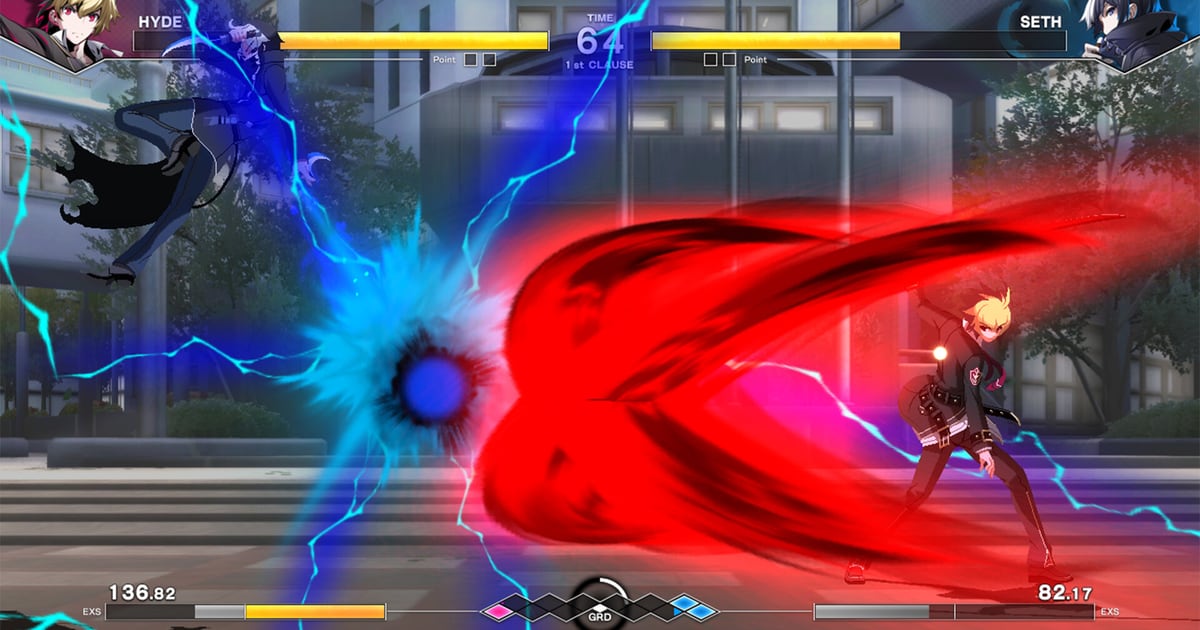
UNDER NIGHT IN-BIRTH II Sys:Celes is the fighting game people bounce off because of one gauge. Celestial Vorpal is gated on that gauge filling, Vorpal rewrites what individual moves do, and a player who cannot read the meter feels the match slipping without knowing why. Search for an explanation and you mostly get community shorthand. The publisher’s own written record is spread across two years of patch notes, and almost nobody reads it as a system document — which is what it is, if you put the notes side by side.
What this covers: the GRD, Vorpal, Concentration, Shield and Guard Thrust rules that Arc System Works has actually printed in English, version 1.10 through 1.43. Why it matters: the notes show the gauge being re-priced three times in fourteen months — twice against combo-route income, once in favour of standing your ground. Read as a sequence, they say what the mechanic rewards. Who should care: players who have learned commands but not the economy, and anyone deciding whether the 1.32–1.42 build is worth re-learning.
This is the job our Guilty Gear Strive Burst-gauge breakdown did for Tension and Burst, except that piece leaned on a fan wiki and this one cannot: the community wiki documenting UNI2 sits behind a bot challenge, and the in-game tutorial text is not published anywhere fetchable. Nothing below rests on community documentation, and where a number exists only in the tutorial it is named as unconfirmed rather than estimated.
The gauge is counted, but the publisher uses two units
Both figures come off official pages. The product page describes the top of the system in nodes. The fine-grained patch notes talk in blocks of GRD instead, and one note in 1.42 refers to a GRD amount “between 0 to 1 block”. Whether a node is a subdivision of a block or the same unit under two names is not stated on either page, and neither prints the gauge’s maximum — so treat any figure for the top of the gauge as unconfirmed.
| Statement | Where it is printed | Version |
|---|---|---|
| “If the GRD gauge is filled 6 nodes or more, you enter Celestial Vorpal.” | ASW America product page | Current page |
| “The entire GRD becomes yours and your attack power, and more, will be greatly increased for a set amount of time.” | ASW America product page | Current page |
| Natural GRD increase while the opponent is being hit slows according to the recovery proration value | Ver.1.32 notes | 19 Aug 2025 |
| The gauge “no longer decreases while walking backwards if the opponent is in hit stun” | Ver.1.32 notes | 19 Aug 2025 |
| GRD gained while guarding was increased; the amount “increases each frame during guard stun” | Ver.1.35 notes | 1 Oct 2025 |
| “This change does not affect guarding during Vorpal.” | Ver.1.35 notes | 1 Oct 2025 |
| GRD is spent on a failed Guard Shield | Ver.1.42 notes | 8 Oct 2026 |
What actually fills it
Three income streams are documented, and they pull in different directions.
Hitting the opponent. The gauge rises naturally while your opponent is being hit, but 1.32 tied the rate to recovery proration: the longer the combo, the slower the gain. That single line removed the simplest folk model of the mechanic — that a big combo is a big GRD deposit. It is not. The notes state the intent plainly, that the change “slows down the rate at which a player gains GRD advantage just by performing a long combo.”
Guarding. Version 1.35 raised GRD gained while guarding and adjusted the per-frame gain during guard stun. The same note explains why: “We’ve adjusted the balance to create a fair exchange of risk and reward by mitigating the payoff of powerful defensive actions while increasing the inherent benefits of guarding itself.” Guarding in place is income. That is the sentence most guides leave out.
Concentration. This is the deliberate farming tool, and it has been restricted twice. Version 1.10 states that “There was a limitation to Concentration, slowing the GRD gain rate when activated at long range”, and that the limit existed so characters who lock the opponent down with set-up moves could not go for Celestial Vorpal unchallenged. The same patch removed the limit at long range when the Concentration user is already low on GRD. Version 1.32 then disabled the Transfer State acceleration while the opponent is being hit, because it made cancelling a combo into a Vorpal too easy.
The 1.10 notes are candid about the trade this creates: “the player can go for more GRD gain in exchange for lower combo damage.” That is the decision the gauge asks you to make several times a round, and it is a pricing question with a published price list.
What drains it
- Walking backwards. 1.32 changes the case where the opponent is in hit stun, which tells you the default: retreating costs GRD. Backing off is the one action the notes treat as an expense.
- A failed Guard Shield. 1.42 fixes a bug so that GRD is now spent when a Guard Shield fails during a successful Shield. The spend was always intended; the patch closes a hole.
- Steer Ender, the A+B follow-up on a connected attack. 1.10 introduced EXS gauge gain on Steer Ender hit and described the remaining downside as “the concern of potential GRD cost when using it in a combo.” Later notes treat that cost as gain-side rather than a fixed price: 1.35 cut GRD increase when recovery proration is extremely low, and 1.42 decreased Steer Ender’s GRD gain outright.
- Specific moves that absorb it. Two characters’ movesets are named in 1.35: Carmine’s [That’s Gotta Hurt!] and [Give Me That!] “now absorb half the GRD when used not as a starter”, with Londrekia’s [Frozen Slope] and [Frozen Vine] doing the same “when hitting outside of starter”. They are the only GRD-stealing moves the English notes name, and each is labelled a nerf tied to “the reduced GRD gain during combos introduced in version 1.30” — Carmine’s note says it “balances” the change, Londrekia’s that it “aligns with” it.
Vorpal, and the second tier above it
Vorpal is a state, not a meter. The 1.21 notes describe the Command List as showing “Vorpal Enhancements (moves that change properties only during Vorpal) for each character” — so the state rewrites individual moves, character by character, rather than applying one global buff.
Celestial Vorpal is the tier with a printed threshold. Six nodes or more, per the product page, and then the wording above: the entire GRD becomes yours, attack power rises, “and more”, for a set amount of time. The phrase “and more” is the publisher’s; the page never itemises it.
| Term | What Arc System Works prints | What no fetched page states |
|---|---|---|
| Vorpal | A state that enables per-character Vorpal Enhancements; guarding during it ignores the 1.35 guard-GRD buff | The threshold at which plain Vorpal begins |
| Celestial Vorpal | Entered at 6+ GRD nodes; whole GRD becomes yours; attack power raised for a set time | What “and more” covers; whether the duration scales with anything |
| Concentration | Slows at long range; low-GRD exception; Transfer State cycle acceleration | Its exact frame data and any meter cost |
| Chain Shift | Can be activated mid-air and re-enables special moves with an air-use restriction | What it costs, and whether Vorpal gates it |
| Guard Thrust | →+A+B+C while blocking; invincibility frames; counter-hit vulnerable in recovery | Its cost in GRD |
One more documented transition: 1.32 refers to cancelling a combo into a Vorpal and treats that as a skill worth preserving. It is the closest the notes come to describing Vorpal as a state you steer into mid-sequence rather than one you are handed.
The defensive kit the notes keep re-pricing
Guard Thrust gets more attention in 1.21 than any other single action. That patch expanded its upper hitbox, increased its invincibility frames, made it input-holdable through a superflash, reduced the space it creates when blocked so the attacker can actually punish it, and made the character counter-hit vulnerable during its recovery. Read together: a strong escape that is now priced for failure. Nothing in these notes tells you what it costs in GRD.
Shield moved the other way. 1.21 made Shield performable mid-dash — the stated reason was that some characters struggled to dash-Shield projectiles more than others — allowed it to persist through a side switch, and made the back-input check depend on facing rather than the opponent’s position. It also made the character counter-hit vulnerable during Shield’s activation and recovery. 1.40 and 1.41 then added a setting for Guard Shield activation rate in Training Mode, which suggests the developers expect players to drill the failure case, not just the success.
Creeping Edge is a ↘+D movement that 1.21 addresses as a universal system action: throws had their grab range during the movement expanded so they function “more clearly as a countermeasure against Creeping Edge”, and the input can be held through a superflash. The Steam store page calls Creeping Edge and Celestial Vorpal “the new game mechanics” this entry adds. The patch notes treat Creeping Edge as a movement with counterplay rather than as a buff, which is the useful way to read it.
Veil Off, Cross Cast Veil Off and Chain Shift complete the system layer. 1.10 shortened Veil Off’s duration when it hits on activation, after the reversal-to-big-damage route made attacking too risky. 1.21 removed throw invincibility during superflash from EX special moves specifically so that “players can no longer use EX special moves after Chain Shift to force the opponent’s throw to whiff.”
Three re-pricings, and what they add up to
| Version | Date | GRD-relevant change |
|---|---|---|
| 1.10 | 25 Jul 2024 | Concentration’s long-range restriction documented and loosened at low GRD; combo-time Concentration capped; Veil Off duration cut on hit; Steer Ender cost acknowledged |
| 1.21 | 20 Feb 2025 | Vorpal Enhancements exposed in the Command List; Guard Thrust, Shield and Creeping Edge re-specified |
| 1.32 | 19 Aug 2025 | Combo GRD gain tied to recovery proration; no GRD loss when sides switch; Concentration acceleration off during hitstun; rollback frame display added |
| 1.33 | 20 Aug 2025 | Bug-fix pass only |
| 1.34 | 29 Aug 2025 | Bug-fix pass only |
| 1.35 | 1 Oct 2025 | Roster health raised across the board; GRD gained while guarding increased |
| 1.35.01 | 24 Dec 2025 | Network-connection fixes only |
| 1.40 / 1.41 | 16 Sep 2026 | Zohar added; per-character IR rating added to Ranked Matches |
| 1.42 | 8 Oct 2026 | Steer Ender GRD gain reduced; failed Guard Shield now spends GRD |
| 1.43 | 23 Oct 2026 | Bug-fix pass; battle version set to 1.43 |
The direction of travel is legible. Every patch that touches passive GRD income from combos tightens it: long combos (1.32), Steer Ender (1.35, 1.42), Concentration during lockdown (1.10, 1.32). The one patch that widened income widened it for guarding (1.35), and 1.35 also raised health across the roster — Hyde from 10,300 to 11,200, Waldstein from 11,500 to 12,500 — to stop “the number of hits required to finish an opponent and the amount of interactions in battles from decreasing too much.” In the same note the developers describe GRD-based interaction as “a key feature of this title” and say they adjusted it to be “more crucial.”
That is a system being tuned around attrition, not around burst. The popular framing — that UNI2’s gauge only pays out for initiative — is half right. It pays for contact and it pays for a held position, and it charges for the retreat. The distinction matters because it changes what a losing round looks like: walking away to reset spacing is the one documented way to bleed GRD, while standing still and blocking is the documented way to earn it back.
Using this in training mode
The notes have quietly turned Training Mode into the place where the system is taught.
- Set “Always Vorpal” or “Both sides Vorpal” (1.21) and walk the Command List’s Vorpal Enhancements (1.21) for your character. That is the only publisher-authored list of what the state changes.
- Turn on recovery proration in the damage display (1.35) and watch the bar’s edge colour shift blue → light blue → gray → black while you extend a combo. That single display is the clearest readout of why a longer route pays less GRD.
- Use the 1.40 additions: separate reversal actions on hit and on block, a Guard Shield activation rate, simultaneous 1P/2P frame data, and a frame count for the gap in a string.
- Watch the rollback frame counter (1.32). The note’s own advice is that if large values appear often, raising input delay a little may help.
- For ladder context, 1.40 added IR, an “ELO style point system calculated for each character separately”, which only moves in Ranked Matches where both players are S or S+ rank. It sits alongside the older RIP.
What this piece does not answer
Three things a reader will reasonably want and I could not source: the interval at which the gauge is evaluated for Vorpal, the threshold for plain Vorpal as distinct from the six-node Celestial tier, and the GRD cost of Chain Shift, Guard Thrust or Force Function. No fetched page states any of them. Force Function appears in the pages I fetched only as a move class newly brought under damage scaling when used immediately after a jump (the exclusions are Increase versions and special moves); Guard Thrust appears only as a frame-data and punishability problem.
Those numbers live in the in-game tutorial and in community documentation I could not retrieve. Rather than fill the gap with a plausible figure, this primer stops at the edge of the printed record. Everything above can be checked against the seven pages in the source block, and the version described is battle version 1.43, dated 23 October 2026.
The wider point holds regardless. Coming to UNI2 from a game with one super meter, the GRD gauge does not read as a meter you fill and spend — it reads as a score you defend, with published income and published rent, and the publisher has spent two years re-pricing it in public.