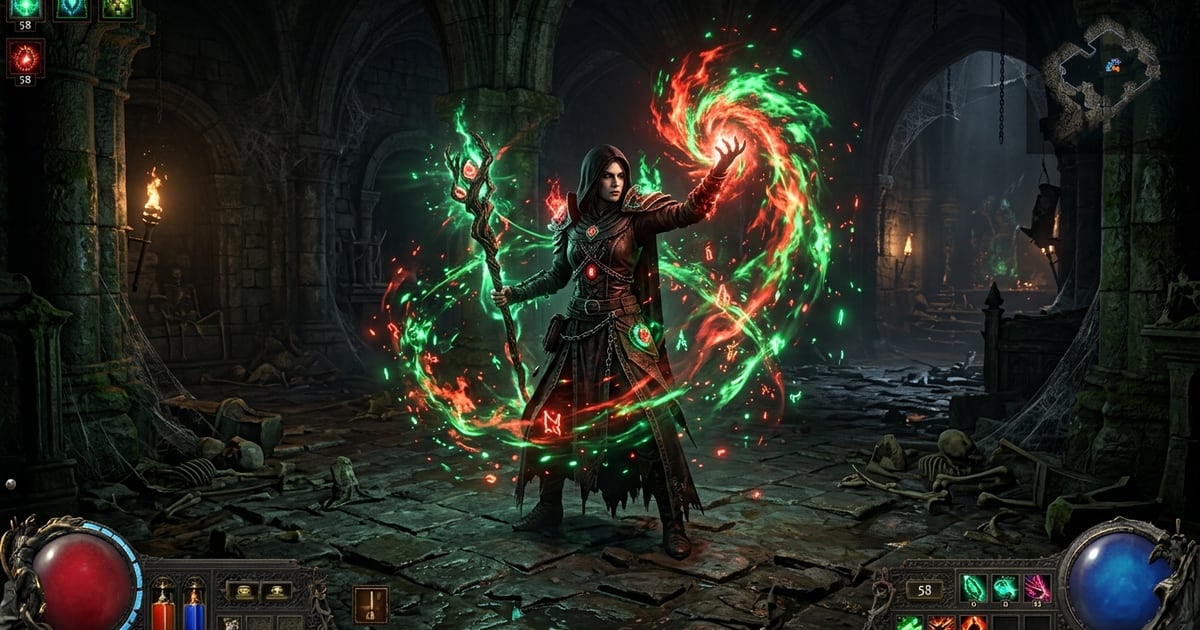
Path of Exile 2 took the socket off your armour. A support gem is no longer something you link into a chest piece; it goes into the skill gem itself, in the Skills panel, and it only ever applies to that one skill. The chromatic-orb lottery is gone. What replaced it is four independent limits — socket count, category, attribute budget and copy rules — and most build questions that look like “which support is best” are really “which of these four am I hitting”.
What this covers: how support gems attach in patch 0.5.5e — where sockets come from and how many a skill can hold, the Category lock, the attribute budget, tier drop breakpoints, Lineage and Kalguuran supports, and meta gems. Why it matters: four separate systems cap what goes into a single skill, and three of them have nothing to do with damage numbers, so a support that looks like an upgrade can be unsocketable next to the one you already have. Who should care: anyone assembling a five-support skill, anyone buying supports for an item-granted skill, and anyone who has wondered why two similar supports refuse to sit in the same gem.
Version check: this page is maintained against 0.5.5e (6 October 2026), the Return of the Ancients build introduced by Content Update 0.5.0 on 29 May 2026. Hotfix 1 for the same build only fixes minimap rendering. Where a rule arrived in an earlier patch, the patch is named.
Sockets belong to the skill, not the gear
A skill gem holds between two and five support sockets. The two it starts with are base sockets; everything above that is bought. Gear upgrades used to be the thing that broke a build; now you can replace every item you own without touching a support link.
Where the sockets come from depends on where the skill comes from. Gem skills are upgraded with Jeweller’s Orbs. Skills granted by an item take their socket count from the item’s item level, and skills granted by a passive take theirs from your character level.
| Where the skill comes from | Sockets are set by | Ceiling |
|---|---|---|
| Skill gem in the Skills panel | 2 base sockets, then Jeweller’s Orbs | 5 |
| Skill granted by an item | Item level 36 → 3, 62 → 4, 80 → 5, or a Jeweller’s Orb | 5 |
| Skill granted by a passive | Character level 36 → 3, 64 → 4, 90 → 5 | 5 |
| Corrupted skill gem | Corruption can add or remove a socket | Never above 5 |
Two details in that table matter more than they look. First, the item-level and character-level breakpoints were moved in 0.5.0: skills that scale with character level now gain their third socket at skill level 10, which is character level 36 (previously 40), and their fourth at skill level 15, character level 64 (previously 65). Skills on items gain the same two sockets at skill level 10 and 15, which can drop at item level 36 and 62 respectively. Second, corruption can add sockets but is explicitly barred from taking a gem past five — so there is no route, corrupted or otherwise, to a six-support skill.
The gem-level ladder that feeds those skills — which Uncut Gem you need to engrave what, and how a Spirit gem differs from a skill gem — is a separate system covered in the Spirit and gem-cutting guide. This page stays on the supports.
Three Jeweller’s Orbs, and the word “set”
The three orb tiers do not stack, they overwrite. Lesser sets a skill to three sockets, Greater to four, Perfect to five, and each is restricted to gems below its own number. That “set” wording is a 0.2.0 change with a real consequence: you can take a gem that already has three sockets and apply a Perfect Jeweller’s Orb directly to it, without spending a Greater first. Before 0.2.0 the orbs added sockets to gems that already had a specific number, so the order of application could waste currency.
Since 0.5.0 the same rule extends to items: Lesser, Greater and Perfect Jeweller’s Orbs can be used on items that grant skills, raising the socket count on those skills, and an orb used on an item with several skills affects all of them. Hotfix 10 of 0.5.0b added the friendlier path — applying the orb to an item-granted skill from the Skill Gems panel rather than to the source item.
The Category lock is the constraint that costs you builds
Every support gem belongs to one or more Categories, and two supports from the same Category cannot be socketed into the same skill. They can be used in different skills on the same character. This is the rule behind most “why can’t I socket this” moments, and it is printed on the gem itself: Fire Attunement’s stat block reads “Category: Fire Attunement”, followed by the line that no more than one support of the same Category may sit in a single skill.
Categories are drawn at the level of the effect, not the gem family. Herbalism I and Herbalism II share the Herbalism Category, so you can run one in each of two skills but never both in one. Others are traps. Return of the Ancients standardised Seals: Unleash, Expand, Salvo and Freezing Salvo Support now all use the same Seal concept, and the patch notes state that “Supports granting Seals now consistently all have the Seal category”. Under the Category rule, that means the four can no longer be combined inside one skill, which is exactly the combination an old projectile build would have reached for.
A support whose Category is named after itself, like Fire Attunement, has nothing competing for its slot. The rule only bites where a family has been split into tiers or variants — which, since 0.3.0, is most of the common ones. That patch gave many supports multiple tiers, and the patch notes were explicit that higher tiers are not simply bigger: they “provid[e] different stat values, additional stats, or perhaps work[] a bit different to their lower-tier counterparts”. Tier II of a support is sometimes a different tool wearing the same name.
Attributes are a budget, not a checklist
Path of Exile 2 caps support gems by your attribute totals, in colour. Strength supports are red, Dexterity green, Intelligence blue, and five points of the corresponding attribute buys you one support of that colour — a character-wide total, not a per-skill one.
The wiki’s worked example is the clearest version: 20 Strength, 40 Dexterity and 30 Intelligence supports four red, eight green and six blue support gems in total, across every skill you are running.
| Colour | Attribute | Supports per attribute | Example: 30 in that attribute |
|---|---|---|---|
| Red | Strength | 1 per 5 points | 6 |
| Green | Dexterity | 1 per 5 points | 6 |
| Blue | Intelligence | 1 per 5 points | 6 |
Supports also carry their own requirement line — Fire Attunement asks for “+5 Str” — so a gem can be unavailable for two reasons at once: you have not met its own requirement, or you have run out of budget for its colour. Since 0.3.0 a missing requirement is no longer fatal to the whole link: if a skill holds supports whose attribute requirements you do not meet, only those supports are disabled, and the skill keeps working with the rest.
Tiers 1 to 5 are a drop schedule
Support tiers are not a power ranking, they are a map of where you are in the campaign. Uncut Support Gems come in five levels, and since 0.3.0 each level is its own base item rather than a single item rolled at a level. They can be traded through the Currency Exchange.
| Area level | Highest Uncut Support Gem level available |
|---|---|
| 1–3 | none (uncut supports start at drop level 4) |
| 4–15 | 1 |
| 16–32 | 2 |
| 33–44 | 3 |
| 45–54 | 4 |
| 55 and above | 5 |
The two breakpoints worth memorising are 45 and 55: tier 4 supports become available in area level 45, and tier 5 not until 55. A support you plan around in a late-endgame build may simply not exist yet in act 3, and no amount of currency fixes that — the gem is gated by the area, not the market.
Two hard edges sit on top of the ladder. Uncut Support Gems cannot engrave Lineage supports at all, so the strongest supports in the game cannot be cut from currency. And support gems themselves cannot be levelled or corrupted, which means the only two upgrade axes a support has are which tier you can obtain and how many sockets you can afford it.
Tier boundaries do move. 0.5.0 changed Brink I so it can now be cut as a level 1 support gem, previously level 2 — a reminder to check the tier of a levelling support after each patch rather than trusting a guide written two leagues ago.
Copy limits: one per rank, one Lineage per character
0.3.0 removed the old restriction that you could only own one of each support gem per character. You can now use as many copies as you like. Three narrower limits survived or were added on top of that.
- One copy per rank of a reservation support. Supports that add a Spirit reservation are limited to one copy of each rank across all your skills. Two copies of Herbalism I is illegal; Herbalism I in one skill and Herbalism II in another is fine.
- One copy of each Lineage support across all your skills. Lineage supports are the endgame drop tier — 40 were introduced in 0.3.0 and 23 more were named in the 0.5.0 notes. They cannot be crafted, and they drop from the core drop pool or from specific bosses.
- The Solus Ipse exception. The unique helmet Solus Ipse allows two additional copies of each Lineage support, in different skills — so up to three copies of the same one, each in its own skill.
Lineage supports are also where the design gets strange, and the drop table is genuinely useful information because each one is worth planning a character around:
| Lineage support | Source | What it does |
|---|---|---|
| Prototype Seventeen | The Arbiter of Divinity | Non-channelling self-used skills gain critical chance based on Rage, but lose all Rage on a crit |
| Seraph’s Heart | No drop source listed on poe2db | Persistent buffs give enemies a chance to calculate hits as though your resistances were 90% |
| Uhtred’s Constellation | Uhtred, the Stardrinker | Two extra cooldown uses, plus more damage per different cooldown skill used recently |
| Catha’s Brilliance | The Bodach | Companion skills blind and ignite nearby enemies, with ignite scaled off the minion’s life |
| Tangmazu’s Thurible | The Raven Trickster | Summoned companions become Gigantic and gain evasion and deflection based on yours |
| Styrn’s Ferocity | Styrn, Fallen Knight of Aldur | Shield skills that hit Crush their targets, and physical hits then break armour |
A fourth support family sits outside all of this. Kalguuran supports come from Remnant encounters, need no attribute points at all, and are not aligned to any attribute; their effects scale off or interact with Runic Ward. If you are running a Runic Ward character, the Kalguuran supports are a parallel ladder to the ordinary colour budget, not a supplement to it.
Meta gems invert the arrow
A meta gem is a skill gem that other skill gems socket into. Supports placed in a meta gem support the meta gem itself and every compatible skill gem socketed inside it, and meta gems can never be socketed into other meta gems. Most require at least one skill gem in the sockets before they function at all. poe2db’s live counters read 18 meta gems against 419 skill gems and 558 support gems, checked on 3 November 2026.
This is where the “Connected” definition earns its keep. Two gems count as Connected if one is socketed into the other, or if both are socketed into a third gem — and a support in a meta gem stays Connected to that meta and to the other skills inside it even when it cannot support some of them. Almost nothing reads that flag; the Gemling Legionnaire ascendancy does, through Integrated Efficiency, which converts Connected red, blue and green supports into damage, critical chance and skill speed respectively. On a Gemling, the colour budget above is not just a cap — it is a stat stick.
One caution for weapon-swap characters, and it is new. 0.5.5 fixed a bug that let auras and support gems from an inactive weapon set keep applying to the player. If a support you had parked on the other weapon set appeared to be working, it was not supposed to be.
What this means when you plan a five-support skill
Read the constraints in the order they bind, not the order they are announced.
- Sockets first. Decide how many supports the skill is allowed. Five is a Perfect Jeweller’s Orb; four is a Greater. An item-granted skill at item level 40 will not go past three no matter what you own.
- Then Categories. List the supports you want and check for repeats inside a family. This is where most five-support plans collapse to four, and where the 0.5.0 Seal change bites old projectile setups.
- Then colour. Add up reds, greens and blues against your attribute totals at one support per five points. A gear swap that drops 15 Strength can quietly disable three red supports at once.
- Then tier. Confirm the support exists at the tier your current area level can drop. Anything above area level 55 is fine; anything above 45 is tier 4.
- Then Lineage, if at all. A single Lineage support can define the skill, but you get one copy of that support on the whole character unless you are wearing Solus Ipse.
Everything after that — which support multiplies hardest, which ailment scales best — is balance work that changes with every league. The four limits above are the part of the system worth learning once.