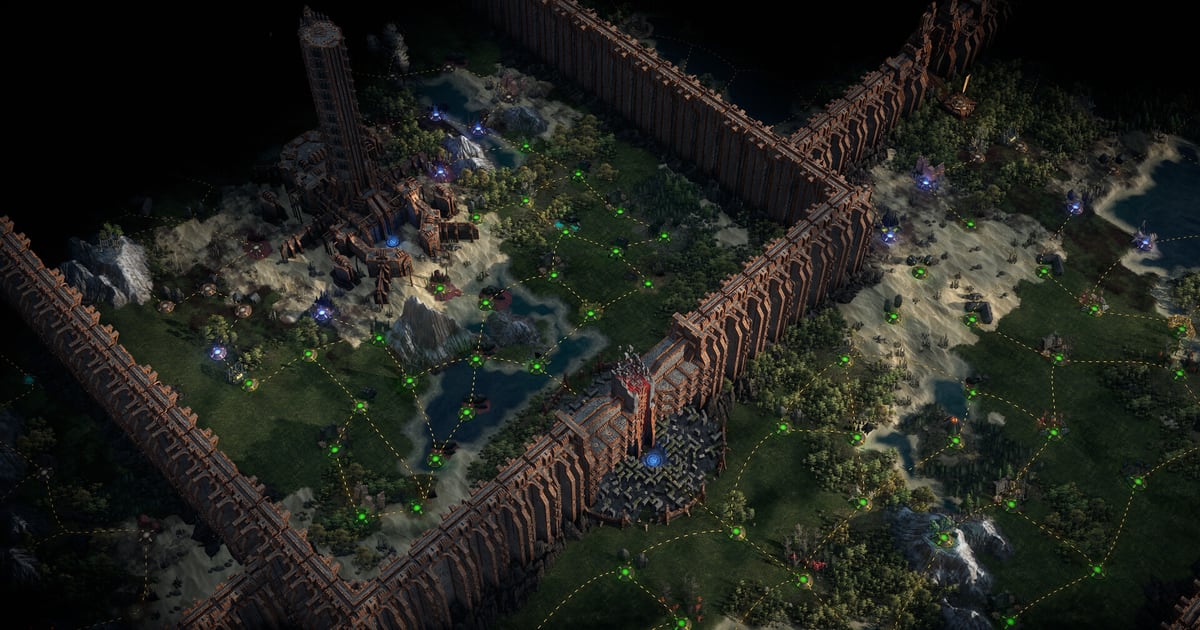
Grinding Gear Games’ Path of Exile 2 completely divorces skill gem sockets from physical gear. In the original Path of Exile, finding an exceptional chest piece with the wrong color or number of sockets required hundreds of Chromatic Orbs and Jeweller’s Orbs to fix. In PoE2, gems socket directly into a dedicated Skill Gem Screen, gear sockets are eliminated, and aura reservation is separated from Mana into an entirely new resource: Spirit.
What this covers: Uncut Gem crafting tiers, 6-link socketing directly inside gems, the Spirit pool resource, and dual-specialization weapon passive trees. Why it matters: Sockets belong to the gems themselves, allowing players to upgrade boots, body armor, and weapons freely without breaking active builds. Who should pick this: ARPGARPG. Action RPG — an RPG with real-time combat rather than turn-based fights. theorycrafters building league-starter characters for Path of Exile 2.
Uncut Gems and Direct Gem Sockets
In Path of Exile 2, monsters drop Uncut Skill Gems and Uncut Support Gems tied to specific item levels:
- Right-clicking an Uncut Gem opens a selection window, allowing you to choose any skill gem belonging to that level tier.
- Every skill gem now has its own internal sockets (up to 5 support sockets for a true 6-link skill).
- Upgrading a skill’s socket capacity is performed using Jeweller’s Orbs applied directly to the gem item in your skill menu, permanently preserving your 6-link status forever.
| System Variable | Path of Exile 1 | Path of Exile 2 | Strategic Player Benefit |
|---|---|---|---|
| Gem Sockets | Rolled on physical armor / weapons | Sockets exist inside the Gem itself | Swap armor pieces instantly without re-rolling sockets |
| Aura Reservation | Reserves % or flat Mana pool | Reserves dedicated Spirit resource | Mana remains 100% available for casting active spells |
| Baseline Spirit | None (Mana only) | 0 base; +100 from campaign bosses | Permanent baseline reservoir for auras, buffs, and permanent minions |
| Weapon Swapping | Swaps weapons only | Swaps passive tree points dynamically | Cast spells with staff stats, auto-swap to daggers for melee |
Jeweller’s Orb Tiers and the Socket Ladder
Support sockets are no longer a lottery. Three currency tiers set a skill gem’s support count outright, and a fresh active skill gem begins with just two:
- Lesser Jeweller’s Orb sets a skill gem to 3 support sockets and starts appearing around item level 25.
- Greater Jeweller’s Orb sets it to 4 sockets and drops from item level 45 content onward.
- Perfect Jeweller’s Orb sets it to the maximum of 5 sockets and drops from item level 65 content.
| Orb Tier | Sockets After Use | Drop Item Level | Recommended Target |
|---|---|---|---|
| Lesser Jeweller’s Orb | 3 | 25 | A campaign damage skill still being tested |
| Greater Jeweller’s Orb | 4 | 45 | A skill that will survive into early endgame |
| Perfect Jeweller’s Orb | 5 (maximum) | 65 | Only a settled main damage skill |
The orbs set a fixed count rather than adding one socket at a time, so the upgrade order runs Lesser, then Greater, then Perfect. A lower tier cannot reduce a gem that already holds more sockets — it is simply consumed with no effect — and there is no vendor recipe or crafting-bench option to trade Lessers up into Greaters. Since patch 0.5, Jeweller’s Orbs also work on skills granted by equipped items: applying one to a weapon or unique that carries a built-in skill raises the support count for that granted skill, and if a single item grants several skills the orb affects all of them at once. Which supports are even eligible for a given socket is a separate check — the tag and restriction rules are mapped in our skill gem socketing guide.
Corruption is the gambler’s alternative. A Vaal Orb on a skill gem can add a socket, increase or decrease quality, permanently raise the gem’s level by one, or leave the socket count untouched — but it also permanently locks the gem, because corrupted gems can no longer accept Jeweller’s Orbs or Gemcutter’s Prisms. Because a Vaal Orb can push a gem to six support sockets where a Perfect Jeweller’s Orb stops at five, players sometimes take a five-socket gem and corrupt it for the last slot. The safe sequence is to finish every normal socket and quality upgrade first, then corrupt only a gem you already intend to keep.
The Spirit Resource Economy
In PoE1, reserving auras meant shrinking your usable Mana globe down to 10% or 15%, requiring heavy investment in mana reservation efficiency. In PoE2, auras, persistent herald buffs, and permanent undead minions consume Spirit.
- Every character starts with a baseline pool of 0 Spirit; the campaign’s boss rewards grant a permanent +100 (+30 for slaying the King in the Mist, +30 for Ignagduk, +40 in the Interlude), and every scepter adds +100 more as an implicit.
- Activating an aura (like Determination or Grace) reserves 30 to 50 Spirit.
- Summoning permanent skeletal warriors reserves 60 Spirit per minion at gem level 1, falling to around 20 at high gem levels, and the first two warriors summon for free.
- Additional Spirit can be acquired from rare scepter affixes, Spirit modifiers on amulets, body armor, boots, helmets, and staves, and high-tier passive tree nodes.
Spirit Reservations, Rewards, and Gear Slots
Spirit is a hard budget, so the useful question is not how much you have but what actually fits. Most auras, heralds, and persistent buffs reserve a flat 30 Spirit each, while the heaviest reservations sit at 60 or 100.
| Spirit Consumer | Reservation | Build Role |
|---|---|---|
| Herald of Ash, Blood, Ice, Thunder, Plague | 30 each | Damage conversion and clear speed |
| Grim Feast, Ghost Dance, Arctic Armour, Wind Dancer | 30 each | Persistent defensive layers |
| Blink, Wolf Pack, Elemental Conflux, Sacrifice | 60 each | Mobility and specialised utility |
| Archmage, Summon Companion, Cast on Critical, Cast when Damage Taken | 100 each | Meta gems and flagship mechanics |
The campaign’s permanent Spirit rewards are fixed and finite, and they do not scale with level:
| Encounter | Location | Spirit |
|---|---|---|
| Slay The King in the Mist | Freythorn — Act 1 | +30 |
| Slay Ignagduk, the Bog Witch | The Azak Bog — Act 3 | +30 |
| Slay Lythara, the Wayward Spear | Kriar Village — Interlude | +40 |
| Uhtred’s Boon | Expedition logbook reward — endgame | +10 |
That is 100 Spirit from the main campaign plus a further 10 available in the endgame. Every sceptre then grants 100 base Spirit, multiplied by any percent-increased Spirit roll the sceptre carries, which is why a caster holding a sceptre can maintain a minion army that a two-handed-weapon build cannot.
Reservation efficiency is the other lever, and it divides rather than adds: reserved cost equals base cost multiplied by 100, divided by 100 plus your efficiency percentage. A 30 Spirit herald with 50% reservation efficiency therefore reserves only 20. Flat Spirit rolls on gear and percent-increased Spirit on sceptres work differently again — the flat rolls enlarge the pool itself, while the percentage rolls enlarge the sceptre’s own contribution to that pool.
| Gear Slot | Spirit Source | Typical Roll |
|---|---|---|
| Amulet | Implicit (Solar Amulet) | +10–15 Spirit |
| Body Armour / Amulet | Prefix ladder up to Queen’s | +57–61 Spirit at the top tier |
| Body Armour | Corvus or Conjurer Mantle implicit | +20–30 Spirit |
| Boots | “of the Stars” suffix | +10–15 Spirit |
| Helmet | Corruption implicit | +20–30 Spirit |
| Staff | Amanamu’s abyssal prefix | +35–50 Spirit |
| Sceptre | Prefix ladder up to King’s | 61–65% increased Spirit |
| Passive tree | Small Spirit passives | +10 each |
Minion builds feel the budget differently because their cost scales down with gem level. A Skeletal Warrior reserves 60 Spirit per minion at gem level 1, falls to roughly 20 per minion at high levels, and the first two you summon reserve no Spirit at all. Other summons open higher and stay there longer: a Skeletal Sniper runs 90 down to 30 per minion, while a Skeletal Frost Mage or Storm Mage starts at 120 and bottoms out near 39. A minion build’s real ceiling is therefore not gem level but how many warriors, snipers, and mages it can hold simultaneously inside the sceptre-funded pool.
Dual-Specialization Weapon Trees
Path of Exile 2 allows characters to bind separate passive skill points to Weapon Set 1 and Weapon Set 2:
- When you cast an ice spell, the game automatically switches to your cold staff, activating cold damage passives.
- When you press a lightning melee strike, the game instantly switches to your daggers, redistributing those passive points into critical strike chance and attack speed!
Weapon Set Passive Skill Points make that split concrete. A character earns a total of 24 points for each of the two weapon sets across the campaign, and each set’s tree can be allocated differently:
- Book of Specialisation rewards come from campaign bosses and bonus objectives — The Lost Lute and The Crowbell in Act 1, Tradition’s Toll and Kabala, Constrictor Queen in Act 2, the Aggorat Blood Sacrifice and Mighty Silverfist in Act 3, and further points through the Interlude.
- Weapon Set points do not increase your total point count. Allocating one consumes an unallocated regular passive point, so a full weapon-set tree still costs regular progression.
- Keystone passives and jewel sockets cannot be split across weapon sets, and since patch 0.3 weapon swapping is instant — there is no longer a delay while the game re-tunes your character’s stats.
| Weapon Set Source | Where | Reward |
|---|---|---|
| The Lost Lute (quest) | Act 1 | 2 Weapon Set points |
| The Crowbell (boss) | Act 1 | 2 Weapon Set points |
| Tradition’s Toll (quest) | Act 2 | 2 Weapon Set points |
| Kabala, Constrictor Queen (boss) | Act 2 | 2 Weapon Set points |
| Aggorat Blood Sacrifice | Act 3 | 2 Weapon Set points |
| Mighty Silverfist (boss) | Act 3 | 2 Weapon Set points |
A practical example: a storm-weaver keeps one weapon set and tree tuned for cold damage with a staff equipped, and the second set tuned for lightning melee with daggers. No hotkey press is required to switch — when a skill bound to the other set is used, the swap happens automatically, and the passive points that were dormant in one set become active in the other. Builds that previously had to spread a single tree across two damage types can now specialise each set, then let the skill bar decide which one is live at any moment.