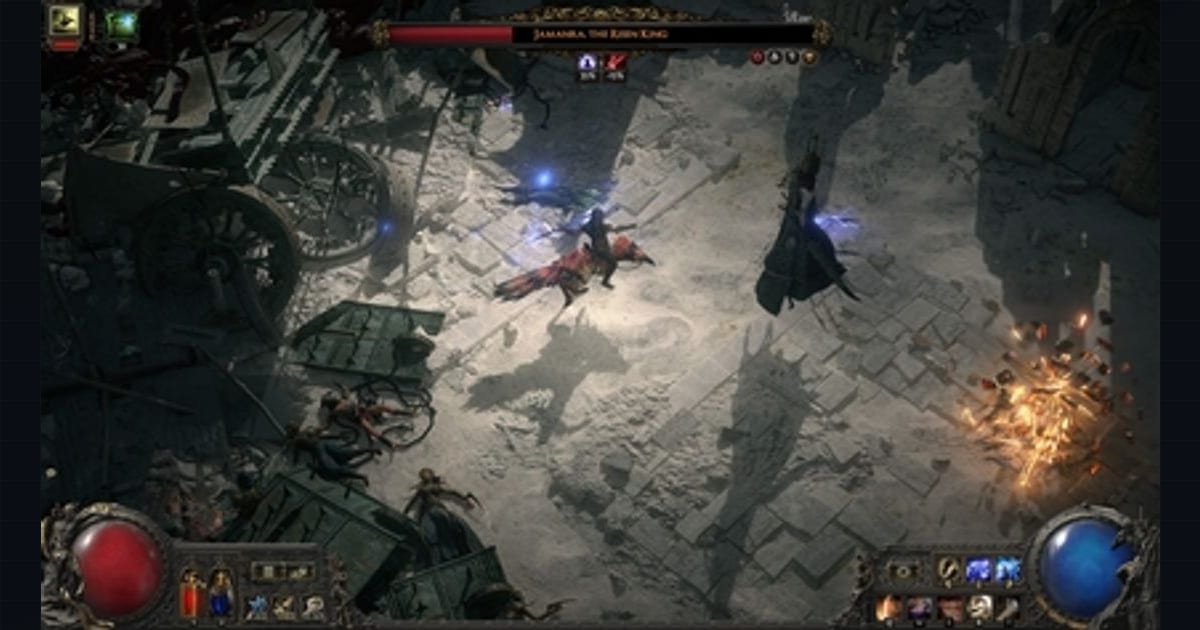
The Druid, added in Path of Exile 2’s The Last of the Druids update (0.4.0, December 12, 2025), is the game’s first Strength/Intelligence hybrid and its most systems-dense class: three animal forms, a new weapon type, a human spell kit, and four separate resource economies that all matter. This guide explains how the forms interact with Rage, Mana, charges, and Spirit, and how the Shaman and Oracle Ascendancies reshape the equation.
The core loop: one weapon, three forms
Everything starts with the Animal Talisman, a new weapon type that determines which form your basic attack uses: Bear, Werewolf, or Wyvern. Transformation happens automatically the moment you use a form-specific skill — game director Jonathan Rogers described the design goal as swapping forms without the player needing to think about it — and human-form skills that you lay down first (like volcano vents) persist long enough to support your animal-form combat.
An important design correction worth stating plainly: one persistent fan expectation was a “stag” form, but the shapeshift trio shipped as Bear, Werewolf, and Wyvern. Stag actually lives on the Huntress — the Spirit Walker Ascendancy added in 0.5.0 channels Stag, Owl, and Bear spirits. That class is not the Druid.
Bear form: the Rage engine
Bear is the tank of the trio — slower, bigger hitbox, and compensated with passive damage reduction to offset the larger target profile (a concession Rogers detailed in a pre-launch interview; hitboxes differ by form, but terrain collision doesn’t). Its gameplay spine is Rage, the Warrior-familiar resource that builds when you hit and decays out of combat:
- Maul, the basic attack, generates Rage on hit.
- Furious Slam and Rampage consume Rage for escalating area damage; Rampage near a Volcano spills extra lava projectiles.
- Walking Calamity is the flagship spender: a ring of fire around you that grants extra damage and Rage regeneration while active.
- Ferocious Roar is a meta gem — it breaks armor and can be socketed with other warcry gems (Seismic Cry for stuns and double slams, Ancestral Call for Karui flavor) so its effect adapts to your build. Talisman implicits (Rabid, Fury, Maji) roll +7–10 to maximum Rage as of the 0.5.0 adjustment.
Werewolf form: cold, marks, and minion Spirit cost
Werewolf is the speed option — hitbox close to human size, fast on all fours, and built around cold damage and Freeze. Where it interacts with the broader resource web:
- Its mark skill, Pounce, applies a mark that summons a wolf minion when the target dies — a genuinely rare bridge between the two economies. Wolf minions reserve Spirit, the persistent-buff/minion resource, so a pack-focused wolf build is juggling Mana for human spells, Spirit for the pack, and Moon skills on cooldown.
- Lunar Blessing, the marquee skill, transforms you into an Arctic Werewolf that’s faster, hits harder with cold, and — critically — consumes any Rage you banked in Bear form to extend its duration. This is the clearest designed form-cross-synergy in the kit: build Rage as a lumbering Bear, then burn it in a moonlit sprint.
- Arctic Howl drops chilled ground, adds cold damage, and buffs your wolf pack.
Wyvern form: Power charges from corpses
The Wyvern is the ranged/mobility flex form, swapping between talon slashes up close and fire breath at range. Its resource niche is Power charges: Devour eats corpses (and culls low-health enemies outright when they show the blue icon) to generate them, and a charged basic attack becomes a lightning-infused AoE. Rogers has emphasized the devour animation is tuned for quick use during movement.
The rest of the kit supports a hit-and-run caster-adjacent identity: Flame Breath lifts you over the battlefield raining fire (with an Energy Gain penalty as of 0.5.0), Rolling Magma lays bouncing fire orbs that detonate placed Volcanoes, and Oil Barrage coats enemies for ignites — with power-charged casts now consuming a charge approximately every 1.5 seconds to keep channeling. If you want a hit-and-run ES build, the Wyvern form grants improved energy shield recharge.
Human form: the glue and the Mana tax
Human form is where the Intelligence half of the hybrid lives, and where Mana becomes your bottleneck. The human spell kit is designed as setup for animal payoff: Volcano spits magma that detonates when a Bear slam or Wyvern Rolling Magma hits it; Thunderstorm soaks targets so Werewolf cold skills freeze more readily; Thrashing Vines and related plant skills scale with wet ground. Because these spells persist after you shapeshift, an optimal rotation is spells first, form second, Mana third — you front-load the resource-hungry casts, then let the animal form harvest them on Rage, charges, or basic attacks that cost nothing.
Spirit: the Druid’s quiet bottleneck
Spirit governs persistent buffs and minions, and the Druid touches it in three places: the Werewolf’s summoned pack, Spell Totems, and any Heralds/persistent buffs you weave in. Spell Totems — a fan-requested mechanic introduced in 0.4 — socket any spell into a casting totem, but typically require charges to place (three Endurance or Power charges, for instance). Bear and Wyvern generate those charges as a byproduct of normal form play.
The 0.5.0-era Ancestral Bond keystone reframes the entire trade: totem limit doubled, no charge requirement, but each totem reserves 75 Spirit.
Ascendancies: Shaman vs Oracle
Shaman is the Rage-caster. Its headline node, Druidic Champion, grants increased spell damage per point of Rage and removes inherent Rage decay — turning the Bear’s engine into a permanent damage buff for your human spells. Bringer of the Apocalypse rains elemental storms around you once you hit a damage threshold, and Wisdom of the Magi adds exclusive “Bonded” modifiers to Runes and Idols, pushing the class toward runic gear builds. Play Shaman if you want forms to feel like a staging ground for one overwhelming caster rotation.
Oracle is the wildcard. The Unseen Path reveals over 190 entirely new passive nodes sprinkled across the Druid section of the tree — a class literally unlocking real estate nobody else can see — while Fateful Vision shows you a vision of your “future self” mid-battle and rewards you with bonus damage if you match the skill sequence (its frequency scales with your equipped skill count, and cooldown recovery modifiers now control how often visages appear as of 0.5.0). Oracle favors reactive, adaptive play where your build reads the fight rather than dictating it.
Build path: practical priorities
- Pick a form as your primary, and let the other two supply utility (Bear for Rage banking, Wolf for cold setup, Wyvern for charges/corpses). The 0.5.0 Wyvern’s Breath notable — 40% increased Elemental Ailment Application after recently shapeshifting — is the tree’s strongest “swap often” incentive.
- Solve Spirit before it solves you. Minion wolves, totems, and buffs all want the same pool; know what you’re sacrificing before you spec a second reservation.
- Hybridize deliberately. The strongest setups the reveal highlighted — Shaman Rage-spell stacking, Werewolf cold pack play, Wyvern charge machine — all treat one form as the chassis and the other two as fuel.