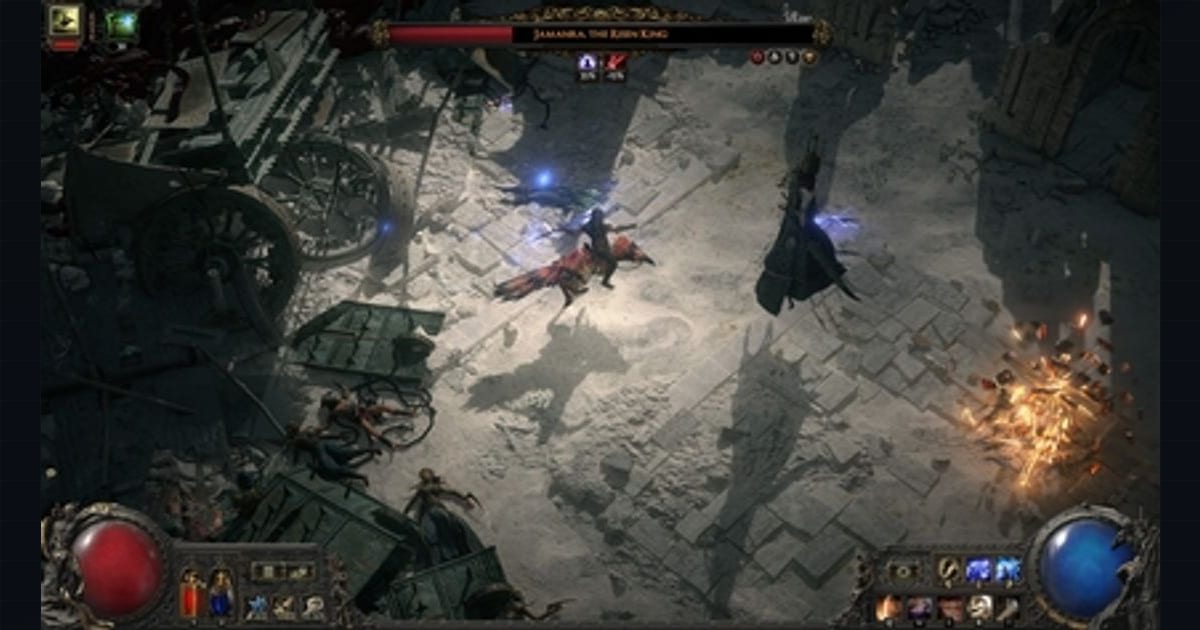
The Huntress is Path of Exile 2’s spear specialist, and spears are the weapon family most tuned around Bleeding. The problem with Bleeding as a boss-killer is that it is movement-conditional: a Bleeding target takes 100% extra damage while moving, and bosses do not move much. The fix is Aggravated Bleeding, which treats the target as moving for the duration of the debuff, and the cleanest way for a Huntress to Aggravate Bleeding on demand is the Rupture support gem, which Aggravates Bleeding on enemies you Hit while they are Heavy Stunned. This guide builds around that loop: stack Bleeding with a high hit-rate spear skill, build Heavy Stun rapidly so Rupture fires, and keep every Bleed Aggravated so the +100% damage multiplier is always on. Done right, it out-DPSes crit builds on the targets crit builds are worst against — stationary bosses.
How Bleeding and Aggravation work
Bleeding is a Physical damage-over-time ailment with a 5-second base duration. Its base magnitude is 15% of the pre-mitigation Physical damage of the Hit that inflicted it, per second, and it bypasses Energy Shield. Two rules make it strong: Bleeding deals 100% extra damage while the target is moving, and an Aggravated Bleed always treats the target as moving for its whole duration. Once a Bleed is Aggravated it stays Aggravated until it expires, and an effect that Aggravates Bleeding does so to all Bleeds currently on the target. The catch is that Bleeding needs an explicit source of chance to inflict — it does not roll from raw damage the way Ignite or Chill do — so a build has to stack “chance to cause Bleeding on Hit” from skills, supports, gear, and the passive tree before the ailment appears at all.
Aggravation is the lever that makes Bleeding a boss skill. Against trash, mobs die before the ailment matters; against bosses, the fight is long enough that a permanent +100% multiplier from Aggravation compounds. The Rupture support converts “the boss is not moving” from a weakness into a non-issue, because you Aggravate the stack yourself.
The Rupture loop
Rupture is a support gem whose effect is simple and powerful: supported skills Aggravate Bleeding on enemies they Hit while those enemies are Heavy Stunned. Heavy Stun is the deeper of PoE 2’s two stun states, built up by hits that deal enough damage relative to the target’s stun threshold. A high hit-rate spear skill — one that lands many small hits fast — does two jobs at once: it stacks and refreshes Bleeding (more Bleeds on the target, refreshed before the 5-second duration drops) and it builds Heavy Stun quickly so Rupture Aggravates the whole stack. The interaction is why hit-rate, not per-hit size, is the build’s tuning dial: you want enough hits per second to keep Bleeds up and to reach Heavy Stun on a boss in a reasonable window, then Rupture Aggravates everything on the bar.
Because Aggravation applies to all current Bleeds on the target, the play pattern is “stack to cap, stun, aggravate, repeat.” You are not trying to land one enormous Bleed; you are trying to keep a full stack Aggravated as close to permanently as your Heavy Stun uptime allows. On a boss that is the difference between a damage profile that spikes and one that holds.
Build path: skill and supports
The spear skill is the foundation. Spear skills that Inflict Bleeding on Hit and that hit rapidly are the fit — a dash-and-slash spear skill that applies Bleeding to everything struck, with a damage bonus for distance travelled, is the archetype. Socket Rupture as the aggravation support. Around it, layer bleed-amplifying supports:
- A “deep cuts” style support (more Bleeding magnitude, less Hit damage) trades the hit damage you do not need for stronger ailments, which is the right trade in a bleed build.
- A physical-only support (more Physical damage, no Chaos or Elemental) concentrates your damage into the type that feeds Bleeding magnitude, since only Physical contributes to Bleeding by default.
- A “concoct” style support that scales Bleeding magnitude off Life Flask charges consumed turns your flask economy into direct ailment damage on a burst window.
Tuning hit-rate matters more than tuning per-hit damage here. If your skill hits slowly but hard, you build Bleeds slowly and reach Heavy Stun slowly, so Rupture fires late. If it hits fast, you stack and stun quickly. Pick the support mix that keeps your hits-per-second high without gutting magnitude.
Passive tree and spear synergies
The tree and spear implicits do most of the magnitude and chance work. Spears carry implicits that make Bleeding you inflict deal damage 10-20% faster — shorter duration, same total damage, which means each Bleed tick hits harder and the stack refreshes more aggressively. Quivers add a chance to cause Bleeding on Hit. On the tree, stack chance to inflict Bleeding, increased Magnitude of Bleeding, and Bleeding Duration; the keystone that Aggravates Bleeding you inflict and shortens its base duration to one second while adding magnitude is the aggressive capstone — it makes every Bleed Aggravated by default and front-loads the damage, which pairs with Rupture as a redundant aggravation source so you are never dependent on a single trigger. Notables that increase Bleeding magnitude against Pinned or stunned enemies compound the stun-driven loop.
Gear follows the same plan: chance to cause Bleeding on Hit, increased Magnitude of Bleeding, and Bleeding Duration on jewellery and body armour, with spear implicits doing the “faster” work. Bleeding bypasses Energy Shield, so the ailment ignores one layer of boss defense by design — another reason it scales well on heavy targets.
Defense and the Staunching Charm
The build is physical and bleed-themed, which means you are also a target for Bleeding. The Staunching Charm grants immunity to Bleeding when it triggers on you starting to Bleed, and it is the standard answer for a build that will eat its own ailment type from reflect or Bleeding-on-Hit map mods. Carry the charms that cover the ailments you cannot outsustain, and lean on Life and resistances as usual. Because the build does not need crit investment to deal damage, the points you would have spent on crit multipliers go into life and mitigation, which is part of why the profile is stable on bosses where crit builds spike and die.
Why it out-DPSes crit on bosses
Crit builds convert burst into damage: they hit hard, but their damage is hit-driven, front-loaded, and dependent on crit rolls landing in a window. A Rupture-bleed Huntress converts uptime into damage: every second the boss stays Aggravated-Bleeding is damage that does not depend on a crit roll, does not miss, and bypasses Energy Shield. On a stationary boss the crit build’s variance hurts and the bleed build’s consistency wins; on a moving trash pack the opposite is true, which is why this is a boss-and-boss-rush profile rather than a clear-speed map build. The trade-off is real and worth stating: you give up screen-wide burst for single-target dominance, and the Rupture loop is what makes that trade worth taking.