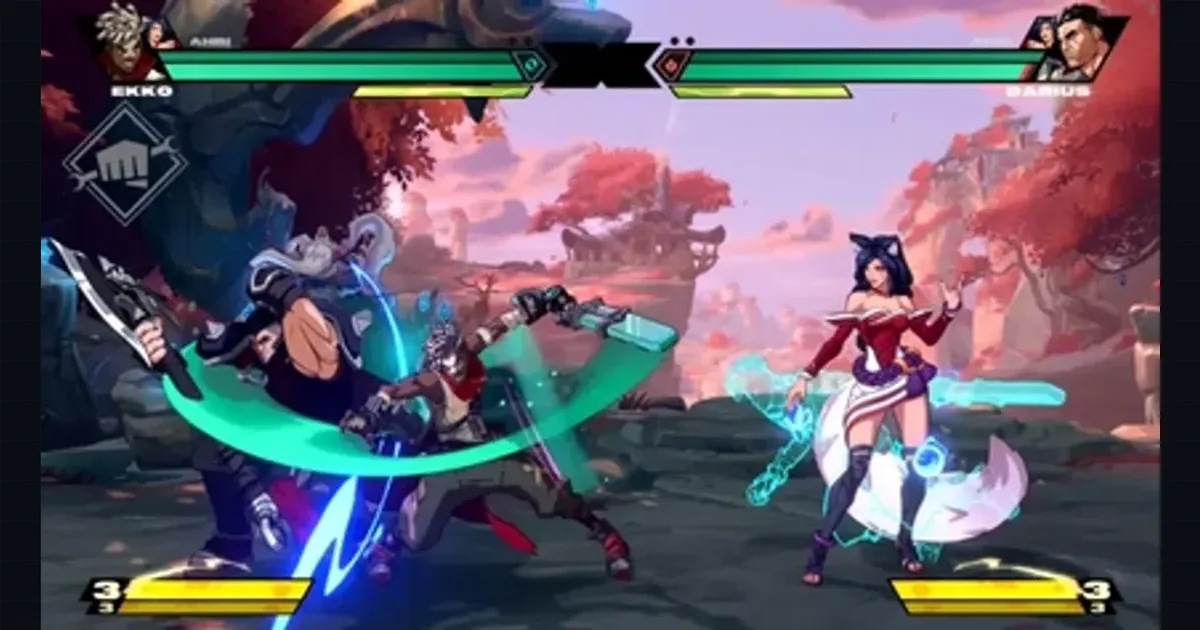
Riot Games’ entry into the fighting game space — long known by its codename Project L, since officially titled 2XKO — is one of the most heavily scrutinized unreleased fighters in the genre’s history. That scrutiny comes with good reason: the project is led by Tom and Tony Cannon, the founders of the Evo Championship Series and the original architects of GGPO rollback netcode. Every developer diary and gameplay snippet has been dissected by the competitive community for what it signals about Riot’s competitive intentions. This analysis breaks down the revealed gameplay footage, the tag-team assist mechanics shown so far, and what those systems imply for competitive 2v2 play.
What it covers: The revealed 2XKO footage, tag-team assist mechanics, and what they imply for 2v2 competition. Why it matters: Led by GGPO’s architects — every system choice signals Riot’s competitive intent. Who should pick this: Fighting-game players tracking Riot’s entry into the genre.
Origins and the 1v1-to-Tag Pivot
Project L was first announced in 2019 as a League of Legends fighting game set in the Runeterra universe. Early footage showed a traditional one-on-one fighter with simplified special inputs. In a November 2021 developer update, Tom Cannon confirmed the project had pivoted to a tag-team, assist-based format — a change the team later described as having happened roughly two years before the December 2022 mechanics deep dive.
Game director Shaun “Unconkable” Rivera later explained the reasoning directly: the tag format gave the team more room to create the kind of team-fight fantasy that League of Legends players already associate with the IP. One champion alone could only express so much; two champions coordinating opened up the combo extensions, pressure sequences, and comeback mechanics that Riot wanted to build around.
That pivot is the single most important design decision in the project’s history. It moved 2XKO out of the crowded 1v1 lane — where Street Fighter 6, Tekken 8, and Guilty Gear Strive already dominate — and into the tag-fighter space occupied by Dragon Ball FighterZ and the Marvel vs. Capcom lineage, a format with a smaller but fiercely dedicated competitive following.
Core Movement and the “Incentivize Action” Philosophy
Before the tag systems, Rivera laid out the foundational movement toolkit. Every champion has access to walk, run, dash, chain dash, jump, long jump, and super jump, with additional character-specific air mobility options layered on top. The stated design goal is that positioning itself is a mastery skill — getting your champion into the right place at the right frame is something players improve at over hundreds of hours.
The offensive philosophy was summarized as “incentivize action”: buttons should be worth pressing, and offense should be rewarding to execute and to watch. Rivera explicitly contrasted this with a mix of “big, clear defensive options” and “more nuanced systems that reward you for reading your opponent’s next move.” That framing — powerful offense paired with readable defense — is the same tension that every successful modern fighter negotiates, and it suggests Riot is not trying to reinvent neutral play so much as tune it toward aggression.
The Three Revealed Tag Systems
The December 2022 mechanics deep dive introduced three tag actions, all with placeholder names that Rivera noted could change before launch. Those three systems remain the backbone of everything shown since.
Assist Actions
Assist Actions are the bread-and-butter tag call. Each champion has two assist actions they can perform from off-screen, and the input can be held to produce a Charge Assist — a stronger variant with a wind-up cost. This mirrors the assist architecture of Marvel vs. Capcom and Dragon Ball FighterZ, where the off-screen character’s assist calls define neutral spacing, pressure strings, and combo extensions.
The two-assist-per-champion design is narrower than Marvel vs. Capcom 3’s three-assist selectable lists, which means each assist has to carry more functional weight. A Charge Assist adds a timing layer: holding the input telegraphs the call to the opponent, creating a read-based minigame around when to commit to the stronger version versus snapping out a fast, uncharged assist to cover space.
Handshake Tag
Handshake Tag is the swap mechanic. When both champions are on screen simultaneously, a Handshake Tag immediately transfers point control to the assist character. Combined with Assist Actions, this enables the tag-fighter staple of extending combos past the point character’s damage ceiling — the assist hits, the point tags out mid-string, and the incoming character continues the sequence.
Rivera specifically called out that Handshake Tag plus Assist Actions produces “powerful pressure sequences” and combo extension opportunities. In competitive terms, this is the system that determines the game’s combo damage ceiling and its mix-up depth. The more flexible the tag window, the more the meta will reward two-character coordination over solo execution.
Dynamic Save
Dynamic Save is 2XKO’s combo breaker, and it is the most competitively significant system revealed so far. At the start of each match, each team has access to a Dynamic Save. When the point character is being combo’d, calling Dynamic Save brings the assist champion on screen in an attempt to interrupt the opponent’s sequence. If successful, the results are “explosive” — Rivera’s word — meaning the opponent is blown back and the saved character regains control.
The critical caveat: Dynamic Save can be countered. If a player calls it predictably, the opponent can bait it, punish the incoming assist, and potentially convert the whiffed save into their own damage. This is functionally similar to Guilty Gear’s Burst mechanic or Killer Instinct’s Combo Breaker — a limited defensive resource that creates a second-layer guessing game inside the combo itself.
For competitive 2v2, Dynamic Save is the system that prevents the format from devolving into touch-of-death loops. Without a combo breaker, a 2v2 tag fighter risks the Marvel vs. Capcom 2 problem, where a single opening leads to an unescaped sequence that kills one character and immediately sets up the next. Dynamic Save gives the defender a tool, but one that costs a match-long resource and can be punished, which keeps it from being a free escape valve.
The Fuse System: Pre-Match Team Modifiers
Revealed in March 2024 and detailed by Riot designer Daniel “Clockw0rk” Maniago, the Fuse system is a pre-match selection that modifies how a team’s tag mechanics function. Four Fuses were shown:
- Double Down — allows the point character’s super to chain into the assist character’s super or ultimate, functioning like Marvel vs. Capcom’s Delayed Hyper Combo system. Maniago noted the damage output is high when resources are committed.
- Freestyle — permits two Handshake Tags within a single sequence, enabling advanced combo extension and pressure. Maniago described it as a fuse that shines when a duo is tightly synchronized.
- 2X Assist — grants two assist actions from a single assist call instead of one, doubling neutral coverage and pressure density.
- Fury — increases damage when a character’s health is low, a comeback-oriented fuse.
The Fuse system is the customization layer that differentiates team compositions beyond raw character picks. A Double Down team optimized for super-chain damage plays differently from a Freestyle team built around extended tag pressure, even with the same two champions. This is the system most likely to generate competitive metagame discussion, because fuse choice interacts with both character synergy and player skill — Freestyle demands more two-character coordination than Fury, which is a simpler damage multiplier.
Duo Play: The 2v2 Twist
The competitively novel feature is Duo Play, revealed in July 2023. In standard tag fighters, one player controls both characters. Duo Play allows two players to share a team — each piloting one champion, tagging in and out cooperatively. Rivera compared it to tag-team wrestling: one player on stage, the other waiting off-screen for the right moment to enter.
2XKO supports 1v1, 2v2 (one player per side controlling two characters), and the four-player 2v2 Duo Play format, plus 2v1 handicap matchups. The four-player mode is where the design ambition lives. Real-time coordination of Handshake Tags, Dynamic Save timing, and Assist calls between two humans introduces a communication layer that no major competitive fighter has pushed at scale. Street Fighter x Tekken attempted a version of this in 2012 with its Scramble mode, but never as a flagship competitive format.
The competitive viability of Duo Play hinges on whether two coordinated players can consistently outperform a single player piloting both characters. If Duo Play is strictly better, the tournament standard becomes two-player teams. If solo play remains competitive, both formats can coexist. Riot’s 2026 competitive circuit runs both formats — mixed-mode tournaments where a solo player can enter the same bracket as a duo, alongside dedicated duos-only events — so the question of which becomes the community standard is left to settle on the results board rather than dictated from above.
Netcode and Competitive Infrastructure
The Cannon brothers’ GGPO heritage means rollback netcode was integrated from the project’s earliest playable builds — Tony Cannon confirmed in an October 2025 developer post that GGPO was the first core tech integrated and that all daily playtests ran over real internet via a Las Vegas packet proxy from the start.
2XKO has since moved from peer-to-peer to a client-server architecture, a shift driven by the demands of four-player matches. In a 2v2 Duo Play game, client-server reduces per-player bandwidth to roughly one-third of peer-to-peer traffic and, critically, hides player IP addresses from opponents — eliminating the DDoS and doxxing attack surface that plagues peer-to-peer fighters.
The server acts as the authority for input, state, and time, which lets Riot balance the rollback “rift” across all four players rather than relying on pairwise synchronization. Additional infrastructure includes:
- Fair Play mode — if a player’s inputs arrive late, their last input is replicated and the match continues without stuttering for the other team. This is explicitly designed to neutralize lag-switch cheating and unstable connections, though Cannon noted it is still experimental and requires tuning.
- Riot Vanguard anti-cheat — kernel-level protection aimed at preventing auto-parry, whiff-punish scripts, and botting.
- Game Validation Server (GVS) — a cloud copy of every competitive match that validates game-state checksums against clients, enabling anti-cheat, skill rating via TrueSkill 2, and instant spectating through 50 KB save-state snapshots.
- Fixed 3-frame input delay applied identically online and offline, on PC and console, so offline muscle memory transfers directly to online play.
The fixed 3-frame delay is a notable competitive design choice. It is higher than some fighters’ offline baseline, but applying it universally means the offline-to-online gap that ruins combo timing in other games effectively does not exist here. Whether 3 frames feels responsive enough at the highest level is something the community will judge once the game is in wide competitive circulation; the fixed 3-frame value has held through the game’s launch and early competitive play.
What This Signals for Competitive 2v2
The revealed systems collectively point toward a competitive identity built on three pillars:
- Team-synergy expression over solo execution. Assist Actions, Handshake Tag, and the Freestyle fuse all reward two-character coordination. The combo ceiling is explicitly designed to be higher when both champions contribute than when one carries.
- A controlled combo-breaker economy. Dynamic Save gives defenders a resource-based escape that is itself punishable, preventing touch-of-death dominance without making openings free.
- Infrastructure-first competitive integrity. Client-server netcode, Vanguard, GVS, and Fair Play mode are not post-launch additions — they are foundational to the design, which signals Riot intends to run this as a serious competitive product with ranked, spectating, and tournament support from day one.
The open questions are the ones no reveal footage can answer: the final roster size, character balance at launch, whether Duo Play or solo 2v2 becomes the tournament standard, and how the Fuse system settles once top players optimize it. What the reveals do confirm is that Riot is not building a casual-adjacent League spinoff. The mechanics shown are calibrated for the competitive fighting game community the Cannons helped create, and every system revealed so far is a competitive system first.
Sources & further reading
- Riot Games — “How 2XKO Handles Online Play & Netcode” (Tony Cannon), https://2xko.riotgames.com/en-us/news/dev/how-2xko-handles-online-play/
- Riot Games — “Project L /dev: Finding our Game” (Tom Cannon, Nov 2021), https://www.riotgames.com/en/news/project-l-dev-finding-our-game
- EventHubs — “2XKO developers reveal how ‘Fuses’ work” (March 2024), https://www.eventhubs.com/news/2024/mar/21/2xko-developers-fuses-work/
- EventHubs — “Riot Games announces 2v2 Duo Play for Project L” (July 2023), https://www.eventhubs.com/news/2023/jul/26/2v2-duo-play-project-l/
- Polygon — “League of Legends fighting game Project L has 4-player 2v2 tag battles” (July 2023), https://www.polygon.com/23808892/riot-games-project-l-league-of-legends-fighting-game-duos-2v2/
- Riot Games — Tom Cannon leadership bio (2XKO / GGPO / Evo background), https://www.riotgames.com/en/who-we-are/riot-games-leadership/tom-cannon
Next read
- For the netcode lineage its leads built, see Rollback Netcode and Fighting Game Latency in 2026.
- For where the project stands now, see 2XKO: Active Development Ends December 2026.
- For the genre’s current flagship, see Street Fighter 6: How to Choose a Main.