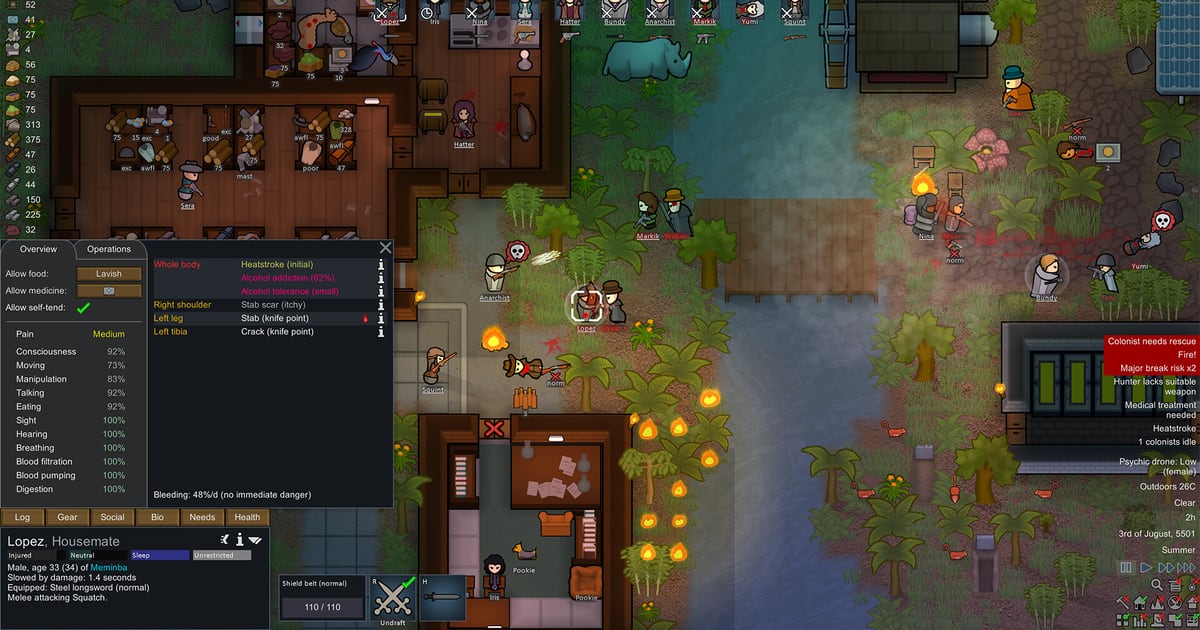
RimWorld’s fifth expansion, Odyssey, does not add another weapon tier or a new factionfaction. An in-game group or nation players can align with or fight against, with its own goals and reputation system. to negotiate with. It changes where a colony is allowed to exist. Released on July 11, 2025, Odyssey hands the player a gravship — a mobile base that lifts off, crosses the planet, and lands with the colonists, animals, and buildings still aboard. Ludeon Studios announced the expansion on June 11, 2025 and shipped it alongside the free 1.6 update for the base game.
That single change rewrites the opening hours of a run. In a classic colony you pick a tile and build outward from it forever. In Odyssey you can build a house that moves, and the map you leave behind is deleted unless you spend resources to keep it. This guide covers what the gravship is, the parts and hard limits that govern it, how a flying colony is sequenced in practice, and the ways the playstyle departs from the settlement loop RimWorld has shipped for over a decade.
What this covers: what Odyssey’s gravship is, the parts and hard limits that govern it, and how a mobile colony is built, fuelled, and flown. Why it matters: a gravship reorders progression. You expand range and lift capacity before you expand rooms, and the tile you leave is gone unless you plan for it. Who should care: returning RimWorld players, settlement-sim players weighing the DLC, and anyone who has only ever played the classic single-tile start.
What Odyssey changes
Ludeon framed Odyssey as an exploration-themed expansion that “expands your adventure beyond a single map.” The pitch is a colony that travels: a gravship described in the announcement as “a mobile colony of bedrooms, labs, hospitals, workshops, and everything else your colonists need.” You land anywhere, hunt for treasure, scavenge forgotten gravtech, and bring back souvenirs — the announcement’s example is a gold-plated charge rifle.
The expansion also adds several new biomes that change how and where you play, each with a distinct hazard: the glowforest is plunged into permanent darkness and supports only fungi; the scarlands are war-torn city ruins under constant toxic rain; the grasslands are fertile but drought- and fire-prone; the glacial plains bring blizzards and prehistoric wildlife; the lava fields shift as rivers of molten rock swallow whatever is in their path. A new landmarks system combines with those biomes to vary map generation further, and some landmarks add explorable underground maps such as the insect megahive. Heavy bridges allow a whole coastal town to be built on the water.
Wildlife expands too. Odyssey adds over 40 new animals that can be tamed, trained, traded, and eaten, per both the announcement and the Steam page. A sentience catalyst — an ultratech injection — can be used on animals that cannot normally be trained, enabling them to learn new tasks. The expansion’s endgame thread is the mechhive, an inhuman machine mind far above the planet that “pulses with hate”; when you reach it you choose whether to destroy it and shut down every mechanoid, or take control of its power.
How the gravship actually works
The core object is the grav engine. The wiki describes it as generating lift “by inverting and intensifying the effect of gravity in a field around itself.” Two limits follow from that description and they matter more than anything else about shipbuilding. The engine “can lift upwards, but does not produce forward thrust,” and it “can’t function far from a large gravity well like a planet, so it is useless for interplanetary travel.” A gravship flies across one world, not between them.
Everything you build rides on gravship substructure, which acts as the ship’s floor. Only substructure that is connected to the grav engine — and everything standing on it — is carried along when the ship launches. The absolute minimum for a flightworthy gravship, per the wiki, is one small thruster, one small chemfuel tank, a pilot console, and a grav engine with enough substructure to connect all of those parts. The wiki compares that bare-bones ship to a portable transport pod or a passenger shuttle: able to hop between world tiles, but not much more.
| Part | What it does | Hard limit |
|---|---|---|
| Grav engine | Generates lift and anchors the ship’s build area | Only one is obtainable at a time per playthrough |
| Gravship substructure | Acts as the floor; only connected substructure flies | 500 tiles at base, up to 2,000 with extenders |
| Small / large chemfuel tank | Holds the fuel each launch burns | Required for powered flight |
| Small / large thruster | Sets the ship’s maximum jump range | Max 4 small, 6 large |
| Pilot console | Assigns the pilot who flies the ship | Required for powered flight |
The size limit is the first wall a new shipwright hits. A grav engine initially supports up to 500 tiles of substructure, and all of it must be built within roughly a 19-tile radius of the engine. Grav field extenders raise both numbers: each one adds 250 supported tiles, up to a maximum of six extenders and 2,000 tiles total. Anything built beyond the supported limit is left behind at launch, along with anyone standing on it. There is, notably, no weight limit — the wiki notes any number of pawns and items can travel together, and buildings that cannot be uninstalled can come along.
Fuel, range, and the launch ritual
A gravship runs on chemfuel. By default each tile travelled consumes 10 chemfuel, with a minimum cost of 50 chemfuel per launch regardless of distance. A fuel optimizer — up to two can be installed — reduces consumption by 30% each, but the 50-chemfuel floor never moves.
Range is set entirely by thrusters. The wiki’s figures: small thrusters are capped at four, each adding 10 tiles of range, for 40 tiles total; large thrusters are capped at six, each adding 16, for 96 tiles. Together that is a maximum range of 136 tiles. Where you land matters as much as how far you can go. Landing on a plain tile that is not a quest site or faction base immediately creates a new colony; landing on a faction base initiates an attack with no option to trade.
Launches are not free of risk. After landing there is a cooldown before the next launch, and both the cooldown and the chance of a mishap depend on the quality of the launch ritual. The wiki lists four equally likely mishaps: a minor gravship crash that damages some buildings, a thruster breakdown that disables the thrusters until repaired, an overheated grav engine that extends the cooldown, and grav nausea affecting colonists for 2–5 hours. The 1.6.4566 update later added a “view range” option to the pilot console so you can check the ship’s range without running the whole launch process.
The flying colony versus a classic settlement
The difference from a classic run is not just mobility; it is what you have to plan for. The two playstyles pull in different directions, and the table below sets the main ones side by side.
| Dimension | Classic single-map colony | Gravship flying colony |
|---|---|---|
| Home map | One tile, kept indefinitely | Deleted on launch unless a grav anchor is installed |
| Expansion | Build outward across the map | Extend the ship: 500 tiles at base, +250 per grav field extender |
| Travel | Caravans, shuttles, transport pods | The whole colony lifts and lands, with no weight limit |
| Wealth profile | Rooms and stockpiles | Every ship tile costs steel and gravlite panels, inflating colony wealth |
| Threat | Raids arrive at the base | Some raid types can spawn or drop inside the ship itself |
The most consequential row is the first. Without a grav anchor installed, a gravship that leaves a tile deletes that map, and any pawns left behind are lost. The anchor — which can be built once Basic gravtech is researched and cannot be placed on the ship itself — prevents the local map from being destroyed and also stops temporary maps from being abandoned. For a player who wants both a permanent base and a ship, it is not optional.
The wealth row is easy to underestimate. Because every ship tile requires steel and gravlite panels, a gravship-focused colony is worth a lot of wealth, which scales up the size of incoming raids. The wiki’s guidance is blunt: on lower difficulties that is manageable, but on “Losing is Fun” and above, wealth management becomes a real concern.
Sequencing a gravship run
A gravship is gated behind two resources, and knowing which to chase first saves a lot of dead time.
Gravlite panels are the material for substructure and most gravtech buildings. They are crafted at a fabrication bench once Advanced gravtech is researched, from one plasteel and five vacstone blocks, taking 30 seconds of work and a crafting skill of 8, per the wiki. Vacstone blocks themselves can be obtained from orbital asteroids, which means the early game pushes you toward limited off-world trips. Panels are also handed out by the initial grav engine quest and later gravship quests, and can be looted from sealed crates.
Gravcores are the rarer resource. The wiki describes a gravcore as “an ultratech device that generates an unstructured graviton field,” useless on its own but used to construct three gravtech buildings: the grav field extender, the signal jammer, and the gravcore power cell. Because there is a limit of six field extenders and one signal jammer, the wiki’s advice is to spend the first few gravcores on field extenders to grow the ship’s build area, then branch into power cells. Extenders are the item that unlocks everything else, so they come first.
The signal jammer is deliberately low priority in that order — it is only needed to enter the mechhive and to raid the traders’ guild platforms, and the mechhive is the final stage of the gravship quest. The gravship itself is obtained either from The Gravship starting scenario or from a quest that drops a grav engine onto the map after a mechanoid ship crashes; the wiki notes that quest “will always appear early into a new game,” and that only one grav engine can exist at a time.
Space, vacuum, and keeping people alive
Orbit is where the design constraints bite hardest. Ludeon’s announcement describes space as harsh — “no oxygen, sub-zero temperatures, and a single hull breach can be lethal.” Airtight walls protect colonists and pets from the vacuum; oxygen pumps provide life support; airlocks with vac barriers prevent depressurization; and colonists who leave the hull need vac suits. Heaters matter too, since the cold is as dangerous as the void.
The 1.6.4566 update tightened several of these edge cases. Colonists will no longer automatically remove vacuum-resistant apparel while in a dangerous vacuum — a change that prevents an avoidable death. The update added a vacskin gland prosthetic from the Empire that protects against vacuum, available to players who own both Odyssey and Royalty. It also rebalanced the starjack xenotype with a “low gravity adapted” gene that makes them faster and better workers in orbit, and let mechanitors summon mechanoid bosses while in space.
One structural fix is worth calling out for anyone starting the scenario: the gravship scenario now requires you to begin with at least one colonist capable of intellectual work. Ludeon added that requirement, in its words, to prevent you “from becoming immediately stranded.”
What the 1.6 update changed for ships
The free 1.6 update shipped alongside Odyssey and is the reason the base game feels different even without the DLC. The headlining item is performance: Ludeon’s announcement says a major part of 1.6 is optimization for late-game colonies, with the pathfinding system now “fully multithreaded and batched” and the lighting system multithreaded. On the studio’s development machines, version 1.5 launched in 18.57 seconds with all expansions; version 1.6 launched in 4.66 seconds, and that was with one more expansion loaded.
For gravship players specifically, 1.6.4566 added a new gravship launch interface that can bring colony animals and mechanoids aboard and remove neutral pawns before takeoff, which makes launches cleaner and prevents accidental kidnappings. The same update reduced the generation time for a 100%-coverage world by about 40%, made gravships stop clearing pollution when they land, raised the final mechhive raid’s strength by 50%, and set the reward for destroying the mechhive at +50 reputation with all factions plus a larger, longer-lasting moodlet for the colonist who did it.
If you are coming from a game like Against the Storm, where the progression is a fixed ladder of hearth upgrades, Odyssey inverts the habit: the ship’s capacity, not the settlement’s tier, is what you are levelling. The practical summary is short. Get a grav engine, keep it connected to everything by substructure, respect the 500-tile and 19-tile-radius limits until extenders arrive, bank enough chemfuel for a 50-chemfuel minimum per hop, and install a grav anchor before you fly away from anything you want to keep.