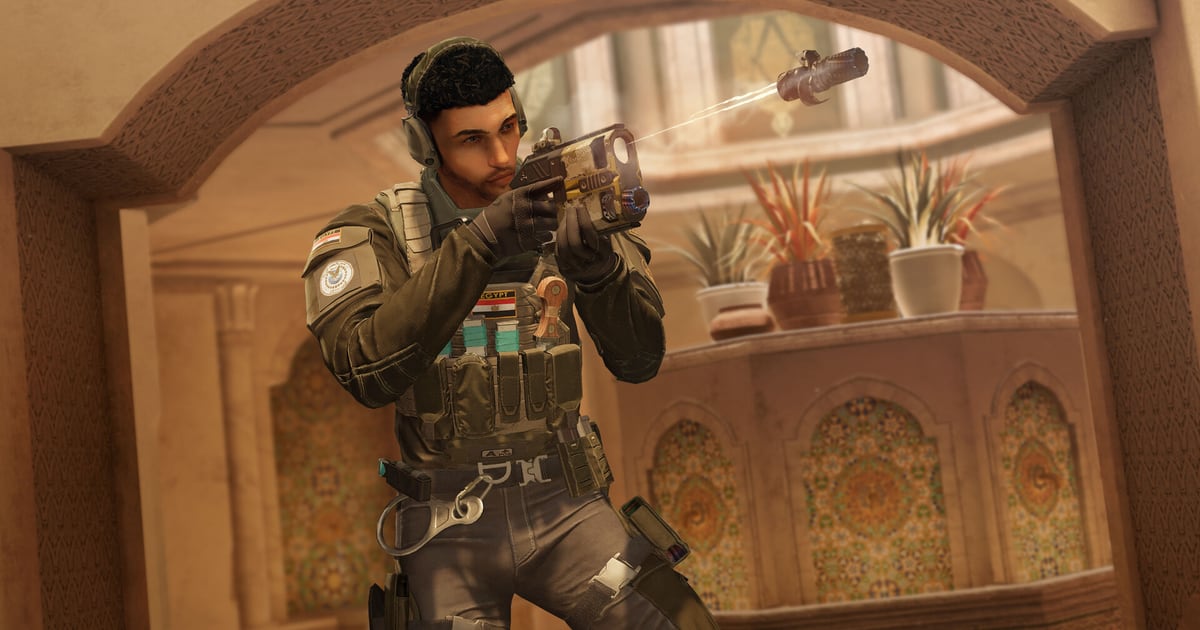
Rainbow Six Siegesiege. A timed, large-scale attack on a settlement — attackers try to destroy it, defenders try to hold it.’s Year 11 Season 3 has been live since September 1, 2026, and it shipped a Defender whose entire design brief is one class of opponent: shield operators. Operation Split Fire added Noor and his Horus Lance Launcher, and the mid-season balance patch that arrived on October 15, 2026 moved almost every value on that gadget at once. For anyone who pushes with a ballistic shield, or defends against one, the October patch changed the arithmetic of the matchup.
What changed: Y11S3.2 raised Noor’s Horus Lance guard break from 30% to 100%, cut drilling time to 1.5 seconds from 2, cut equip time to 0.4 seconds from 0.9, and raised direct impact damage to 80 from 50. Why it matters: the gadget was already the season’s dedicated shield counter; the patch removes the reaction window a shield operator had to interrupt it. Who should care: Siege players on both sides of a shield push, and anyone tracking how Ubisoft tunes a hard-counter gadget across a season rather than at launch.
What the Horus Lance actually does
Ubisoft’s official Operation Split Fire page describes Noor as “designed to counter Shield Operators,” and describes the gadget plainly: the Horus Lance Launcher “can fire 5 projectiles that pierce shields and destructible surfaces before erupting into flames.” The same page notes the projectiles work through floors and ceilings and from adjacent rooms, and lists what they can be aimed at — Ballistic Shields, surfaces, and devices such as Castle’s Armor Panels and Azami’s Kiba Barriers.
That description frames the gadget as denial first and damage second. The counter it was written for is the shield-led push: a Montagne, Blitz, Fuze or Osa committing to a doorway expects to absorb incoming fire while the rest of the attacking team closes. A projectile that pierces the shield, attaches, and then burns removes the assumption that the shield is a reliable wall.
The launcher is not the only thing Noor brings. Ubisoft lists a Commando 9 assault rifle and an ALDA 5.56 light machine gun as his primary options, the 1911 TACOPS and Bailiff 410 as sidearms, and the Deployable Shield and Barbed Wire as his gadgets — a loadout that leans toward sitting on a site and making attackers solve a problem rather than roaming.
The Y11S3.2 values, side by side
Ubisoft shipped Y11S3.2 on October 15, 2026 as the season’s mid-season balance patch; MP1ST reports that console players see it as update 3.51 / 1.000.157. Four of the patch’s headline entries belong to the Horus Lance Launcher, and UpdateCrazy’s summary of the same notes lists the identical values.
| Horus Lance attribute | Before Y11S3.2 | After Y11S3.2 | What it changes |
|---|---|---|---|
| Drilling time on ballistic shields, soft surfaces and solid non-destructible surfaces | 2 seconds | 1.5 seconds | The projectile attaches faster to whatever it lands on |
| Guard break strength on projectile impact against ballistic shields | 30% | 100% | A direct hit now applies the full guard-break value named in the patch |
| Equip animation | 0.9 seconds | 0.4 seconds (quickdraw animations) | Faster switch to the launcher inside a firefight |
| Direct impact damage against an operator | 50 | 80 | Absorbing a hit costs more health |
| Projectile hitbox | previous model, flagged as oversized in the bug list | updated for accuracy and consistency | Fewer unintended hits, more reliable on-target placement |
| Damage against shield operators during their shield-removal animation | — | now enabled | Closes the animation window a shield operator could use |
Two of those entries pull in opposite directions, and the patch notes keep them separate. The balance entry says the hitbox was “updated for better accuracy and consistency”; the bug-fix entry says “the hitbox for Noor’s Horus Lance projectiles is too large” was fixed. Read together, the October pass made the projectile land where it is aimed while removing some of the accidental generosity it had before.
The September 22 patch was the counterplay map
Y11S3.1 landed on September 22, 2026, and Ubisoft’s patch notes for it are mostly refinement work — small moves like Buck’s Skeleton Key total ammo rising to 36 from 31, Castle’s Armor Panel taking 10 melee hits instead of 9, Maestro’s Evil Eye battery life going to 9 seconds from 8, and the M1014 and SPAS-15 each gaining 2 points of base damage.
The interesting part is the bug list, because almost every entry documents a way the Horus Lance and shield operators were interacting badly:
- Montagne’s Le Roc Shield auto-retracting when hit by the Horus Lance.
- Shield operators being unable to throw devices after being hit by it.
- Shield operators taking no damage when pressing an embedded Horus Lance against a wall.
- Operators continuing to move while hit.
- Flames failing to damage opponents when deployed on top of a door frame.
- Flames travelling the wrong direction on Blackbeard’s H.U.L.L Adaptable Shield while rappelling.
- A “Remove Horus Lance to perform action” tip appearing randomly during a match.
For a reader trying to understand how the gadget behaves in October, that list is the useful artifact. A launch gadget that a shield player can remove while holding a secondary gadget, or that stops dealing damage when pressed into geometry, is not yet a hard counter — it is a work in progress. Ubisoft spent September stabilising the interactions and then spent October raising the numbers. The same pattern shows up in Siege’s wider season cadence, where a launch window and a mid-season correction do different jobs.
The rest of the October 15 patch
Noor was not the only operator touched. MP1ST and UpdateCrazy report the same set of changes:
Tachanka’s Shumikha Launcher gained a firing mode that triggers Incendiary Grenades on impact, giving him an alternative to the existing bouncing behaviour. Solid Snake’s Soliton Radar MK III dropped to 3 precision-mode charges from 4. Valkyrie picked up the Glaive-12 as a secondary weapon. In the refinement bucket, Capitão’s fire-bolt expansion delay fell to 0.9 seconds from 1, Clash’s slowdown on retreating enemies rose to 10% from 5%, and Osa’s Talon-8 Clear Shield had its deployment restrictions reduced. Fire damage rose to 14 HP from 12, a change the notes say affects Capitão, Dokkaebi, Goyo, Noor, Tachanka and Gas Pipes. BU-GIs now become entangled in Barbed Wire, stopping and self-destructing, and defenders no longer lose points for destroying their own wire.
UpdateCrazy also notes that the Y11S3.2 mid-season designer’s notes carry the usual win-delta-versus-presence and operator-ban statistics split between PC and console, which is the data set to read if the question is whether the Horus Lance changes moved operator presence rather than damage numbers.
Legend Division and the Villa rework
Operation Split Fire was not only a balance season. The official page describes Legend Division as a SoloQ-only Ranked playlist for the game’s highest-rated players, opening mid-season, with eligibility gated on current Champion rank, Platinum rank the previous season, a positive reputation standing, and completed security requirements. Those requirements run through what Ubisoft calls the ShieldGuard Secure Platform: Secure Boot, Windows Memory Integrity (HVCI) and TPM2.0 fully enabled on PC, temporary administrative privileges to verify them, and two-step verification via an authenticator app.
That is the same integrity stack that modern anti-cheat designs depend on, examined in more detail in our kernel anti-cheat architecture guide. Legend players get a dynamic banner showing their standing, and Ubisoft says the top 100 receive a charm next season that displays their final ladder position — kept only if they stay inside the top 100.
The other headline structural change is Villa. Ubisoft calls it the first “targeted map update,” a format that touches specific areas instead of rebuilding a whole map: the basement and garage were redesigned, the Living Room / Library bomb site moved downstairs to create an alternative objective, and the garage became interior rather than exterior, changing how attackers approach from the east.
What the October values change for shield play
Strip the patch down to the shield matchup and three of the four numbers point the same way. Drilling time at 1.5 seconds instead of 2 and equip time at 0.4 seconds instead of 0.9 both shorten the span in which a shield operator can react before the projectile attaches. Guard break at 100% instead of 30% means a single direct impact now applies the value the patch defines as full guard break, where the earlier figure applied less than a third of it. Impact damage at 80 instead of 50 raises what a direct hit costs on top of that.
The fourth change is the one that closes a door rather than opening one. Shield operators previously had a removal animation that the launcher could not punish; after October 15, the notes state the Horus Lance can damage them during that animation. Combined with the September fixes that stopped the gadget’s damage from being cancelled by geometry or a weapon swap, the October patch is best read as finishing a gadget rather than launching one.
Whether that makes Noor oppressive is a question the numbers here cannot answer on their own. The mid-season designer’s notes on operator bans and win delta are the place to look, and Ubisoft has not published a figure for how the launcher’s changes moved them.
One practical note for anyone re-reading older guidance: values from the September season launch are stale on all four of these attributes. Any guide written between September 1 and October 15 quotes the pre-3.2 numbers, and the Horus Lance was buffed in every headline category the patch touched.