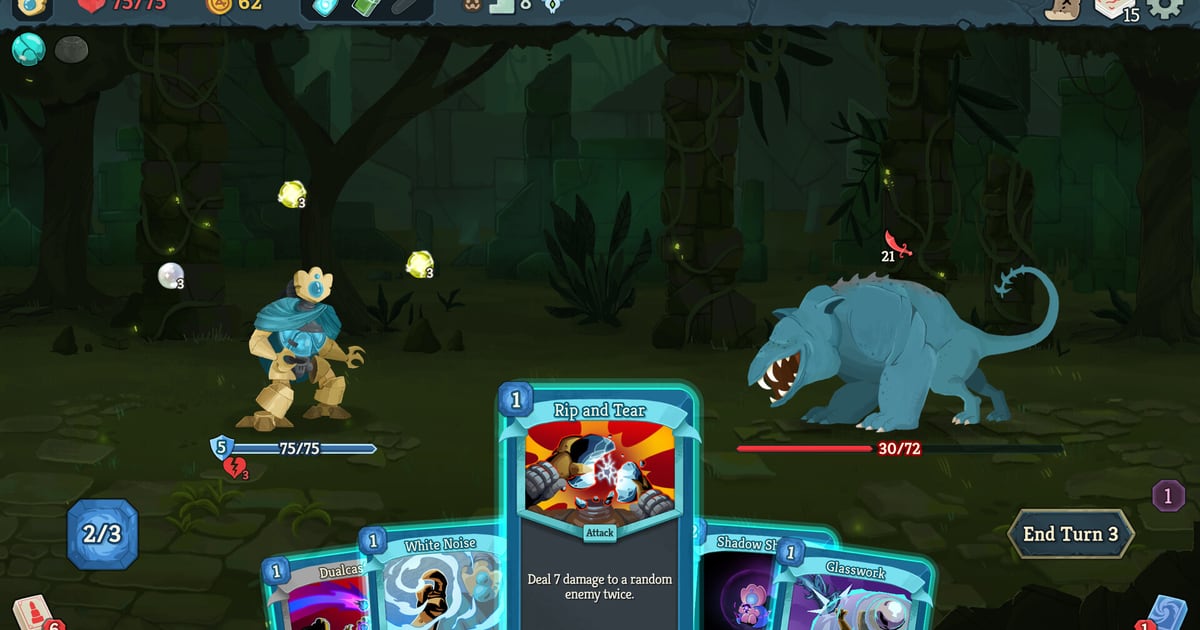
Slay the Spire 2 arrived in early access on 5 March 2026, and it did not slip out quietly. Mega Crit said the sequel had sold three million units and seen more than 25 million runs attempted in its first week, per the studio’s March 2026 Neowsletter. Seven months later, the game’s clearest break from the 2019 original is not a new card or a new act — it is the option to bring three friends along. Here is how co-op actually works, who the five playable characters are, and what Mega Crit’s roadmap has shipped and still owes.
What this covers: Slay the Spire 2’s four-player co-op — turn structure, enemy scaling, rewards and progression — plus the full five-character roster and the current state of the early access roadmap. Why it matters: co-op changes what a card, a relic and a Vulnerable stack are worth, and the character you pick shapes what your whole party can do. Who should care: groups already climbing together, and solo players deciding whether to buy in now or wait for the 1.0 content.
Co-op is four players, online, friends-first
The scope comes first, because it is easy to misread. Slay the Spire 2’s co-op supports up to four players, and it is online-only: there is no local or couch co-op and no public matchmaking queue, as IGN’s guide and PC Gamer both note. One player hosts a multiplayer save and the others join through Steam, so everyone needs to be on the host’s friends list (PC Gamer). Duplicate picks are allowed — “you can all be The Silent,” PC Gamer points out — and the host owns the save, which means a party cannot drop someone in later to fill an abandoned slot (PC Gamer).
The run is shared in some places and private in others, and that split is the most useful thing to learn first.
| Element | How it works in co-op |
|---|---|
| Map path | Shared — the party votes; an unresolved vote is decided at random, weighted by the votes |
| Enemy encounter | Shared — everyone fights the same enemies |
| Deck, gold, energy | Individual — each player builds and spends alone |
| Battle rewards | Individual — each player is offered their own |
| Merchant inventory | Individual — every player sees their own cards, relics and prices |
| Rest-site options | Every option is open to everyone, plus a Mend option that heals a teammate |
| Treasure chest | One relic offered per player; a tie is settled by an automated rock-paper-scissors duel |
| Ascension | A separate multiplayer ladder, capped at the lowest level unlocked in the lobby |
That merchant row is worth pausing on. Rather than a shared party shop, each player’s Merchant is generated separately, so co-op never turns relic and card buying into a bidding war — the competition sits in the treasure chest, where only one copy of each relic exists and a rock-paper-scissors game decides the contested pick. The Slay the Spire 2 Wiki’s multiplayer page documents both behaviours.
Combat: one turn window, four players
All players act during the same turn window, and the enemy turn does not start until every player has ended theirs; a player who has already ended can step back in while a teammate is still acting (wiki.gg). Sequencing becomes a genuine decision rather than a formality: the wiki notes that most debuffs applied to an enemy affect every player, so an enemy made Vulnerable “takes more Attack damage from all players.” IGN’s guide makes the same point from the other direction — apply Vulnerable and Weak at the start of the turn so the whole table can cash in.
Enemies scale in health, not in attack power. Their attacks land on the whole party at once and each player blocks individually, but the damage numbers themselves do not rise (wiki.gg). That asymmetry is why a coordinated group can feel stronger than four solo runs stacked together: the party pools its blocking and its damage while the enemy spreads its unchanged hit across four health bars. Death is forgiving — a player downed during a fight is revived at the next floor with 1 HP as long as someone survived (wiki.gg) — and rest sites add a Mend action that heals another player for 30% of their maximum HP (wiki.gg; PC Gamer).
Multiplayer also adds cards that do not exist in solo play. The wiki lists five character-specific multiplayer cards per character plus twelve Colorless ones, all built around effects that reach across players. IGN singles out cards such as Gang Up and Flanking as worth calling out to teammates before you commit a turn.
How the Spire scales with the party
Enemy HP is multiplied by the player count and then by an act multiplier. The wiki gives those act multipliers as 1.1 for Act 1, 1.2 for Acts 2 and 3 and 1.3 for the Act 3 boss:
| Players | Act 1 | Acts 2 and 3 | Act 3 boss |
|---|---|---|---|
| 2 | ×2.2 | ×2.4 | ×2.6 |
| 3 | ×3.3 | ×3.6 | ×3.9 |
| 4 | ×4.4 | ×4.8 | ×5.2 |
Enemy Block scales too — a flat ×2 for a two-player party, and the HP multipliers for three and four players (wiki.gg). Several enemy buffs get their own formulas as well: Artifact becomes Amount + PlayerCount − 1, Slippery is multiplied by the player count, and Plating uses Amount × ((PlayerCount − 1) × 2 + 1) (wiki.gg). Acts are one floor shorter in co-op, with the wiki placing the Act 1 boss on floor 16, Act 2 on floor 31 and Act 3 on floor 45.
The five playable characters
The roster is five characters. Three return from 2019’s Slay the Spire — the Ironclad, the Silent and the Defect — and two are new: the Regent and the Necrobinder (Steam store page; Wikipedia). Game Informer, covering the co-op reveal, noted the line-up “only excludes the Watcher” among the first game’s cast, and that early access leaves room for her to reappear.
| Character | Status | Signature mechanic | Starting HP | Starting relic |
|---|---|---|---|---|
| Ironclad | Returning | Strength scaling, self-damage, Exhaust | 80 | Burning Blood |
| Silent | Returning | Poison, Shivs, the new Sly keyword | 70 | Ring of the Snake |
| Defect | Returning | Elemental orbs, channelled and evoked | 75 | Cracked Core |
| Regent | New | Stars (a persistent second resource) and Forge | 75 | Divine Right |
| Necrobinder | New | Osty the companion, Doom, Souls | 66 | Bound Phylactery |
Starting HP and relics come from the Spire Codex character database; the mechanic summaries are drawn from Wikipedia, GamesRadar+ and IGN.
Unlocking is a straight chain, and per GamesRadar+ a failed run still counts: play any run as the Ironclad to unlock the Silent, the Silent to unlock the Regent, the Regent to unlock the Necrobinder, and the Necrobinder to unlock the Defect.
The two newcomers
The Regent is built around Stars, a second resource that does not behave like Energy. Energy refills to your maximum each turn, but the Star pool persists across turns, GamesRadar+ explains, so a Regent player is always choosing between spending now and banking for one large turn later. The class also Forges a Sovereign Blade and works with Colorless cards and minions (GamesRadar+; Wikipedia).
The Necrobinder summons Osty, a skeletal hand that acts as a wall absorbing damage after Block breaks; if Osty is already on the field, further “summon” effects raise his maximum HP instead (GamesRadar+). Her cards add Soul cards that draw without spending Energy, and she stacks Doom, which IGN describes as a debuff that “instantly kills the target when its stacks of Doom reach or exceed its current HP,” resolving at the end of the enemy’s turn — a slower, block-piercing Poison. Her 66 starting HP is the lowest on the roster (Spire Codex), which is why IGN warns against a party of low-HP picks.
The three returning characters
The Ironclad keeps the first game’s shape: Strength scaling, self-damage used as a resource, and Exhaust payoffs, backed by a starting relic that restores 6 HP after every battle (GamesRadar+), which IGN notes “gives room for some reckless turns.” The Silent still wins on Poison — damage that bypasses Block — and on Shivs, but adds the Sly keyword: weaker cards that play for free when discarded (GamesRadar+). The Defect channels elemental orbs that fire at the end of its turn, defaulting to three slots with any extra orb evoking the front of the line; GamesRadar+ counts five orb types, and IGN calls the class flexible but tricky to build.
What the early access roadmap says
Mega Crit published an early access roadmap in April 2026 and pointedly refused to date it. In that Neowsletter, co-founder Casey Yano answered the “where are the dates” question himself: “It’s not what works for us,” he wrote, adding that “Exacting deadlines produce sloppy uninspired work and I don’t want Sloppy Spire 2, I want Slay the Spire 2.”
By the August 2026 Neowsletter, several items had been crossed off. Its “added” list includes Steam Workshop support, initial scaffolding for the Bestiary, the Badge/Score system, Traditional Chinese and Indonesian localisation, and new cards and relics. The “actively working on” list names experimental game modes, an alternate Act 2 and a new character — and the studio said it would space beta updates further apart to focus on those larger pieces.
| Roadmap status (August 2026) | Items |
|---|---|
| Shipped | Steam Workshop support; Bestiary scaffolding; Badge/Score system; Chinese and Indonesian localisation; new cards and relics |
| In progress | Experimental game modes; alternate Act 2; a new character |
| Still listed | Alternate Act 3; more cards, events, relics and potions |
| Further off | Console and mobile ports; Steam Achievements and Trading Cards; “True Victory” and its content |
The cadence has moved with those priorities. The May 2026 Neowsletter records the switch from weekly to bi-weekly beta patches and the removal of the Doormaker boss, replaced on the beta branch by a new boss named Aeonglass. The March Neowsletter, written a week after launch, had already introduced the beta branch and put multiplayer quality-of-life features on the list.
On the questions co-op players ask most, Yano has been candid. Asked in the April Neowsletter about matchmaking and in-game chat, he called matchmaking “a bit up in the air at this time,” saying that pairing strangers “brings a whole host of headaches that a smaller team wouldn’t want to deal with.” In-game chat is possible, he added, but “I don’t think we’ll do voice. Unless something horrible happens to Discord.”
The scale is settled even where the timing is not. Mega Crit’s March Neowsletter reported three million units sold and more than 25 million runs in week one; the April letter said the community had passed roughly 145 million runs in the first month. On more characters, the roadmap only ever says “a new character” — though Wikipedia, citing a 2026 Academy of Interactive Arts & Sciences talk with Yano, states that two additional characters are in development and have been described as “weird” in gameplay terms. For a look at how another roguelike handled the step out of early access, our Hades II 1.0 report is a useful comparison.
Co-op is a real mode, not a promise
Seven months into early access, Slay the Spire 2’s co-op is a working, feature-complete mode rather than a trailer bullet point: four players, one shared map, individual decks and shops, scaled enemies and a separate Ascension ladder. The roster is smaller than the first game’s eventual cast but deeper per character, with the Regent and the Necrobinder carrying genuinely new systems. What remains open is the roadmap’s second half — alternate acts, a new character, a true ending — and Mega Crit has been explicit that it will not promise dates for any of it.