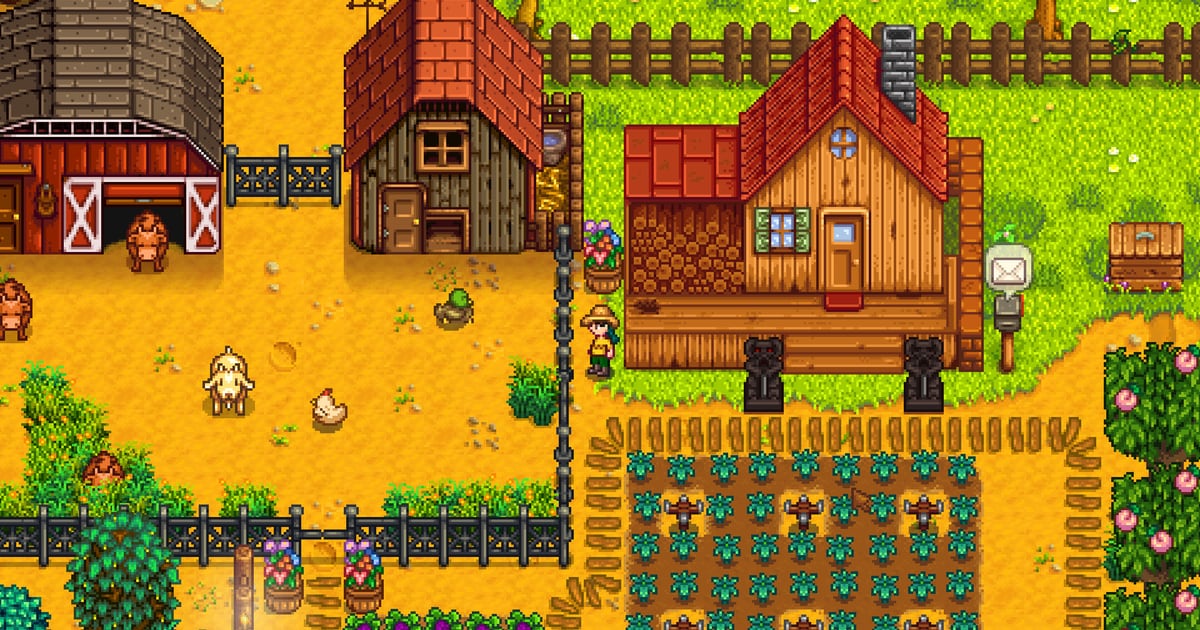
Update 1.7 is the loudest question around Stardew Valley right now, and it is not the question a year-one farm asks. Our 1.7 tracker already sorts what ConcernedApe has confirmed from what the rumour mill invented. This piece does the opposite job: it assumes nothing in 1.7 is in your game, and treats the first year as a 112-day budget where every coin competes with every other coin.
That means real numbers — seed costs, base sell prices, growth days, the wiki’s profit-per-day column, and the price tags on upgrades people buy too early. Where a source gives no figure, this guide supplies none.
What this covers: a season-by-season year-one plan built from the wiki’s seed prices, base sell prices and growth times, the upgrades that quietly cost you a summer harvest, and which Community Centre rooms actually pay back. Why it matters: the first year has fixed deadlines — the Egg Festival’s strawberry seeds, the Farming level that unlocks sprinklers, the 28-day season wipe — and a 10,000g purchase in spring is a summer planting that never happens. Who should care: returning players starting a fresh 1.6 farm, and anyone who has finished year one broke with a gold hoe and no greenhouse.
The version this guide assumes
As of 29 October 2026 there is no official release post for 1.7. The newest entry on the official blog is dated 9 July 2026 and announces a crochet book; the ten-year anniversary post from 26 February 2026 says only that “there’s a new update in the works”; and the wiki’s Version History page — reachable from the official site’s own Wiki link — still opens at 1.6.15, released 20 December 2024, with the console patch notes of 12 February 2025 (1.6.15.1) describing a sync “with the latest on PC”.
So the plan below assumes the 1.6 content set: no new farm type, no extra marriage candidates, nothing from 1.7. None of it depends on a feature that has not shipped.
On sourcing: stardewvalleywiki.com rejects direct requests from this machine, so wiki pages cited here were read through the r.jina.ai reader against the canonical URL.
The year-one clock, in one table
Four seasons of 28 days. The wiki is blunt about the transition: crops out of season wither on the 1st, and fully grown crops waiting to be harvested wither too. What survives is a multi-season crop still in its window.
| Season | What the calendar hands you | The crop decision | The deadline that actually bites |
|---|---|---|---|
| Spring | Egg Festival mid-month; starting tools; 15-crop crow threshold | Parsnip cash, then potato, then cauliflower for the bundle | Strawberry seeds are festival-only, so the planting day is fixed |
| Summer | Best per-day crop of the year; Quality Sprinkler needs Farming 6 | Blueberry as the volume crop, melon for the Quality Crops bundle | Sprinklers must exist before you scale, or watering eats the day |
| Fall | Cranberries and pumpkin; the last outdoor season | Cranberries for repeat harvest, pumpkin for the bundle and the keg | A 13-day pumpkin planted after Fall 15 cannot finish |
| Winter | No shop-bought field crop; greenhouse if the Pantry is done | Nothing outdoors — sell, mine, finish bundles | The greenhouse is the only winter income that compounds |
Spring: parsnips buy potatoes, the festival buys the rest
Spring is a cashflow problem, not a profit problem. You start with hand tools and very little gold, so the question is which seed turns a small purse into a bigger one fastest.
| Crop | Seed cost | Base sell | Days to first harvest | Regrowth | Wiki profit/day |
|---|---|---|---|---|---|
| Parsnip | 20g | 35g | 4 | — | 3.75g |
| Potato | 50g | 80g | 6 | — | 5g |
| Cauliflower | 80g | 175g | 12 | — | 7.92g |
| Green Bean | 60g | 40g | 10 | 3 days | 7.2g |
| Strawberry | 100g (Egg Festival) | 120g | 8 | 4 days | 20.83g / 11.67g |
| Blue Jazz | 30g | 50g | 7 | — | 2.86g |
| Tulip | 20g | 30g | 6 | — | 1.67g |
The parsnip line is the whole opening: 20g in, 35g out, four days. That 15g margin doubles your seed budget inside a week, which is what a starting farm needs. Potato is the better second step at a 30g margin over six days. Cauliflower is where spring’s money is — 175g base for an 80g seed — but twelve days means it goes in early or not at all.
Two mechanics decide whether those numbers land. Grow times exclude the planting day, so a 12-day crop planted on Spring 1 is ready on Spring 13. And crops only advance on watered days: the wiki is explicit that unwatered crops do not die, they simply do not grow — a distinction that matters later, when a tool upgrade steals two mornings.
Strawberries are the spring decision most players get half right. Seeds are sold only at the Egg Festival, at 100g, and each plant yields one berry every four days. The wiki’s profit column shows the split: 20.83g per plant per day for a Spring 1 planting, 11.67g for a Spring 13 or 14 planting — and the second is the only one that exists, because that is when the festival happens.
Then there is the crow rule. The wiki states crops can be eaten by crows when more than 15 are growing and no scarecrow is in range. Fifteen is not a large farm, so a scarecrow is part of the plan, not a decoration.
Summer: blueberry volume against the sprinkler clock
Summer is where a year-one farm either compounds or stalls, and the stalling is almost always a watering problem rather than a seed problem.
| Crop | Seed cost | Base sell | Days to first harvest | Regrowth | Wiki profit/day |
|---|---|---|---|---|---|
| Blueberry | 80g | 50g | 13 | 4 days | 20.8g |
| Melon | 80g | 250g | 12 | — | 14.17g |
| Hops | 60g | 25g | 11 | 1 day | 13.52g |
| Hot Pepper | 40g | 40g | 5 | 3 days | 10.77g |
| Tomato | 50g | 60g | 11 | 4 days | 9.26g |
| Corn | 150g | 50g | 14 | 4 days | 1.92g |
Blueberry’s per-day figure is the best in this table for a reason the table hides: each plant yields three berries per harvest, with a 2% chance of more. At 50g base that is 150g per pick, every four days, for the rest of summer. Melon is the highest single sale in this table at 250g base, and one of the crops Quality Crops accepts in gold quality.
Hops is the interesting one: 60g per starter, 25g base per hop, a one-day regrow, and a trellis you cannot walk through — the wiki lists Green Bean, Hops and Grape as the trellis crops, so the layout needs a path. Hops is only worth its tile if it goes into a keg as Pale Ale, which brings up the machine rule.
The Preserves Jar page states the comparison directly: the jar pays 2 × base value + 50, while a keg triples fruit and multiplies vegetables by 2.25, with the breakpoint at 50g for fruit and 200g for vegetables. Above those values the keg wins, below them the jar does. Tomato at 60g is jar country, 170g pickled against 135g as juice.
None of that matters if you spend summer watering. Sprinklers are gated on Farming level: the basic Sprinkler at level 2 waters four adjacent tiles for one copper bar plus one iron bar, and the Quality Sprinkler at level 6 waters eight for one iron bar, one gold bar and one refined quartz. The mine trip and the farming XP both have to land before you commit tiles you cannot hand-water.
The arithmetic makes the point better than advice does. Melon seeds cost 80g and sell at 250g base, so 10,000g spent on a tool tier instead of seeds is 125 melon seeds — 125 × 170g of margin, or 21,250g, before a second planting. Buying the gold tool in summer pays 10,000g to save swing time and gives up a season.
Fall: repeat harvest versus single big sales
Fall is the last outdoor season, and it rewards two different strategies at once.
| Crop | Seed cost | Base sell | Days to first harvest | Regrowth | Wiki profit/day |
|---|---|---|---|---|---|
| Cranberries | 240g | 75g | 7 | 5 days | 18.89g |
| Pumpkin | 100g | 320g | 13 | — | 16.92g |
| Grape | 60g | 80g | 10 | 3 days | 16.8g |
| Amaranth | 70g | 150g | 7 | — | 11.43g |
| Eggplant | 20g | 60g | 5 | 5 days | 11.2g |
| Yam | 60g | 160g | 10 | — | 10g |
Cranberries cost the most of any seed in the season at 240g and are still the best per-day crop, because each plant yields two berries and keeps producing every five days. Pumpkin is the single-sale play at 320g base, the biggest individual sale in fall, and the crop the Quality Crops bundle wants in gold. Yam and eggplant are the cheap entries, and the Fall Crops bundle accepts both.
One quirk is worth planning around: a dead crop left in place keeps its tile tilled, which the wiki notes can cut day-one tilling.
Winter: sell, mine, and finish the greenhouse
Winter has no seed-shop crop. The wiki’s winter section lists one field crop, the Powdermelon, and I could not source how its seeds are obtained, so this guide does not build a winter plan on it. Winter in year one converts the other three seasons into infrastructure: mine floors for ore, bundles for the Pantry, and the greenhouse if it is done.
The greenhouse is the Pantry room reward, described by the wiki as year-round growing for crops, fruit trees and trees. It is the only Community Centre reward that produces income every day of every season, which is why the next section ranks it first even though it is not the cheapest.
Upgrades that are traps before summer
None of these are bad purchases. They are bad in year one before summer, because the same gold buys seed. Costs are the wiki’s; verdicts are mine.
| Purchase | Cost | What it returns | Verdict |
|---|---|---|---|
| Gold or iridium tool tier | 10,000g or 25,000g + 5 bars, 2 days each | Swing speed and area | Skip in year one |
| Trash Can upgrades | 1,000g to 12,500g | 15% to 60% value back when deleting items | Worst ratio in the game |
| Watering can, copper then steel | 2,000g / 5,000g + 5 bars | 3-tile then 5-tile line; 55 then 70 charges | Copper yes, steel only if you still hand-water |
| Hoe upgrades | 2,000g to 25,000g + 5 bars | Bigger tilling area | Copper only |
| Stable | 10,000g + 100 hardwood + 5 iron bars | A horse | Travel, not income |
| House Upgrade 1 | 10,000g + 450 wood | Kitchen, bigger interior | Defer past year one |
| Fiberglass rod | 1,800g (Fishing 2) | Bait | Buy it if you fish |
Two rules sit under that table. Tools upgrade only in ascending order, and every upgrade takes two days with the tool gone. Two days without a watering can is two days of stalled growth on everything planted, which is why that upgrade belongs in late winter and stops being worth gold once Quality Sprinklers cover the field.
The trash can is the clearest trap here: 12,500g for 60% back on deleted items is convenience dressed as economy.
The Community Centre route that pays back fastest
The wiki counts 6 rooms and 30 bundles, plus a Joja Warehouse alternative with 5 purchasable rewards. Rewards and costs are the wiki’s; the payback column is my ranking.
| Room | Bundles | Room reward | Gold payback |
|---|---|---|---|
| Pantry | 6 | Greenhouse (year-round crops) | Best — permanent daily income |
| Boiler Room | 3 | Minecart fast travel | Strong — it buys time, not gold |
| Crafts Room | 6 | Quarry bridge | Cheap early — foraging items only |
| Fish Tank | 6 | Boulder removed, Copper Pan | Weak for gold, fine for pans and fish tanks |
| Bulletin Board | 5 | Friendship with every non-datable villager | Social, not economic |
| Vault | 4 | Bus repair to the desert (42,500g total) | Expensive, but it unlocks the desert |
The reason the Pantry is first is not just the greenhouse. Its six bundles hand you five machines as individual rewards: Speed-Gro (20) from Spring Crops, a Quality Sprinkler from Summer Crops, a Bee House from Fall Crops, a Preserves Jar from Quality Crops, a Cheese Press from the Animal bundle, and a Keg from the Artisan bundle. The Keg’s recipe unlocks at Farming level 8, so the bundle hands you the machine far ahead of schedule — and a keg is the difference between a 60g tomato and 135g of juice.
The crop bundles are ordinary work — Spring Crops wants a parsnip, green bean, cauliflower and potato; Summer wants tomato, hot pepper, blueberry and melon; Fall wants corn, eggplant, pumpkin and yam — and Quality Crops takes 3 of 4 gold-quality sets from parsnip, melon, pumpkin and corn. The Animal bundle is the roadblock: five slots over six items (large milk, large brown egg, large egg, large goat milk, wool, duck egg), which pushes both the coop and the barn into their Big tiers. Coop is 4,000g plus 300 wood and 100 stone, Big Coop 10,000g, Barn 6,000g, Big Barn 12,000g.
The Vault is where the gold argument is cleanest. Completing it costs 42,500g across four purchases and repairs the bus to the desert, where Oasis sells Starfruit Seeds at 400g for a crop that sells at 750g base and turns in 26.92g per plant per day — the highest figure on the wiki’s list outside Ancient Fruit. The wiki also records that Joja’s bus costs 40,000g against the Vault’s 42,500g, and that every Joja development together costs 135,000g, or 140,000g with the 5,000g membership. The Vault tiers also pay a Crystalarium at 25,000g and a Lightning Rod at 10,000g.
Read as a plan: Crafts Room for cheap foraging items, Pantry in parallel because the machines arrive with it, Vault last because 42,500g in fall is a season of cranberries, Boiler Room whenever the mine trip produces the bars.
What I could not confirm, and did not write
Four gaps are worth naming, because the honest version of this guide is shorter than the confident one.
The 1.7 date does not exist, and anything claiming one is guessing — the confirmed-versus-rumour breakdown covers that ground. Powdermelon seed acquisition I could not source, so winter has no crop plan here. Backpack prices are missing because the wiki page I fetched for them returned the Tools article, and omitting a number beats estimating one. And the profit-per-day figures come from a wiki column that states it excludes fertilizer and the Agriculturist profession — trust the ordering, not the decimals.
One last caveat: with remixed bundles enabled, the item lists above do not apply.