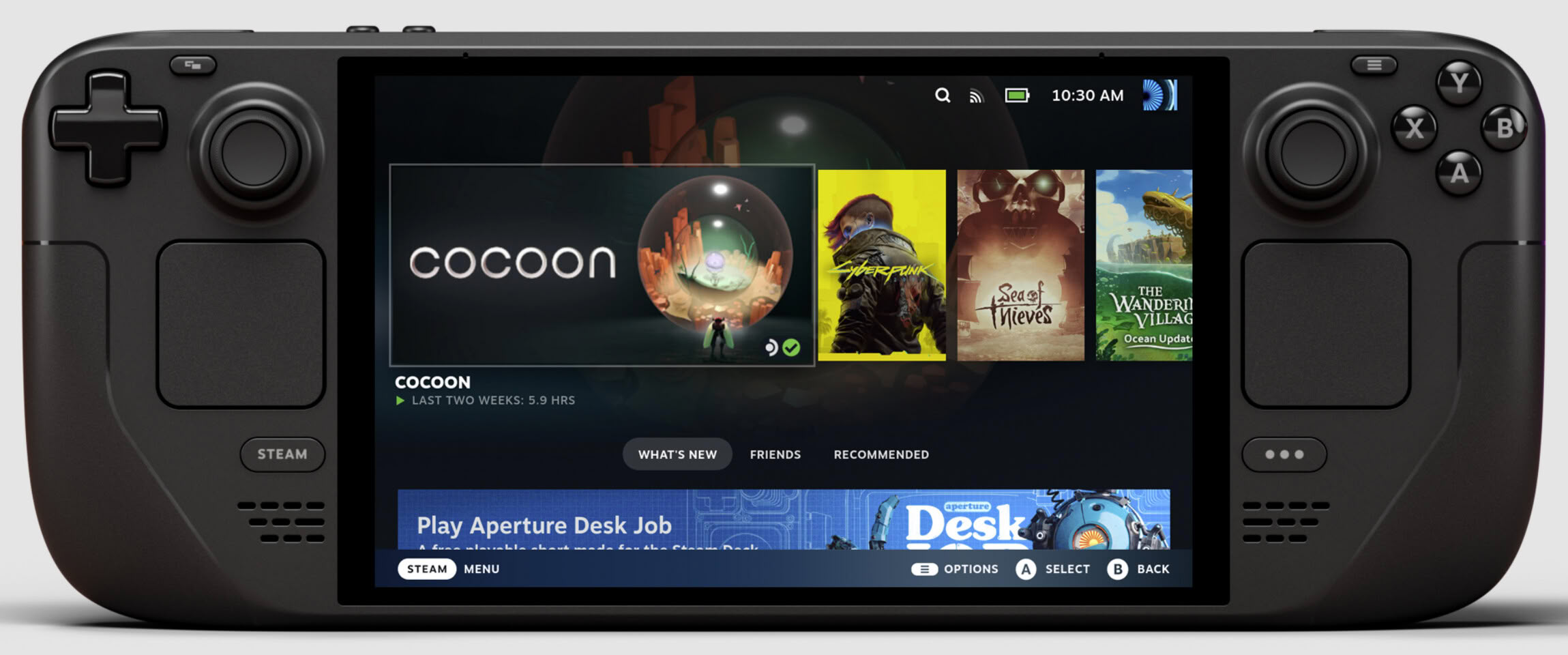
Valve has re-enabled HDR during Remote Play on the Steam Deck OLED in the latest Steam Client beta, roughly three weeks after disabling it alongside the Big Art Mode update in early October.
What changed: A Steam Client beta update restores HDR on Steam Deck OLED during Remote Play and adds automatic and always-on HDR modes. Why it matters: The OLED panel’s main advantage over the LCD model is its HDR range, and streaming is how most Deck owners reach demanding titles. Who should care: Steam Deck OLED owners who stream from a desktop, and anyone who noticed HDR quietly disappearing this month.
What the update adds
| Change | Detail |
|---|---|
| HDR in Remote Play | Re-enabled on Steam Deck OLED |
| Automatic mode | HDR only when HDR content is detected |
| Always-on mode | Higher brightness for SDR content |
| Windows host support | HDR now works with Remote Play on Windows, in games and on the desktop |
| Channel | Steam Client preview/beta |
The two modes address different complaints. Automatic is the safe default: it avoids washing out SDR content by forcing an HDR container onto it. Always-on trades accuracy for brightness, which is a reasonable option on a handheld used in daylight.
Why it went away
Valve never gave a reason for disabling HDR in early October. Reports at the time pointed to bugs and issues with HDR support on the OLED model, and the beta notes describe an overhaul of Remote Play rather than a simple switch being flipped back. The gap between removal and return suggests the feature was pulled to be rebuilt, not patched.
That distinction matters for anyone who assumed it was a regression. The re-release arrives with new modes and a Windows-host change, which is more than the feature had before it disappeared.
What this means in practice
Streaming HDR depends on both ends: the host must output HDR, and the Deck must decode and present it. The Windows-side addition is therefore the other half of this update — without it, a Windows desktop could not feed an HDR stream to the handheld regardless of what the Deck supported.
The remaining variable is the host GPUGPU. Graphics Processing Unit — the chip that renders the game's visuals; the main driver of framerate and image quality.’s encoder and the network path. HDR generally costs more bitrate for the same perceived quality, so a marginal Wi-Fi link may show more compression artefacts with HDR enabled than without.
What is still open
This is a beta, so it can change or regress before it reaches the stable channel. Valve has not said when that promotion happens, and there is no published list of the Remote Play features bundled in the same overhaul.
Forward look
The feature is live in the Steam Client beta now. Stable-channel availability is the next milestone; until then, Deck owners who want HDR streaming back need to opt into the beta and accept that the surrounding Remote Play changes are also in flux.