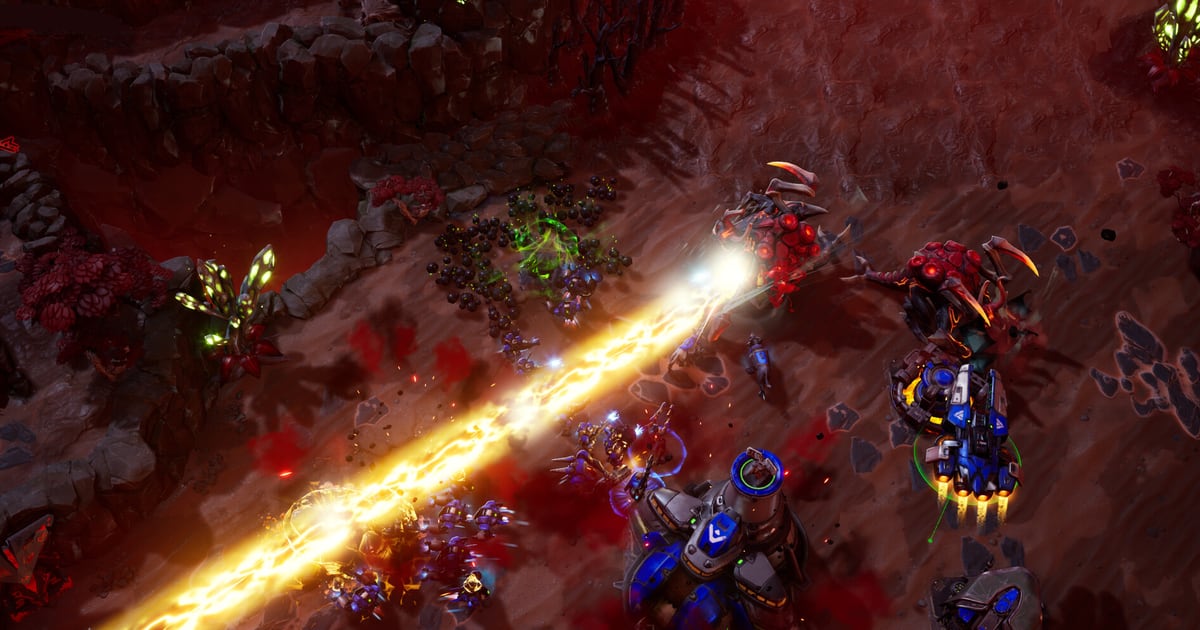
Created by former StarCraft II and Warcraft III developers at Frost Giant Studios, Stormgate is engineered for competitive precision. While the Human Vanguard and Infernal Host play with familiar workers and supply caps, the divine Celestial Armada throws out traditional RTSRTS. Real-Time Strategy — a strategy game where everyone plays at the same time, continuously, instead of taking turns. infrastructure rules. Celestials feature no ground supply depots; their economy is powered by a high-altitude orbiting mother-ship (the Arcship) that projects the Cascade Field they build inside, backed by a pooled Power economy.
What this covers: The pooled Power economy and its Gracelight, Energizer and Judicator node system, Arcship flight and transformation, Collection Array and Prism macro management, and Morph Core structure deployment. Why it matters: Power is a pooled resource — insufficient Power limits abilities and construction, while an excess of Power provides benefits that empower your army. Why should pick this: High-APM RTS players looking to command the most mechanically distinct factionfaction. An in-game group or nation players can align with or fight against, with its own goals and reputation system. in Stormgate.
The Celestial Power Economy and the Cascade Field
Unlike Vanguard buildings constructed by manual worker Servos, Celestial structures are projected directly from orbit:
| Infrastructure Node | Power | Deployment | Strategic Operational Purpose |
|---|---|---|---|
| Arcship (Central Hub) | Provides 15 Power | Flying HQ; projects the Cascade Field | Massive mobile command center; lifts off to expand to new bases |
| Gracelight Node | Power provider and utility structure | Morphed from a Morph Core | Heals nearby out-of-combat friendly units with Gracelight Endowment; morphs into an Energizer or Judicator Node |
| Energizer Node | Part of the node power system | Morphs from a Gracelight Node | Restores energy to friendly units with Energize |
| Judicator Node | Part of the node power system | Morphs from a Gracelight Node | Defends the Celestial base with its weapon |
| Collection Array | Consumes 10 Power | Built by the Arcship beside Luminite mines | Passively harvests Luminite; up to three attached Prisms each raise its harvesting rate by 50% |
| Creation Chamber | Unit production | Morphed from a Morph Core | Produces the core Celestial robotics units |
| Starforge | Unit production | Morphed from a Morph Core | Produces War Machines, including the Saber and the Navi spellcaster |
| Legion Hall | Unit production | Morphed from a Morph Core | Produces the angelic Biosynths |
| Morph Core | Multipurpose builder | Hovers freely across the battlefield | Morphs into Celestial structures even outside the Cascade Field, at an increased rate |
Power is a pooled resource rather than a severable grid: insufficient Power limits your abilities and construction, while an excess of Power provides benefits that empower your army.
Power Budgeting and the Node Economy
Power is a resource you spend every minute, and the Celestial build order bends around it. The Arcship provides 15 Power, lowered from 20 in the March 2026 Community Update, while a deployed Collection Array consumes 10 Power and refuses to construct at all while the pool sits in Low Power. That surplus is what funds the top-bar Astral Interventions: Power Surge raises a structure’s construction speed by 100% and its building movement speed by 50%, and can now be cast on allied structures other than HQs, while Zenith Scan — the vision tool that reveals an area including stealthed units — requires an Arcstation before it unlocks. Purify restores energy to nearby friendly units while draining it from enemies, and Evolution Catalyst instantly clears or respawns Creep camps.
The three-node system replaced the pre-launch power structures entirely, and each node converts Power into a different kind of value:
| Node | Morphs From | Ability | Current Tuned Values |
|---|---|---|---|
| Gracelight Node | Morph Core, or auto-built when you construct an Energizer or Judicator Node | Gracelight Endowment | Starting energy 25, armor 5, energy regeneration 2/sec; Endowment heals 10 HP instantly and a further 600 over 30 seconds, and the heal-over-time is cancelled if the unit takes damage |
| Energizer Node | Gracelight Node | Energize | Armor 5, energy regeneration 2/sec; restores energy to friendly units and can now be constructed independently |
| Judicator Node | Gracelight Node | Defensive weapon | Armor 5, energy regeneration 2/sec; attack damage lowered from 28 to 20 |
Matter Reallocation now refunds 50 Luminite per node instead of 25, so re-shaping your node layout to answer a tech switch costs half of what it once did. Because a Gracelight Node is always built first and then auto-morphs, you never queue a specialised node from nothing — you queue the base and let it transform.
The Celestial Roster: Robotics, War Machines and Biosynths
Knowing which structure feeds which unit is what lets Celestials centralize production and answer a scout’s read without marching reinforcements across the map. The Creation Chamber produces the core robotics units, the Starforge builds War Machines, and the Legion Hall raises the angelic Biosynths, while the Prism — the Celestial worker — attaches to Collection Arrays to lift their Luminite rate.
| Structure | Role | Notable Output |
|---|---|---|
| Creation Chamber | Core robotics production | Builds the Celestial robotics line, including the stealthy Carnivex |
| Starforge | War-Machine production | Builds the Saber and the Navi spellcaster |
| Legion Hall | Biosynth production | Raises the angelic Biosynth casters |
| Guardian Nexus | Robotics upgrade structure | Upgrades Robotics units produced from the Creation Chamber |
| Ascension Matrix | War-Machine and Biosynth upgrades | Upgrades units produced from the Starforge and Legion Hall |
| Aeon Gate | Logistics | Allows the direct and instant transfer of units between other Aeon Gates |
The March 2026 pass reshaped several of those units. The Saber main battle tank fires a Dark Matter Distortion beam from its Dark Matter cannon that splashes onto adjacent enemies, and can either engage Mass Accelerators for a temporary speed boost or power down into Self-Repair; the update pushed its attack to 60 (+50 vs Heavy), its range to 14, its cost to 250/125, and moved it behind the Ascension Matrix. The Carnivex, a new Tier 2 front-line tank with stealth, builds from the Creation Chamber and requires an Arcstation — 350 HP, 10 armor, 30 damage, 175/50 — with Shikari Venom stacking percent-health damage and a Sapping Pounce dive. The Navi, a new Tier 3 spellcaster, builds from the Starforge behind an Arcfortress and carries Radiant Mantle, which halves incoming damage on an ally, plus Hallowed Ground for area Sovereign’s Favor. The Prism worker had its cargo capacity cut from 7 to 2 and its gather-period multiplier raised to 1.25, but up to three Prisms still attach to a Collection Array for +50% harvesting each, and Prisms can strip Therium directly. Beyond the production line, the roster pairs the four-bladed Kri melee construct — Roll Out mobility and a Geodesic Shockwave spin attack — with Biosynth casters such as the Animancer, whose Animus Redistribution drains 30 health and 30 energy per second back to nearby allies, and the Archangel, a 900-HP flier whose Meteor Strike, Aether Slash and Censure abilities anchor the late-game sky. The Scythe was removed from the game entirely, with the Saber and Navi taking over its command-card positions.
Reading the Community Update for Celestial Macro
The Community Update patch notes are the balance context behind every Celestial opener, and several of its general changes matter as much as the unit tuning. All factions now begin with 50 Luminite, all HQs start with one worker charge and cap at three, and the first Stormgate spawns at 3:00 rather than 3:30 — a faster opening that rewards the Celestial habit of floating the Arcship straight onto a natural expansion. Rich Luminite Mines were raised to 1.5 times the value of a regular mine, and Celestial Collection Arrays placed on them mine at 1.5 times rate, which makes expansion selection a genuine scoring decision. The Collection Array itself climbed from 600 to 825 Luminite per minute and from 600 to 1200 HP while its Power cost rose from 8 to 10, and the Arcship now regenerates 4 HP per second, shrinks to a 4x4 footprint, and costs 400 rather than 300.
Arcship Flight and Rapid Expansion
The Celestial command center, the Arcship, is fully mobile:
- Lifting Off: The Arcship can take flight at any moment, hovering over cliffs, oceans, and impassable terrain.
- Expanding to Natural Expansions: Rather than training an expensive new town hall, Celestials can float their starting Arcship directly over a natural expansion Luminite field, drop down into anchored mode, and begin immediate resource extraction.
- Orbital Energy Projection: The Celestials channel top-bar Astral Interventions — Power Surge, Zenith Scan, Evolution Catalyst and Purify — and the Arcship’s own Skyward Salvation heals friendly units out of combat, so retreating armies can cycle back into the fight.
Morph Cores and Celestial Production
Units in the Celestial Armada do not march out of barracks doors. You build universal Morph Cores that hover across the battlefield:
- Morph Cores can be pre-built and hovered along with your frontline army.
- When you need presence anywhere on the map, you can morph those cores directly on the battlefield into Gracelight, Energizer or Judicator Nodes, Creation Chambers, Starforges, Legion Halls, Guardian Nexuses, Ascension Matrices or Aeon Gates — even outside the Cascade Field, at an increased rate.
- Structures never morph into combat units: core robotics units are produced at the Creation Chamber, War Machines such as the Saber and Navi at the Starforge, and the angelic Biosynths at the Legion Hall — with Celestials able to centralize production and spawn their entire troop output from a designated Prime structure.