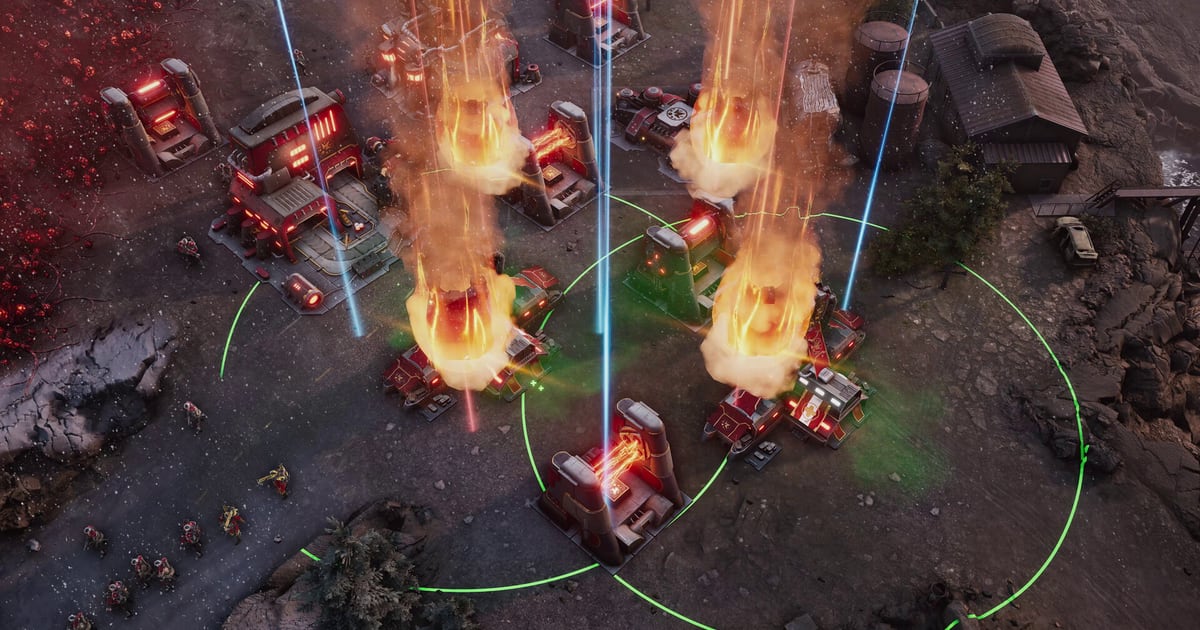
Slipgate Ironworks and 3D Realms deliver an unapologetic love letter to 1990s base-building RTSRTS. Real-Time Strategy — a strategy game where everyone plays at the same time, continuously, instead of taking turns. games in Tempest Rising. Channeling the classic spirit of Command & Conquer, the game depicts an alternate post-nuclear Cold War where global powers vie for control over Tempest—a volatile, self-propagating plant-like growth that emerged from the fissures of the Earth after the Third World War and now covers radioactive wastelands. Mastery of competitive multiplayer hinges on understanding the radically asymmetric economic models of the Global Defense Force (GDF) and the Tempest Dynasty.
What this covers: Tempest growth cycles, GDF Harvester conveyor logistics, Dynasty mobile refinery pods, and the Intel-driven secondary economy. Why it matters: Unlike static resource nodes in modern RTS games, Tempest fields grow and spread; pods mature through three stages, and harvested nodes revert to living vines that regrow. Who should pick this: RTS commanders seeking high-speed base-building macro optimization.
The Tempest Ecosystem
Tempest is an anomalous plant-like growth — despite its vining appearance, it is neither a plant nor even eukaryotic — that emerged from the fissures of the Earth after the Third World War:
- Mature Tempest (High Yield): Tall glowing crystalline pods that offer maximum credit returns per harvester haul.
- Sprout Vines (Low Yield): Young seedlings expanding along the edge of the patch.
- Regrowth Cycle: No patch dies permanently. Nodes climb from living vines to 1st-stage pods (200 credits), 2nd-stage pods (400 credits), and fully mature 3rd-stage pods (800 credits); fully harvesting a pod simply reverts its node to living vines, which regrow after 30 seconds. Fields stay alive while sustained by living flowering pods or a Tempest crater.
| Economic Aspect | Global Defense Force (GDF) | Tempest Dynasty | Strategic Distinction |
|---|---|---|---|
| Harvester Unit | SG10 Harvester: tracked, heavily armored, hauls up to 800 credits per trip | Tempest Rig: a tracked mobile refinery that deploys at the field, its four wheels detaching into remote-controlled Harvester Wheels | GDF hauls Tempest home; the Dynasty brings the refinery to the field |
| Processing Hub | Stationary Concrete Refinery | Mobile Refining Rig | Dynasty can redeploy refineries directly into contested fields |
| Secondary Economy | Intel: earned mainly through combat, spent on advanced units and support powers | Power Plant Distribution mode plus combat Plans (Logistics, Martial, Security) | GDF turns fighting into currency; Dynasty trades power and structure health for tempo |
| Macro Mechanics | Centralized production queues | Decentralized multi-point construction | GDF rewards neat base design; Dynasty enables proxy forward bases |
Tempestology: Growth Timers and Field Rules
The wiki’s growth model is deterministic, and every number matters when you schedule a harvester round:
| Node State | Yield | Maturation Timer | Harvest Behaviour |
|---|---|---|---|
| Living vines | 0 | Regrows 30s beside a pod; grows into a 1st-stage pod after 45s if connected to a Tempest crater | Must be adjacent to a pod or crater or it dies immediately |
| 1st-stage pod | 200 credits | Matures into the 2nd stage after 2 minutes | A partial harvest resets the timer; a full harvest reverts the node to living vines |
| 2nd-stage pod | 400 credits | Matures into the 3rd stage after 4 minutes | Taking 200 credits downgrades it back to the 1st stage |
| 3rd-stage pod | 800 credits | Fully mature — no further growth | Taking 400 or more credits downgrades it to the 2nd stage |
Fields are 2x2 nodes and stay alive only while sustained by living flowering pods or a Tempest crater, which is a continuous spawner that keeps feeding growth into neighbouring nodes. Harvesting half of a third-stage pod is the common tactical mistake: pull fewer than 400 credits and the pod will not regrow to full value at that stage, so it must downgrade to the 2nd stage and climb back up. Campaign difficulty also stretches the regrowth timers, which makes credits scarcer on the harder settings.
Tempest is not merely scenery. Infantry walk through it untouched, but almost every ground vehicle that is not a harvester builds a Tempest Charge debuff that slows its speed and attack rate; stay long enough and the charge tips into Tempest Overflow, which damages the vehicle over time. Almost nothing can be built on top of a Tempest field — the exceptions are the Refinement Altar and the Ascension Anchor.
What the Tempest Actually Is
The growth’s composition explains why it is worth fighting over: 30% carbon, scandium and yttrium and neodymium at 15% each, nitrogen at 10%, and trace lutetium, sodium, erbium, and promethium. The luminous pods hold a fluid that, once processed, is more fuel-efficient than fossil fuels and produces more than double the power of nuclear energy. Nuclear fallout acts as a growth catalyst — the vines spread across irradiated land and, in the process, lower its radiation level, while away from fallout they still grow but far more slowly. No part of the growth is edible.
GDF Harvester Logistics: Optimizing Refinery Placement
The GDF economy favors heavy infrastructure:
- Refinery Proximity: Build your GDF Refinery close to the mature Tempest field to minimize harvester transit time.
- Bundled Harvester: Every GDF Refinery arrives with its own Harvester — the unit’s 1,300-credit cost is rolled into the Refinery’s price — and each Harvester gathers up to 800 credits of Tempest per haul, unloading at 220 credits per second (patch 1.7.1).
Harvesting Numbers: SG10 vs Tempest Rig
| Stat | GDF SG10 Harvester | Dynasty Tempest Rig |
|---|---|---|
| Role | Resource gatherer (Tier 1) | Mobile refinery (Tier 1) |
| Hitpoints | 900 | 1,600 (1,700 in campaign) |
| Move type / speed | Tracked / 525 | Tracked / 350 |
| Cost | 1,300 | 1,900 |
| Build time | 0:33 | 0:45 |
| Population | 2 | 3 |
| Harvest | Gathers up to 800 worth of Tempest at 100 per second | Four Harvester Wheels, each carrying up to 100 credits before returning |
| Notes | Tempest Shielded electronics make it immune to Tempest Charge | Needs all four Wheels to relocate; a lost Wheel respawns free after 35s, and losses queue (70s for two, 140s for all four) |
The supporting structure is where the two economies really diverge. The GDF Refinery costs 1,900 plus 100, builds in 0:37, stores 500 Tempest, draws 40 power, and arrives with a free Harvester — the unit’s 1,300-credit price is already inside the building. Its Install Storage Pod upgrade adds another 500 storage and turns the refinery into an income generator at 25 credits every 5 seconds. The Dynasty has no stationary refinery at all: the Tempest Rig deploys in place, and because Rigs provide no extra credit storage, the Dynasty Silo holds twice what a GDF Silo does.
Patch Context
Both harvesters have been rebalanced repeatedly since launch. The GDF Harvester’s health stepped down to 950 and then 900, its movement speed climbed to 525, and the Tempest Refinery drop-off rate was cut to 220 credits per second (from 260) in patch 1.7.1. The Tempest Rig lost health to 1,600, saw its power draw rise to 30, and gained the Redeploy Refinery command in patch 1.5. The Refinery’s own health fell to 2,250 and the Storage Pod’s price moved to 25 Intel in patch 1.8. Reading current numbers off a launch-era guide will misprice an early rush.
Tempest Dynasty Mobility: The Forward Siphon
The Dynasty plays aggressively with mobile infrastructure:
- Rather than driving slow harvesters back to a home base, the Dynasty deploys Mobile Refinery Rigs right at the perimeter of the resource field.
- Harvesters travel mere feet to dump minerals, generating an explosive early-game credit spike that fuels aggressive early mechanized infantry rushes.
The Secondary Economy in Detail
The GDF’s Intel is unlimited in storage but leaks on loss: the Satellite Uplink gives up to 20, the Data Core up to 30, a Comms Rig up to 5, and a Drone Command Unit up to 10 when destroyed. It accrues passively from the Construction Yard (1 every 7 seconds), the Satellite Uplink (1 every 8.5s), and the Data Core (1 every 6s), from killing Marked enemies, and from Engineer captures — a captured building returns roughly twice the Intel of Marking and destroying it.
The Dynasty’s analogue is power and Plans. Each Construction Yard runs one plan at a time; building more yards lets you run several, but the same plan never stacks and each additional running plan costs more power than the last. Logistics speeds the Rig and its harvesters and cuts build time, Martial adds attack speed plus Rocket and Explosive resistance and enables the Tempest Dynamos ability, and Security cuts unit and building cost, improves repair, and extends Radar vision. Power Plants can also flip into Distribution mode for faster production and stronger nearby combat buffs — at the cost of damaging those buildings over time.