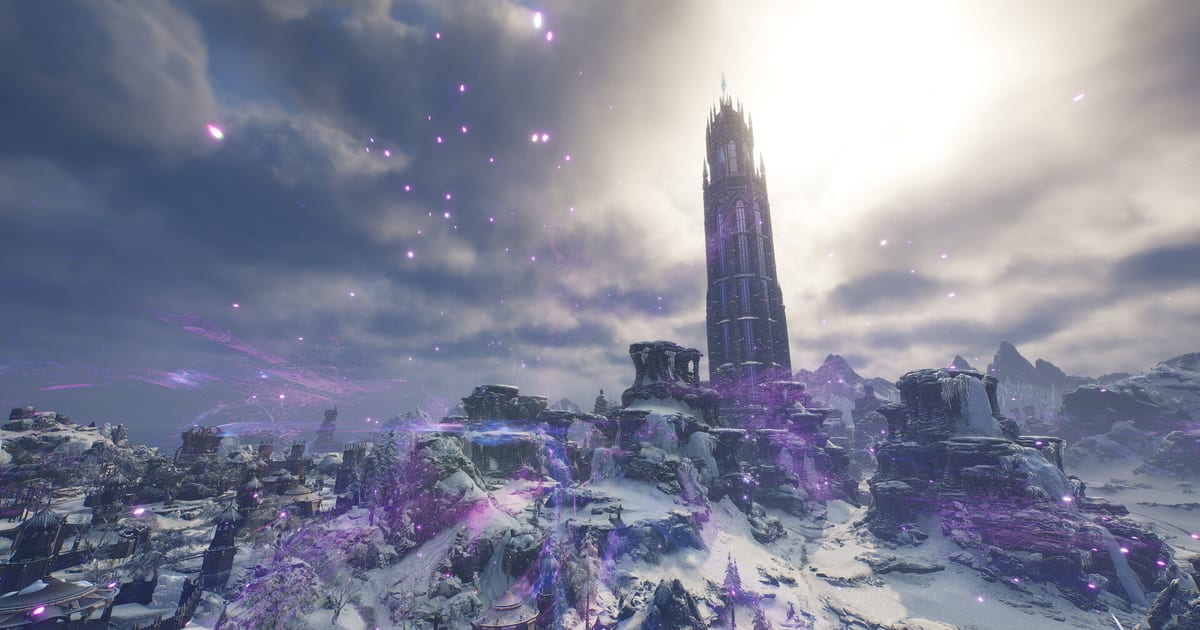
Castle Sieges are the largest scheduled PvP event in Throne and Liberty, the free-to-play MMORPG from NCSOFT and Amazon Games, and the only endgame activity where the official endgame guide explicitly says victory is decided by sitting on the Throne of Stonegard Castle. They run every two weeks, are open to guild alliances of every size, and feed directly back into the wider Solisium PvP economy via tax income, Pillage resources, and — as of the May 2025 update — an interserver ladder that lets castle owners from different realms fight each other for a server-wide buff.
This article walks through how sieges resolve, what the guild-level objectives look like, and how the surrounding PvP economy is wired together. Everything below is sourced from the official Throne and Liberty endgame guide, the Amazon Games Castle Siegesiege. A timed, large-scale attack on a settlement — attackers try to destroy it, defenders try to hold it. announcement, and the Solisium’s Awakening patch notes covering the Stonegard rework and the May 28, 2025 Interserver Siege addition.
What changed
Castle Sieges were the headline PvP feature when Throne and Liberty went live on October 1, 2024, with the first event held on November 17, 2024 at 4 p.m. PT. From the start the ruleset was tuned to let smaller guilds participate alongside the largest alliances: while the largest server alliances contested the Throne itself, smaller guilds and alliances could chase Pillage Zones — secondary objectives that let them “rapidly accrue critical resources” without ever fighting for the Throne room, per Daniel Lafuente, Globalization Design Manager at Amazon Games.
Two big subsequent updates reshaped the system:
- Solisium’s Awakening (September 18, 2025) reworked the Stonegard Castle map and added the 24v24 Battlegrounds mode. The rework was a direct response to player behavior; according to the official Solisium’s Awakening devblog, the team monitored “every weekend during siege events” and found the original map’s terrain naturally led to “prolonged standoffs, which can make gameplay feel dull.” The rework introduced more attack routes, more respawn points, and made throne takeovers happen more often.
- Update 2.12.0 (May 28, 2025) introduced Interserver Siege: castle-owning alliances now participate in a server-vs-server siege every three weeks, with tax revenue from each server added to a shared reward pool.
How a Stonegard Siege resolves
The official endgame guide lays out a fixed match structure:
- Length. Guilds have 45 minutes to win.
- Roles. Defenders spawn inside the castle at the start. Attackers spawn outside and must storm the grounds.
- Win condition. Capture the throne room.
- Overtime. If the throne is contested when the timer expires, a 3-minute overtime triggers “where the battle’s outcome hangs in the balance.”
The May 2025 Interserver Siege follows the same core structure but adds two extra steps: each participating alliance gets a chance to attack and a chance to defend, and rewards are drawn from a shared pool funded by tax revenue from each participating server.
Sub-objectives
The Throne is the headline, but the official endgame guide makes clear that several sub-objectives are how guilds actually win sieges:
- Siege Ruins scattered around the castle provide teleportation and resurrection points, and — crucially — allow attacking guilds to summon Siege Golems.
- Siege Golems come in four types: Stone Crasher, Battle Carrier, Gate Hammer, and Jump Attacker. Each can either “devastate castle walls” or “transport players over them,” so golem pick determines whether a guild tries to punch through a gate or skip it.
- Pillage Stones let guilds steal resources during the siege.
- Resurrection Stones reinforce the holder’s position.
- Environmental tools like the castle’s sewage system allow defenders to ambush attackers; gate levers let defenders cut off routes.
The Throne is contested at the end of every path. There can only be one winner of Stonegard Castle per siege.
The PvP economy around sieges
Sieges aren’t a closed mini-game — they feed Solisium’s wider PvP economy in three concrete ways.
1. Tax income from the castle
The NCSOFT Producer’s Letter introducing the system states that “the triumphant guild in Siege Warfare stands to reap rewards from the accumulated taxes.” This was expanded in the May 2025 update: a portion of tax revenue from each participating server now goes into the Interserver Siege reward pool, then is “divided among the participating alliances based on the outcome of the battle.” In other words, holding Stonegard is not just a status symbol — it’s a recurring income line for the winning guild.
2. Plunder Ground and Tax Delivery sub-sieges
The same Producer’s Letter introduced two related activity types:
- Plunder Ground Conquest — stealing accumulated taxes during the siege.
- Tax Delivery — transporting taxes after a siege has ended.
These exist because taxes are valuable, and any valuable in-world resource in a PvP game becomes its own PvP objective. Pillage Zones and Pillage Stones function the same way inside the siege itself.
3. Server-wide buffs from interserver victories
Update 2.12.0 added the largest pay-off yet for an interserver winner. According to the official patch notes, the victorious alliance brings a 48-hour server-wide buff to their home server, granting “all players on that server increased Abyss Point efficiency and combat damage bonus.” That single buff is the most concrete piece of evidence that siege outcomes are designed to matter to the entire server, not just the participating guild.
Guild objectives and how teams actually plan
The Amazon Games Castle Siege announcement frames siege prep as a four-axis decision the lead guild has to commit to ahead of time:
- Throne push vs. Pillage focus. Will you contest the Throne with overwhelming force, or play for Pillage Zones and the resources they hand out?
- Solo vs. alliance. Do you ally with other friendly guilds, or run your own roster?
- Approach. Stealth and misdirection through the castle’s environmental layout, or a frontal assault keyed off your siege golem choice?
- Summon timing. Lafuente specifically calls out the guild summon stone as a “decisive moment” — using it at the wrong time wastes the only concentrated reinforcement surge your team gets.
Defensive playbooks
The Solisium’s Awakening devblog confirms that defenders were the half of the match that needed the most iteration. The dev team noted: “We started with the belief that siege battles needed to become more offense-driven, but we also had to ensure that defending teams who fought hard to claim the castle wouldn’t feel unfairly punished.” The Stonegard rework added “multiple valuable routes and respawn zones,” forcing defenders to “split into smaller groups and move quickly across the battlefield” rather than camping one chokepoint.
Anti-trust rules
The Amazon Games announcement confirms that the server rules actively try to stop one alliance from sweeping every siege:
- Hard alliance caps on size.
- Randomized nameplates so opposing guilds can’t pre-target known characters by name.
- Standardized guild icons.
The team also committed to “systematically iterate on the Castle Siege rulesets based on real-world data and feedback” — a hint that the ruleset is intentionally a live document rather than a fixed launch configuration.
Build path and prep checklist
Based purely on what the official endgame and Castle Siege sources recommend:
- Hit level 50 and endgame gear progression first. The endgame guide lists Castle Siege alongside Co-op Dungeons, Conquest Battles, Open-World Bosses, and Gate of Infinity as level-50 activities, and explicitly recommends maxing out before sieging.
- Stock consumables and guild materials. Lafuente’s parting advice in the Amazon Games announcement was: “be sure to properly stock up on consumables and guild materials ahead of time. These conflicts can be resource-intensive.”
- Scout the map. “Get boots on the ground to scout the siege environments. Plan out your routes, fallback points, and coordinate roles with your guild.”
- Run Gate of Infinity between sieges. The endgame guide frames it as a leaderboard activity whose reward bracket is designed to feed “your next Castle Siege.”
What it means
Two structural things stand out about Throne and Liberty’s siege design.
First, the system is intentionally layered. The Throne is the headline win condition, but Pillage Zones, Siege Ruins, Siege Golems, Pillage Stones, Resurrection Stones, and the sewer route give small guilds and split-role defenders real things to do. The official sources repeatedly frame this as a deliberate scaling choice, not a side feature.
Second, the PvP economy is now networked. The May 2025 Interserver Siege tied castle ownership to a 48-hour server-wide buff, and interserver rewards are funded by tax revenue from participating servers. A single castle take can now meaningfully change the next 48 hours of PvE and PvP for every player on the winning realm.
If you want to follow the system’s evolution yourself, the team’s stated direction in the Solisium’s Awakening devblog is to keep iterating the map, add new game modes, and “explore new ways to make Siege Battles more accessible and enjoyable for a wider range of players.”