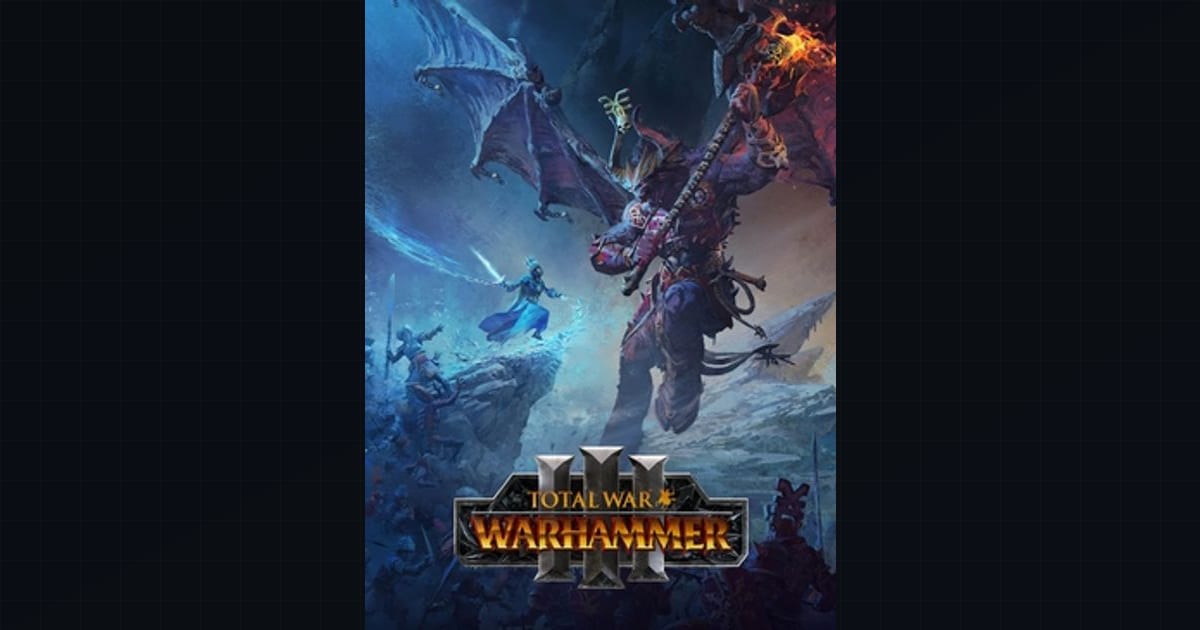
Total War: Warhammer III is a turn-based strategy and real-time tactics game developed by Creative Assembly and published by Sega. Released on February 17, 2022, it is the third entry in the Total War series set in Games Workshop’s Warhammer Fantasy universe, following Total War: Warhammer (2016) and Total War: Warhammer II (2017). The game is available on Linux, macOS, and Windows.
Core Gameplay
The game follows the established Total War formula, combining turn-based campaign management with real-time tactical battles. Players move armies and characters across a campaign map, manage settlements, engage in diplomacy, and fight AI-controlled factions. When armies collide, battles play out in real time. A custom battles mode lets players create tailored real-time engagements, and online multiplayer is supported.
The main campaign spans from the Lands of the East to the Realms of Chaos. Game director Ian Roxburgh stated the campaign map is roughly twice the size of the Eye of the Vortex campaign map from Total War: Warhammer II.
Factions & Races
Playable races include the human civilizations of Grand Cathay (based on Imperial China) and Kislev (influenced by Slavic cultural archetypes), along with five Chaos factions. Four of these are devoted to individual Chaos Gods — Khorne, Tzeentch, Nurgle, and Slaanesh — while the Daemons of Chaos factionfaction. An in-game group or nation players can align with or fight against, with its own goals and reputation system. is led by a customizable Daemon Prince whose traits evolve through “Daemonic Glory” earned during the campaign. The Ogre Kingdoms race was made available as a bonus to early adopters who pre-purchased or bought the game within the first week of release.
Immortal Empires
Owners of the first two games gain access to “Immortal Empires,” a combined world map that merges content across the trilogy. Similar to the “Mortal Empires” campaign in Total War: Warhammer II, this mode launched as a Beta on August 23, 2022 alongside patch 2.0. Players who own races from the earlier titles also unlock those races for multiplayer use in the third game.
Campaign Narrative
The prologue follows Yuri Barkov, a Kislevite commander sent to find the missing Bear-God Ursun. Yuri is corrupted by Chaos during his expedition, ultimately killing his brother Gerik and renouncing Ursun. After wounding the god, Yuri is transformed into a Daemon Prince. The main campaign centers on the Advisor, now enslaved by the Tome of Faces, who seeks a drop of Ursun’s blood to free himself, guiding various factions into the Realm of Chaos to reach the imprisoned god.
Why It Matters: The Capstone of a Cross-Game Megacampaign
The single most consequential design decision in Total War: Warhammer III is not anything inside the box on launch day — it is the structural commitment to Immortal Empires. By treating three separately sold, six-years-apart titles as layers of a single persistent world map, Creative Assembly effectively turned a release cadence into a platform. For the RTSRTS. Real-Time Strategy — a strategy game where everyone plays at the same time, continuously, instead of taking turns. genre, which has spent the last decade fragmenting into smaller, self-contained campaigns and live-service economies, this is an unusual bet: that players will buy into a trilogy on the promise that ownership compounds. The Mortal Empires precedent from Warhammer II proved the concept; Immortal Empires scales it to a map that, by Creative Assembly’s own framing of the base campaign as roughly twice the Eye of the Vortex footprint, dwarfs anything the series had attempted standalone. The implication for players is that “completion” is no longer a property of any one SKU — value accrues to the collector, and the late-game sandbox is reserved for the audience that stayed across two console generations worth of releases.
The Take: When the Sandbox Outgrows the Story
The base campaign’s Realm of Chaos structure — racing factions toward an imprisoned god through chaos-warp portals — is, on paper, the narrative spine of the game. In practice, it is the least interesting thing about it. The prologue’s Yuri Barkov arc (a Kislevite commander corrupted into a Daemon Prince after killing his brother and renouncing Ursun) is a competent piece of Warhammer grimdark, and the Advisor-as-enslaved-narrator framing is a neat callback. But the campaign’s win-condition design pushes players toward a relatively narrow set of objectives, which sits awkwardly next to a faction roster whose whole appeal is asymmetry — Khorne’s melee-rush economy, Tzeentch’s magic-and-scheme plotting, Nurgle’s rot-and-replenishment grind, Slaanesh’s seduction-and-vassal mechanics.
The Daemons of Chaos faction, with its customizable Daemon Prince accruing “Daemonic Glory” across all four gods, is the honest expression of what the game wants to be: a build-your-own-antagonist sandbox where progression reshapes the faction rather than just scaling it. Immortal Empires is where that philosophy fully breathes. The base campaign is the tutorial; the megamap is the product. That is not a flaw so much as a reordering of priorities — and it is the right call for a franchise whose long-term audience demonstrably prefers emergence over authored endings.
What It Signals: The RTS Genre’s Platform Pivot
The cross-game ownership model — where owning races in Warhammer I and II unlocks them in III for both single-player and multiplayer — signals something broader about the genre’s economics. Traditional RTS titles ship, sell, and decay; their multiplayer populations collapse within months and their campaigns are consumed once. Creative Assembly’s model treats the install base itself as a persistent asset: a player who bought Kislev-adjacent content in 2016 is still a monetizable, retainable customer in 2022, and their existing library is the onboarding ramp rather than a barrier. The pre-purchase Ogre Kingdoms bonus is a small, telling example of the same logic — early commitment is rewarded with content, because the publisher’s interest is in locking the player into the platform before the sandbox reveals its full scope.
For competitors, the lesson is uncomfortable. You cannot replicate Immortal Empires by bolting a “combined map” onto a sequel; it requires shipping three deliberately compatible games over six years, maintaining DLC parity, and sustaining a community through the dry spells. That is a moat, not a feature.
Context: Grand Cathay, Kislev, and the Canon-First Strategy
The choice to lead with Grand Cathay and Kislev as headline races is worth pausing on. Both are canon-adjacent in Games Workshop’s lore — referenced, sketched, but historically underdeveloped compared to the marquee Empire, Bretonnia, or Dwarf factions. By foregrounding them, Creative Assembly makes a canny trade: lower fan expectation (so less risk of butchering a beloved roster) against a higher obligation to define the faction’s identity from scratch. Grand Cathay’s Imperial-Chinese-inspired war-rocket and artillery identity, and Kislev’s Slavic ice-magic-and-bear-cavalry themes, are essentially invented-for-game canons that Games Workshop has since had to honor in tabletop releases.
That dynamic — the digital game writing lore the tabletop then ratifies — inverts the usual licensing flow, and it is quietly the most strategically interesting thing about the trilogy’s final act. The game is no longer just adapting Warhammer; it is authoring it. Whether that is a healthy long-term arrangement for the IP depends on how much players trust a studio, rather than a miniatures company, as the custodian of a setting’s tone.