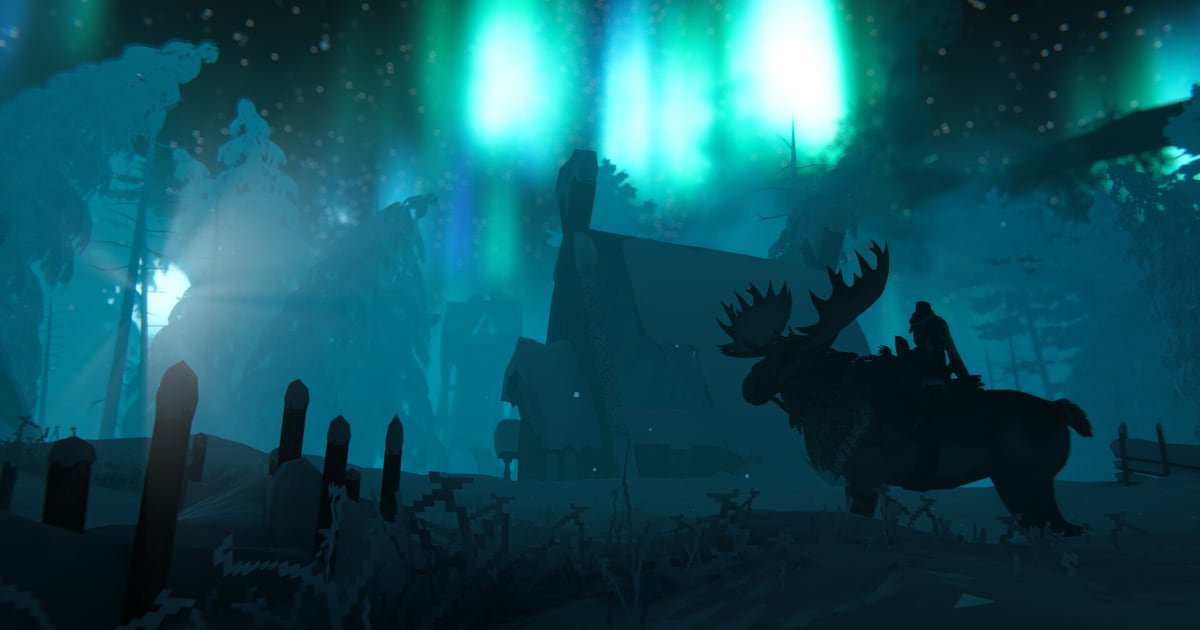
Valheim 1.0 arrived on September 9, 2026, ending five years of Early Access and finally filling in the biome that had sat empty the longest. Iron Gate’s launch post bills the Deep North as the headline of a drop that also carries “40+ New weapons”, “10+ New creatures”, “80+ New buildable pieces”, “30+ New crafting materials” and “20+ New food items”, alongside upgradeable pockets and achievements. The launch-day breakdown lives in our 1.0 report; what follows is the part that matters once you are actually standing in the snow.
What this covers: the Deep North’s progression chain in order — Embers to Ember Charges, Gammeltrolls to Bloodgold, moulds to casts, and the three Malicious Blood that open the final fight. Why it matters: the biome breaks Valheim’s ore-tier pattern. Gear is mould-driven rather than metal-driven, so a chest of Bloodgold buys nothing without the matching Cast and a Frost Foundry to finish it. Who should care: returning players taking an established character north, and anyone deciding what to carry over from the Ashlands before they sail.
Where the Deep North sits in the 1.0 endgame
Coffee Stain calls the Deep North “Valheim’s ultimate biome” and describes it as a place “once inhabited by the first vikings who set foot in the tenth realm, but all signs of life have since withered away” — home to “gammeltroll, elakingar, barka, and numerous other ancient creatures”. The same post calls it “a massive biome, larger than any of the previous areas added to Valheim”, which is worth reading as a warning about expedition length rather than a boast.
It is also gated. Community progression guides are consistent that the intended path runs Ashlands → Fader → Deep North, and that the gate is real: Mobalytics opens with the instruction to “Defeat Fader First”, noting that his drop builds the Eternal Pyre, and that Embers are “required for Deep North progression” but, “unlike most biome resources, you can’t get them inside the Deep North itself”. HostedGG puts the same thing more bluntly — “no dead Fader, no progress”.
The official FAQ gives returning players a softer line than the guides do. Old saves keep working (“Nothing. Your old saves will still be where you last left them”), new content appears in existing worlds, but biome generation “will only work properly on areas that have not yet been explored”. Asked whether you can head straight for the Deep North, Iron Gate’s answer is “You can, but it’s our recommendation that you start over.”
The progression chain, in order
The reason the Deep North reads as a longer biome than the ones before it is that almost nothing here converts resource-to-weapon in a single step. The chain below is the version that agrees across the progression guides, with the gate that holds each step shut.
| Step | Gate | What it unlocks |
|---|---|---|
| Defeat Fader in the Ashlands | Ashlands boss | Fader’s drop |
| Build the Eternal Pyre, bank Embers | Fader’s Kindled Ribs at the Stonecutter | Embers for charges and the Snow Shovel |
| Hunt seals along the coastline | Frost Resistance Mead for snowstorms | Seal Pelts |
| Kill a Gammeltroll, break the petrified remains | Ember Charges | Petrified Tissue |
| Smelt Petrified Tissue with Coal | Blast Furnace | Bloodgold |
| Clear Winding Tunnels | — | Frostcore, equipment moulds, Mould: Intricate Key |
| Build the Frigid Kiln and the Frost Foundry | 10 Frostcore each | Liquid Frost; casting |
| Craft the Intricate Key | 5 Bloodgold, a level 4 Black Forge, a Frost Foundry | Entry to Mörkhalla |
| Clear Mörkhalla’s depths | One Intricate Key, consumed on use | The Jotun Advance |
| Clear the Jotun Invasion, break its Malicious Ice | A working portal network | One Malicious Blood |
| Repeat twice more | Two more keys, 10 more Bloodgold | Three Malicious Blood |
| Offer them at the Strange Bowl | — | The Aesir Passage |
Two details on that table are easy to miss and expensive to learn late. Mobalytics notes that the Intricate Key “is consumed when you use it, so you will eventually need more than one”, which fixes the total at three keys and 15 Bloodgold for the full route. And ValheimPlanner flags that neither Petrified Tissue nor Bloodgold “goes through a wooden portal” — the two materials the whole biome runs on cannot be teleported by a normal portal, so plan the haul, not just the trip.
Embers are the one resource you cannot farm up north
Every other Deep North material is somewhere in the biome. Embers are not. Your supply comes from the Eternal Pyre, which ValheimPlanner says is built from Fader’s Kindled Ribs at the Stonecutter, and Embers feed two things: the Ember Charge and the Snow Shovel.
Ember Charges are the load-bearing item. Mobalytics states plainly that the petrified remains left behind by a dead Gammeltroll “cannot mine this petrified body with a normal Pickaxe” — the charge is the tool. HostedGG puts the recipe at one Ember plus two Seal Pelts for a stack of ten, and argues the charges are “the only practical way to open a Gammeltroll”, because the creature “resists essentially every physical damage type” and its head, while a technical weakness, costs more hits than the fight is worth.
The community numbers around that fight are worth knowing but worth treating as community numbers. HostedGG records a Gammeltroll at 3,000 HP and describes the corpse as a resource node of 52 segments, with two charges — one at each ankle — enough to collapse it, yielding roughly 86.6 Stone and 43.3 Petrified Tissue. Valheim.tools lists the same 3,000 HP in its biome database. HostedGG itself is explicit that these figures are “community-documented from the 1.0 build rather than published by Iron Gate”. The direction of travel is the safe part: one stack of charges covers a troll, so pelts are the bottleneck, not Embers.
Moulds and casts: why Bloodgold alone is not gear
Bloodgold looks like a metal tier and is not one. It is the fuel for a casting system, and the recipe for the gear itself is a mould you have to find.
The loop, as both Mobalytics and GAMES.GG describe it, is: find a mould, combine it with Bloodgold and other materials at a level 4 Black Forge to produce a Cast, then place that Cast in the Frost Foundry with Liquid Frost to finish the item. The Frigid Kiln produces the Liquid Frost, processing Ice. ValheimPlanner adds the station split — the level 4 Black Forge needs the Metal Cutter, while Caller gear and staves come off a level 3 Galdr Table — and notes that each mould “is used up when you craft”, which is why a full sweep of every Winding Tunnel you find matters more than a fast one.
Winding Tunnels are where the moulds and Frostcores come from. ValheimPlanner places their entrances “under the longhouses in abandoned villages”, and Mobalytics recommends 20 Frostcore in total, split 10 for the Frigid Kiln and 10 for the Frost Foundry, which in practice means clearing several tunnels rather than one.
The Mörkhalla loop runs three times
Mörkhalla is the biome’s second dungeon and the reason the progression takes a full evening rather than a session. Mobalytics describes it as a large stone tower whose “entrance is elevated, so you generally need to use a Grappling Hook or another way of reaching the upper section”; you descend to a chained door, spend a key, and work down to a structure called the Malicious Ice. Breaking it does not drop the summon item. It triggers a world event: “a new Jotun Invasion marker will appear somewhere on your world map”, possibly back in an older biome, and the invasion has to be cleared — its own Malicious Ice destroyed at the centre — before one Malicious Blood drops. Three of those open the Aesir Passage, and they take three separate Mörkhalla runs to assemble.
Iron Gate’s own notes corroborate the shape of that without the routing: the 1.0 patch notes add “The Jotun have begun their invasion of Valheim – set out into the world to halt their advance” as a new mechanic, and list two new events, “The Jotun have found you” and “They emerge from below…”. There is no official drop table for the invasion loop, so the three-run cadence here rests on the progression guides, which agree with each other and disagree only on where the infusion essences come from (Mobalytics routes Frostfire and Thunderblood Essence through Memorial Coal at the North Memorial Places; GAMES.GG routes both through Ancestors at an Ancient Altar).
What the Deep North actually upgrades
The gear that comes out the far end is a three-line weapon family, and the lines are sequential rather than parallel.
| Line | Recipe shape | What changes |
|---|---|---|
| Nord | Bloodgold plus a mould, finished as a Cast | The base tier; GAMES.GG lists 400 durability shared across the line |
| Frostfire | A finished Nord weapon plus Bloodgold and an essence | Trades physical damage for a split profile — 12 fire and 88 frost per GAMES.GG |
| Thunderblood | A finished Nord weapon plus Bloodgold and an essence | Keeps the physical damage and adds 45 lightning, with a 25% chance to apply a lightning effect |
Official material: the 1.0 patch notes list Frostfire Essence and Thunderblood Essence as separate crafting materials, and name every weapon in all three lines.
Armour is where the sources diverge. Iron Gate’s launch post counts “4 New armour sets”, and the detailed notes list four: Protector (Breastplate, Trousers, Helmet), Vanguard (Chestpiece, Trousers, Hood), Caller (Robes, Trousers, Headdress) and a Lox Fur set (Jacket, Trousers, Hood). The third-party gear guides cover only three — Protector, Vanguard and Caller — with GAMES.GG listing Protector at 44 armour per piece, Vanguard at 34 and Caller at 22, plus a three-piece Vanguard set bonus. The two capes, Moose Hide and Cape of the Caller, are unambiguous and appear in both the official notes and the guides.
Old saves, achievements and the hotfixes
For anyone returning with a finished world, the FAQ’s position is that nothing breaks and everything is optional. What does change is achievements, and the change is retroactive in the direction people do not expect: “The achievement system will begin to track statistics from the moment you download the 1.0 version”, so “an achievement connected to killing Eikthyr, for example, will require you to kill Eikthyr again, even if you’ve already killed him 500 times previously”. Devcommands and spawned items flag a character or world as cheated and lock achievements out; a temporary cheat state can be cleared by throwing out every cheated item, and spawned items are visibly marked.
A hotfix post followed on September 11, carrying patch 1.0.10 for all platforms. It fixed two Deep North annoyances worth knowing before you file a bug: “The heavy armour in Deep North can now be repaired” and “Punching no longer removes snow”, which makes the Snow Shovel the actual tool for clearing a building site rather than a convenience. Patch 1.0.12, Steam-only at first, stopped the Forge of Potential from unlocking recipes it should not have. That is the hidden forge the 1.0 notes describe as the destination for “mysterious idols scattered throughout the world”, brought there “for the possibility of upgrading your items further”; the same notes list “16 Protection & Battle Idols” as items.
Nothing here changes the endgame answer. Asked whether the game keeps getting updates after 1.0, Iron Gate says it will “continue to improve the game with bugfixes and quality of life stuff” but that it is “too soon to say” whether more content follows — and that 1.0’s scope was the Deep North, not the Ocean.
Next read
- Valheim 1.0: Deep North, 40+ Weapons, September 2026 — the launch-day read of what shipped and what the engine upgrade meant for existing worlds.
- Survival-Craft: The Five Axes That Split the Genre — where a mould-driven endgame loop sits against the gather-build-survive template the rest of the genre still runs on.