Deep beneath the surface inside the GATE Cascade Research Facility, an interdimensional breach has unleashed paranormal anomalies, alien invaders, and military death squads. In Abiotic Factor, surviving as nerdy scientists requires more than makeshift crossbows; it demands building and routing complex 1990s electrical power networks. At 21:00 every night, facility wall outlets shut off during night-cycle power conservation, disabling your defensive turrets and refrigerators unless backed by battery banks.
What this covers: Outlet power basics, Cable Reroute daisy-chaining, battery storage, Night-cycle conservation, and Laser Emitter routing. Why it matters: When facility power cuts at night, unpowered containment fields fail, allowing prowling alien entities to slaughter sleeping scientists. Who should pick this: GATE scientists setting up forward operations bases in Offices, Manufacturing, and Labs.
Power Outage Timing and the Warning Window
The facility does not go dark at random. The GATE Cascade Research Facility shuts down non-critical infrastructure on a fixed nightly schedule to conserve power:
- Emergency lighting and large power transformers stay online around the clock because they are classed as critical.
- Power outlets, temperature control, and non-essential lighting are pulled from the grid at exactly 09:00 PM.
- An intercom warning plays one hour earlier, at 08:00 PM, so a prepared scientist has a full hour to charge buffers before the cut.
- The outage runs for nine hours and ends at 06:00 AM, when outlet power returns.
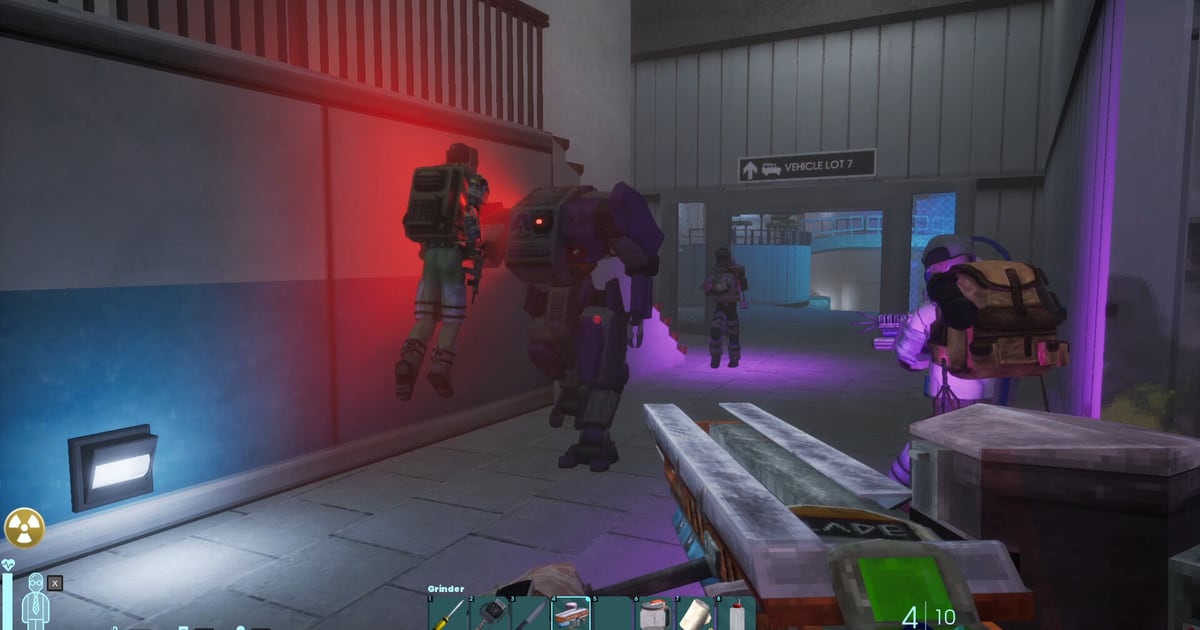
The practical reading of that schedule is that any defensive system on a bare outlet has a nine-hour hole in it. It also explains the facility’s colour language: a blue light on a device generally means power is flowing, while a red light means power is missing or depleted. When a red light appears during the day, the fault is usually a disconnected cable rather than the nightly shutdown. The facility itself sits roughly 500 metres below the surface inside an old lithium mine in Australia and is divided into eight sectors, so power layout differs from wing to wing even though the 09:00 PM rule is global.
The Electrical Grid Architecture
Power originates from stationary wall sockets built into the concrete architecture of the facility. You cannot place new infinite wall outlets; you must route electricity through specialized cabling components:
| Electrical Component | Max Connections | Power Handling | Operational Role |
|---|---|---|---|
| Wall Socket | 1 Direct Plug | Baseline infinite daytime supply | Primary power intake; cuts out completely between 21:00 and 06:00 |
| Cable Reroute | 1 In / 1 Out | Unlimited distance, built on the fly (1 Tech Scrap per segment) | Stretches power across corridors and elevator shafts |
| Plug Strip | 1 In / 3 Out | Splits 1 circuit into 3 leads | Supplies multiple benches, battery chargers, and lamps |
| Battery (Makeshift) | 1 In / 1 Out | 50 charge storage | Buffers small crafting benches through night outages |
| Battery (Industrial) | 1 In / 1 Out | 100 charge storage | Keeps automated Tesla Coil turrets running throughout the night |
Battery Mathematics: Charge Rates and Runtime
Batteries are not interchangeable, and the difference is measured in charge units rather than watts. Matching the battery to the load is what keeps a base alive through the night:
| Battery | Capacity | Charge Rate | Runtime per Device | Full Recharge |
|---|---|---|---|---|
| Battery (Makeshift) | 50 charge | +1 charge / 5 s | 250 s for 1 device | 250 s from empty |
| Battery (Industrial) | 100 charge | +2 charge / 5 s | 500 s for 1 device, 250 s for 2 | 250 s from empty |
Every battery loses 1 charge every 5 seconds per device it powers, so a single fully charged Battery (Makeshift) can hold one appliance for 250 seconds. On default settings the night lasts 270 seconds, which means one Makeshift battery on one device still dies 20 seconds before sunrise. Two Makeshift batteries wired in series sustain a single device for 375 seconds, comfortably past the outage, and three in series can carry two devices for 270.83 seconds — just enough.
The Industrial battery doubles the ceiling. One unit powers a single device for 500 seconds, or two devices for 250 seconds. Two Industrial batteries in series keep three devices alive for 291.67 seconds. There is also a more efficient layout the wiki documents: run one battery’s output into a chain of Plug Strips, then connect up to eight further Industrial batteries to that chain, each powering up to two devices. That powers sixteen devices with only nine batteries, which matters once a base has grown into multiple benches, a refrigerator, and a ring of turrets.
The Night-Cycle Power Cut Survival Loop
To ensure your base defenses stay online through the 9-hour nighttime blackout, establish a sequential battery buffer circuit:
- Connect the wall socket directly into the Input of a Battery (Industrial).
- Connect the Output of the battery to a central Plug Strip.
- Plug your refrigerator, Cooking Pots, and perimeter Tesla Coils into the Plug Strip. During the Day (06:00 - 21:00): The wall socket powers all appliances while simultaneously charging the battery bank to 100%. During the Night (21:00 - 06:00): When the facility grid trips, the battery automatically discharges, providing seamless uninterrupted power until sunrise.
Cable Reroutes, Plug Strips, and Levers
Outlets are plentiful but not unlimited, and none of them can be built — so extending reach means cabling components rather than new sockets.
- Cable Reroute: Unlike other power deployables, a Cable Reroute is not crafted ahead of time. Pull an output cable, hold Tech Scrap in your inventory, and move your aim toward the target; the game shows a small ghost box on the floor, wall, or ceiling, blue when the point is within cable range and red when it is not. Firing on a blue point consumes 1 Tech Scrap and creates a physical Reroute that the cable connects to. Because you can keep laying them, a cable’s range can be extended indefinitely, and Reroutes can be disconnected, reconnected, or packaged to refund the Tech Scrap.
- Plug Strip: Connecting an outlet to a Plug Strip splits one source of power into three. Strips can be chained into one another, which both multiplies the number of available cables and increases the usable distance from the original outlet.
- Lever: A cable run through a Lever lets you switch a device on or off with a pull, the cheap way to stop traps and benches from draining batteries while you sleep.
The one thing you cannot do is move a power outlet. Every base is therefore built around the outlets it happens to sit near, and everything else is Cable Reroutes and Plug Strips bridging the gap.
Advanced Optics: Laser Relays and Power Transmission
In later sectors (such as Cascade Laboratories and its Containment Blocks), physical copper cables cannot reach high security bulkheads. Players must utilize Laser Emitters and Laser Reflectors:
- Laser Emitters convert electric current into concentrated coherent light beams.
- Mount Laser Reflectors along high ceilings to redirect beams around corners without crossing floor walkways.
- Directing the laser into a Laser Power Converter at your outpost regenerates clean electrical current, powering remote bases without hundreds of cable reroutes.
Laser Relay Chain and Sector Reach
Where copper ends, optics begin. In later sectors physical cable runs cannot reach sealed bulkheads, so power travels as light instead:
- Laser Emitter converts electrical current into a laser beam and has a durability of 100 that can be repaired; it can be painted to recolour the beam, which is cosmetic but useful for telling one circuit apart from another.
- Laser Reflector redirects a beam around a corner, though it diminishes the beam’s power in the process.
- Laser Prism splits a single beam into multiple paths, useful when one Emitter must feed several converters.
- Laser Power Converter receives laser input and outputs power again, and is the item that makes long-distance power transmission possible.
The sector order explains why this matters. The Office Sector is the first sector a player encounters, Manufacturing West is the second, and Cascade Laboratories is the third — a labyrinthine complex that houses the Containment Blocks and runs several clearance levels from Orange up to Yellow. Cable reroutes across that distance would need dozens of segments; a reflector chain across the same corridors costs only the hardware at each turn. The Laser Collector sits outside this chain — it recharges laser weapons rather than powering a base, so it will not substitute for a Converter.
Turrets and Traps to Keep Online
The battery maths only matters because of what the night sends. The game’s Base Defense crafting category exists to hold a base against Portal Storms, Assault Events, and hostile entities, and its turret list is fixed:
| Category | Items | Power Note |
|---|---|---|
| Turrets | Chopinator, Disc Turret, Laser Turret, OX Tower, Tesla Coil, X-Ray Tower | All draw power; a dead outlet silences them |
| Traps | Laser Tripmine, Pest Trap, Shock Trap, Snag Vine, Tripwire Mine | Some trigger on contact and need no continuous draw |
| Deployables | Symphonist Scarecrow, Neutrino Emitter, Drop Shield, Exor Fetish, Pest Scarecrow, Radio Scrambler | Repel or redirect rather than kill |
A perimeter of Tesla Coils is the classic night watch, but each coil is another device the batteries must divide their charge across. Counting devices before choosing battery capacity is the difference between a base that wakes up intact and one that wakes up missing a wall.