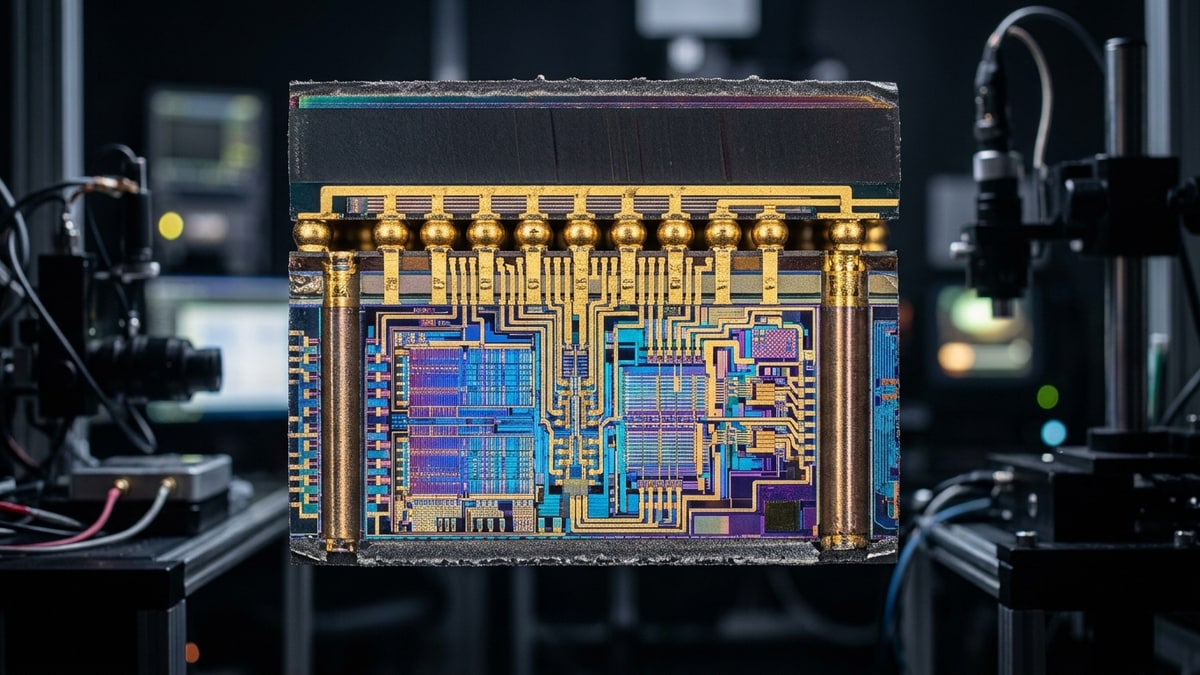
Every X3D processor AMD ever made was forced into the same compromise: the extra cache that made it the fastest gaming chip on the market also strangled its clocks. With the Ryzen 7 9800X3D, AMD flipped the stack — literally — and the compromise disappeared.
Launched on November 7, 2024 at a $479 SEP, the 9800X3D pairs Zen 5 cores with 2nd Gen 3D V-Cache3D V-Cache. AMD's stacked L3 cache that gives the CPU very fast access to data, notably boosting game framerates., and its defining trick is physical. The 64MB L3 cache die no longer sits on top of the compute die. It sits underneath it. That single packaging decision reshaped the thermal behavior, clock targets, and overclocking status of the whole product line.
What changed
To understand the change, start with what the 7800X3D gave up. On the first Zen 4 generation of 3D V-Cache, the cache die was vertically bonded on the upward-facing side of the core complex die — directly between the CPU cores and the heatsink. Silicon-on-silicon stacking insulates. Heat generated by the cores had to fight through (or around) that cache layer before it could reach the cooler, and the cache die itself is sensitive to voltage and temperature.
The practical consequences were baked into the 7800X3D’s spec sheet: relatively restrained clock speeds, a locked multiplier, strict voltage limits imposed at the platform level, and a blanket ban on conventional core overclocking. AMD traded sustained clocks for cache capacity, and reviewers judged it a fair trade for gaming.
The 9800X3D breaks that pattern on paper:
- 8 cores / 16 threads on a Zen 5 CCD built on TSMC’s 4nm process, with a 6nm I/O die — two package dies in total.
- 4.7 GHz base clock, up to 5.2 GHz boost — a 500 MHz higher base and 200 MHz higher boost than the 7800X3D, and the highest clocks ever shipped on an X3D chip at launch.
- 96MB of L3 cache (104MB of total cache), made up of 32MB on the CCD plus the 64MB stacked die.
- 120W TDP, with a maximum operating temperature (Tjmax) of 95°C.
- Fully unlocked for overclocking — the first X3D processor where this is true. Precision Boost Overdrive, Curve Optimizer voltage offsets, and Ryzen Master support are all listed on the spec sheet.
There is no cooler in the box, and AMD’s own product page states that a liquid cooler is recommended for optimal performance.
Outside the thermal headline, the spec sheet stays conventional for Zen 5. The chip exposes 28 lanes of PCIe 5.0 (24 usable), two channels of DDR5DDR5. A generation of system RAM (memory); newer and faster than DDR4. officially rated to 5600 MT/s for a two-DIMM single-rank layout, a 2-core Radeon iGPU at 2200 MHz for display output, and ECC support pending motherboard enablement. Boxed, it carries product ID 100-100001084WOF, with support for every AM5 chipset from A620 to X870E. Instruction set support includes AVX-512, a capability Zen 5 widened considerably and which helps in emulation and certain productivity workloads.
How it works
The fix is elegant because it is so blunt. In the 2nd Gen design, AMD took the entire sandwich and inverted it: the 64MB cache die now sits below the core complex die, connected by through-silicon vias (TSVs) and a direct copper-to-copper “bumpless” bond. AMD’s own technology page puts the payoff plainly — with the extra memory now sitting below the processor cores, “those cores now have direct access to the cooler. And when a chip runs cooler, it can run faster.”
The bond technology underneath matters too. AMD cites over 200 times the interconnect density of an on-package 2D chiplet arrangement and more than 15 times the density of conventional micro-bump 3D stacking, with over three times the interconnect energy efficiency of micro-bump approaches. In practical terms: moving data vertically between the cache and the cores over this bond costs little power and generates little extra heat doing so.
With the compute die now touching the thermal interface directly, three things follow:
-
Higher sustained clocks. The cores shed heat at roughly the rate of a standard Ryzen 9000 part, so the 9800X3D holds frequencies that the cache-on-top design could not. AMD’s launch materials attributed an up to 8% average generational gaming uplift versus the 7800X3D — with some titles gaining far more than the average — and an average ~20% lead over the then-flagship competitor in AMD’s internal testing.
-
Headroom for tuning. Because the cache die is no longer the first thing in the thermal path, AMD could certify a 4.7 GHz base clock — 500 MHz above its predecessor — at the same-sounding 95°C Tjmax, and still leave voltage and frequency margins exposed to the user.
-
An unlocked multiplier for the first time. The 9800X3D supports manual overclocking, PBO, and Curve Optimizer on top of AMD EXPO memory overclocking. (Standard warning applies: AMD’s documentation notes that overclocking outside published specifications voids the product warranty.)
Independent teardowns at launch visually confirmed the layout: when the Zen 5 CCD was opened up, the cache stack appeared on the side of the die facing down toward the package — the mirror image of the 7800X3D’s arrangement.
The stacking change also had a product-line consequence. Freed from the old thermal constraint, AMD went on to ship dual-CCD X3D parts without downclocking the compute side, culminating in what it calls the first dual 3D V-Cache desktop processor design. The cache-under-core blueprint is now the template.
What the numbers say
The spec-sheet deltas versus the 7800X3D summarize the thermal story well: same core count and the same 96MB L3 total, but a base clock 500 MHz higher, a boost ceiling 200 MHz higher, and an unlocked die alongside. AMD’s internal game testing (a roughly 40-title suite, tested with DDR5-6000 and flagship GPUs) framed the generational gain at about 8% on average, and called out 1% low frame rates — the stutter metric — as a particular strength in titles where average FPSframerate. How many images (frames) the game shows per second; higher = smoother motion. 60 fps is a common target. alone looked similar.
It is worth noting what did not change. The 9800X3D still runs on socket AM5 (supported across A620 through X870E chipsets, subject to BIOS updates), still ships with two-channel DDR5 — officially rated to DDR5-5600 — and still caps at 95°C. The I/O die remains 6nm. If you have a working AM5 board and cooler, this is a drop-in generation.
The thermal story also reframes the cooler question. Because the cores now sit directly under the integrated heat spreader, the 9800X3D responds to cooling the way a standard Ryzen 9000 part does: better cooling translates into longer boost residency under Precision Boost 2, rather than being absorbed by a hot cache sandwich. AMD’s liquid-cooler recommendation reads less like a marketing flourish and more like a practical note that this chip, unlike its predecessor, can actually use the thermal budget you give it — and that enthusiasts can now extract further gains through Curve Optimizer undervolting, the classic X3D trick that previously lived in a gray area alongside the locked multiplier.
What it means
The 7800X3D proved cache capacity wins games; the 9800X3D’s contribution is proving you don’t have to pay for that cache with clock speed and tuning freedom anymore. By moving the memory below the silicon that actually generates heat, AMD removed the thermal excuse that defined more than two years of X3D caveats — locked multipliers, aggressive voltage guardrails, and “cooler than expected but slower than it should be” boost behavior.
For buyers in 2026, the 9800X3D is no longer the newest X3D on the shelf — AMD has since shipped a faster-clocked successor using the same 2nd Gen stacking — but it remains the part where the design pivot happened, and its AM5 compatibility and mature BIOS support make it the low-risk version of that pivot. For the industry, the lesson is that advanced packaging is now a first-order performance lever: where you put the silicon matters as much as what the silicon does. Direct copper-to-copper bonding and TSVs were server-grade EPYC technology a few years ago; they now decide how cool your gaming CPU runs.