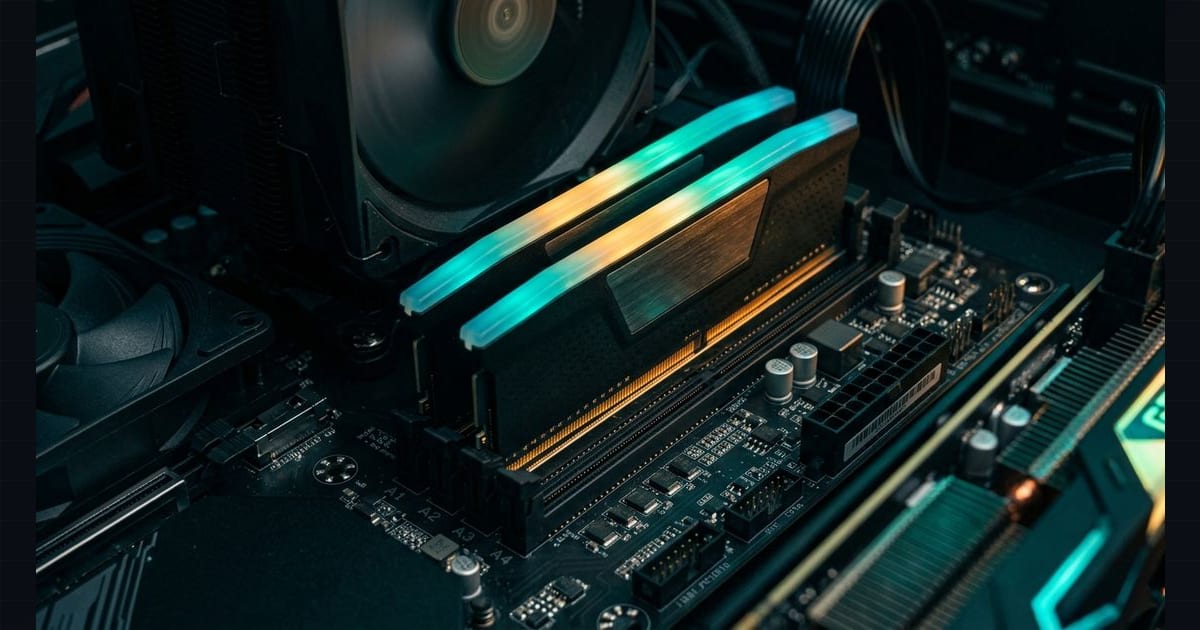
The global PC gaming memory market is undergoing its most significant structural shift since the introduction of DDR5DDR5. A generation of system RAM (memory); newer and faster than DDR4.. ChangXin Memory Technologies (CXMT), China’s premier domestic DRAM manufacturer, has scaled volume production of 17nm and 18nm DDR5 silicon wafers, introducing substantial market competition to the incumbent trio of Samsung, SK Hynix, and Micron.
What changed: CXMT has scaled 17nm/18nm DDR5 to volume production, ending the three-company DRAM era. Why it matters: A 15–22% price-per-gigabyte drop on mainstream DDR5 kits is expected heading into late 2026. Who should care: Anyone speccing a build — 32GB dual-channel is moving back to default-build territory.
That last part is the story. DRAM has effectively been a three-company cartel for a decade — every pricing trend, every supply “adjustment,” every generation cadence was set by three fabs with aligned incentives. CXMT scaling to volume production doesn’t just add capacity; it adds a fourth decision-maker with entirely different incentives: a state-backed manufacturer whose strategic goal is market share, not margin protection. For PC gamers, that distinction is the difference between a spec bump and a genuine market reset.
1. Supply Impact & DDR5 Pricing Outlook
Over the past two years, memory manufacturers prioritized high-bandwidth memory (HBM3e/HBM4) for AI server infrastructure, restricting consumer DDR5 supply and keeping kit prices elevated. The mechanic here is straightforward but worth spelling out: HBMHBM. High Bandwidth Memory — fast stacked memory used by some high-end GPUs and AI chips. sells at a steep premium over commodity DRAM, so every wafer start the big three dedicate to AI accelerators is a wafer denied to the DIMM market. Gamers weren’t just paying more — they were subsidizing datacenter margin by competing for a deliberately shrunken supply pool.
CXMT’s aggressive fab capacity expansion in Hefei is rapidly shifting consumer memory dynamics:
| Development | Detail | Impact |
|---|---|---|
| Volume Output Increase | Monthly wafer output has exceeded 120,000 wafers, with a growing percentage allocated to standard DDR5 desktop and laptop modules. | CXMT has no meaningful HBM business bidding for the same wafer starts, so its consumer allocation isn’t hostage to the AI pull the way Samsung, SK Hynix, and Micron allocations are — its DDR5 output is structurally stickier for the retail channel. |
| Price Normalization Window | Industry supply data indicates a 15% to 22% reduction in price-per-gigabyte for mainstream 32GB (2x16GB) DDR5-6000 kits heading into late 2026. | Effectively cancels out most of the AI-cycle price inflation of the last two years and returns 32GB dual-channel to “default build” territory rather than an upgrade line item. |
| Low-Cost Entry Tier | Entry-level 16GB DDR5 kits are expected to hit price parity with legacy DDR4 modules. | Kills the last rational argument for DDR4-based budget platforms and pulls the entire bottom of the market onto the DDR5 ecosystem, growing the install base developers can safely assume. |
2. Speed Innovations: DDR5-8000+, CUDIMM & CAMM2
Increased raw silicon output is accompanied by technical memory architecture innovations designed to overcome signal degradation at high frequencies:
- Clocked Unbuffered DIMM (CUDIMM): CUDIMM modules integrate an On-DIMM Clock Driver (CKD) directly onto the RAM stick. By regenerating the clock signal at the module level, CUDIMMs achieve stable DDR5-8000 to DDR5-9200 speeds without custom liquid cooling or extreme voltage overclocks. The important shift is where the engineering burden lands: historically, hitting those frequencies meant binning kits, overvolting, and praying to the IMC lottery. Moving clock regeneration onto the stick turns extreme memory speed from an overclocker hobby into a SKU you buy off the shelf — which is exactly the kind of change that moves the median gaming rig, not just the leaderboard rigs.
- LPDDR5X CAMM2 Modules: The Compression Attached Memory Module (CAMM2) standard replaces traditional DIMM slots on gaming laptops and compact ITX motherboards. CAMM2 provides 128-bit wide memory channels on a single thin module, offering reduced trace lengths and lower thermal output. For small-form-factor and laptop gaming this is the unlock: one module, full dual-channel width, shorter signal paths, and less heat in a chassis that has no thermal headroom to spare.
3. Gaming Impact: Frame Pacing & 1% Lows
For memory-intensive gaming titles—such as 1,000-unit RTSRTS. Real-Time Strategy — a strategy game where everyone plays at the same time, continuously, instead of taking turns. battles in Stormgate, dense player hubs in World of Warcraft, and late-game turns in Civilization VII—moving from standard DDR5-4800 to optimized DDR5-7200 CUDIMM memory reduces frametime spikes and boosts 1% low frame rates by up to 18%.
Notice what these examples have in common: none of them are GPUGPU. Graphics Processing Unit — the chip that renders the game's visuals; the main driver of framerate and image quality.-bound. Thousands of simulation entities issuing memory requests, MMOMMO. Massively Multiplayer Online — a game that hosts very large numbers of players together in one shared, persistent world. raid logic churning through player-state tables, grand-strategy AI resolving late-game turn trees — these workloads hammer memory bandwidth and latency while the graphics card waits. This is precisely why average FPSframerate. How many images (frames) the game shows per second; higher = smoother motion. 60 fps is a common target. is the wrong metric for memory upgrades: a faster kit barely moves your mean, but it compresses the worst-case frametimes that you actually perceive as stutter. An 18% lift in 1% lows is, in felt experience, a bigger improvement than a GPU tier upgrade costing three times as much.
Why It Matters: The Cartel Era Is Over
DRAM pricing has historically been cyclical but disciplined — three suppliers meant capacity cuts were coordinated in practice if not on paper, and consumer prices always recovered faster than they fell. A high-volume, share-seeking fourth entrant breaks that discipline. Once CXMT’s DDR5 is flowing at this scale, the incumbents can’t quietly re-restrict consumer supply to protect HBM margins without ceding the retail channel entirely. The 15–22% price-per-gigabyte decline isn’t a sale cycle; it’s a structural repricing, and structural repricings don’t bounce back.
There’s a second-order effect worth watching: when builders stop treating 32GB as aspirational, minimum spec targets across the industry creep upward. Engines, sim-heavy RTS titles, and MMOs design for the installed base they actually find. Cheaper, faster RAM doesn’t just make current games smoother — it raises the floor every future game is built on.
The Take
The DDR5-8000 CUDIMM headlines and the Hefei wafer counts are the same story told twice: the era of RAM as a scarcity-taxed component is ending. The last two years punished anyone building a PC — you paid inflated prices for middling speeds because three suppliers had somewhere more profitable to send their silicon. CXMT’s volume ramp flips both halves of that equation at once.
Our advice: if you’re speccing a build in this window, stop budgeting around today’s sticker prices for mid-2027 delivery. The 32GB DDR5-6000 kit that’s a splurge today is the default by the time the next generation of sim-heavy titles ships. And if you’re on DDR5-4800 with a modern CPU, a CUDIMM kit is the single highest value-per-dollar upgrade on the market — the 1% low data says your memory, not your GPU, is what’s stuttering in the fights that matter. For a genre built on dense simulation — RTS, MMO, 4X4X. eXplore, eXpand, eXploit, eXterminate — a grand-strategy subgenre about building a civilization over a long arc. — cheap, fast memory isn’t a footnote. It’s the frame-pacing patch the whole genre has been waiting for.
The window the article tracks is specific: the 15–22% repricing lands heading into late 2026, with 16GB kits reaching DDR4 parity on a similar timeline. If those supply numbers hold, the next build cycle — CUDIMM kits, CAMM2 laptops, 32GB baselines — is the first in years where memory is the easy part of the spec sheet.
Next read
Fast RAM only pays off with the right processor — see our flagship CPU and 3D V-Cache benchmark breakdown. For the storage side of the same build, check our PCIe 5.0 SSD and DirectStorage benchmarks, and new kits are tracked on the launch calendar.