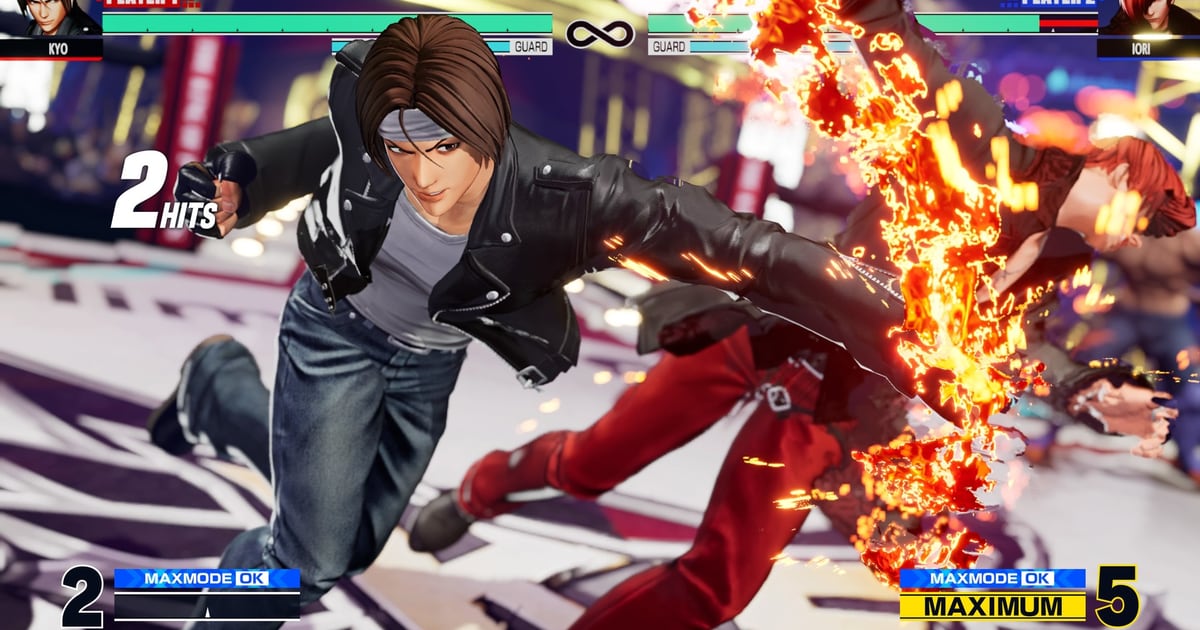
This site has covered the meter systems of Street Fighter 6, Tekken 8 and — closest to home — SNK’s own REV gauge in Fatal Fury: City of the Wolves. It has never written a word about The King of Fighters XV, the SNK flagship that preceded it and is still on a live patch line. This piece fills that gap where KOF XV stops behaving like a 1v1 game: there are two meters, and the second is bought with the first.
What this covers: how SNK defines the Power Gauge, MAX Mode and MAX Mode (Quick) in the game’s own web manual, what every action costs in each currency, and how the rising 3v3 bar ceiling changes the arithmetic of spending. Why it matters: MAX Mode is not a power-up with a price, it is an exchange rate. Once you can tell which gauge a move is charging, “when do I activate” stops being a feeling. Who should care: players arriving from a one-lifebar fighter, and KOF XV players who activate MAX Mode by reflex and cannot say why.
The names SNK prints, and where they disagree
This piece says “Quick MAX” in its title because it is the shorter form. SNK never prints that string. Its materials use four labels for one state: the FEATURES page heads the section “MAX MODE QUICK” and names the result “MAX Mode (Quick)”; the Battle System page frames it as a variant of the ordinary activation; the Icons page names the command-list symbols “Activate MAX Mode” and “Activate MAX Mode (Quick)”, noting “They are displayed in training mode and the command list.”; and the patch notes use a fourth, “MAX Activation (Quick)”.
The patch-note phrasing matters most. Ver.2.50 uses “MAX Activation (Quick)” three times in its character tables — twice as “Increased cancel window for MAX Activation (Quick)” and once as “Can now cancel into MAX Activation (Quick)”. Whether a move can be Quick-activated at all is therefore a property SNK tunes per move, per patch. Quick MAX is not a universal option you learn once; it is a cancel window some moves have and others do not.
Three gauges, and the manual’s own names for them
The Screen Layout page is the only place the game’s own HUD vocabulary is written down in one list:
| HUD element | What SNK says it is |
|---|---|
| Guard Crush Gauge | “decreases when guarding against enemy attacks, causing a Guard Crush when the gauge depletes completely,” and “recovers over time” |
| Power Gauge | “Increases by landing hits or guarding,” with bars “displayed as numbers” |
| MAX Mode Gauge | “displayed when MAX Mode is activated”; while it is on screen, Super Special Moves and EX Special Moves are available |
The Battle System page expands the Power Gauge: it is “the gauge needed to activate Super Special Moves, MAX Mode, Guard Cancels, and more,” and “Landing hits or guarding increases the gauge, adding one bar when maxed out.”
Two things follow, and both are the kind a 1v1 habit gets wrong. First, the Power Gauge fills from defence as well as offence — blocking is income, so a player who has internalised “meter comes from hitting” blocks too little and wonders why the opponent always has two bars. Second, the Guard Crush Gauge is a resource with its own recovery clock, and MAX Mode attacks it: in full MAX Mode, SNK says “Attacks and Guard Crush strength increase.” That is not a damage buff with a side effect, it is a second pressure on a gauge that refills on a timer.
What each action costs, in SNK’s own units
The manual’s “Gauge Usage for Each Action” list, reordered by cost tier. The middle column is what a move charges with no MAX Mode running; the right column is the same move while MAX Mode is up.
| Action | Outside MAX Mode | Inside MAX Mode |
|---|---|---|
| EX Special Move | half a power bar | “small amount” of MAX Mode gauge |
| Advance Strike | half a power bar | “specific amount” of MAX Mode gauge |
| GC Emergency Evasion (forward or back) | one power bar | “small amount” of MAX Mode gauge |
| Guard Cancel Blow Back | one power bar | “small amount” of MAX Mode gauge |
| Shatter Strike | one power bar | “specific amount” of MAX Mode gauge |
| Super Special Move | one power bar | “specific amount” of MAX Mode gauge |
| MAX Super Special Move | two power bars | one power bar plus “specific amount” of MAX Mode gauge |
| Climax Super Special Move | three power bars | one power bar plus the remainder of the MAX Mode gauge |
Read the right-hand column as three levels of precision, because that is what it is: some actions bill in a “small amount,” some in a “specific amount,” one in “the rest.” SNK prints no number for any of them. The MAX Mode gauge is a currency whose unit cost is published as a category, not a quantity. Any guide handing you a figure is reporting its own training-mode measurement or inventing it, and the manual gives you no way to check which.
The substitution is the whole mechanic
In one sentence: MAX Mode lets the MAX Mode gauge take the place of power bars.
Look at the MAX Super row. Outside the mode it wants two power bars; inside, one bar plus a slice of mode gauge — one entire bar substituted. The Climax row goes further: three bars outside, one bar plus whatever is left of the mode gauge inside. Entering MAX Mode costs two bars, so a Climax out of MAX Mode costs two for the mode plus one for the move — the same three a bare Climax costs. A MAX Mode that ends in a Climax never costs more power gauge than the Climax alone, and everything the mode did before that point was free in power-gauge terms. A player who saves three bars for a bare Climax and never touches MAX Mode has paid full sticker for the same move and declined every EX special the mode would have thrown in.
There is a floor. The Climax “will consume only one power gauge bar, as well as the remainder of the MAX Mode gauge” — the remainder is mandatory. Whether you can enter MAX Mode, spend the gauge to nothing, and still buy a Climax for one bar plus zero is not stated anywhere, and this primer will not pretend to know. Treat the remainder as a real cost.
Why MAX Mode (Quick) is a different product
“Activating MAX Mode when you land a regular or command move (or your opponent guards against them) will instead activate MAX Mode (Quick). This lets you combo immediately into the next action without any openings. Just remember, neither attack nor Guard Crush strength increase during MAX Mode (Quick). Also, you start off with less MAX Mode gauge than regular MAX Mode.”
The FEATURES page resolves the manual’s parenthetical: “Also works if the attacks are blocked.” So Quick is what you get when the activation happens on contact. You give up the attack increase, the Guard Crush increase, and some of the gauge. You get one thing: the activation is guaranteed to convert, because it happens inside a hit or a block that has already resolved.
Drop the framing “Quick is the worse MAX Mode.” The two are not comparable at the moment of decision: off a confirmed hit you cannot enter full MAX Mode at all, so the only question there is whether the extension is worth two bars. The corollary is defensive — because Quick also triggers on block, it is a pressure tool off a blocked normal, two bars for one guaranteed gap with no bonus chip on the Guard Crush Gauge.
One last note on the patch phrasing: “Can now cancel into MAX Activation (Quick)” is a sentence about access, not price. Ver.2.50 did not make Quick cheaper for that move; it made Quick reachable from a situation where it was not.
The 3v3 ceiling, and why a bar is not a constant
A 1v1 fighter teaches you that a bar is a bar. Team mode breaks that, and the manual prints the numbers:
| Format and slot | Maximum power bars | “Total Gauge Amount” |
|---|---|---|
| Team battle, first character | 3 | 1000 |
| Team battle, second character | 4 | 1250 |
| Team battle, third character | 5 | 1500 |
| Single battle | 5 | 1500 |
Two bars is two-thirds of your first character’s ceiling and two-fifths of your anchor’s — a far larger commitment in a team’s opening round than in its closing one, the opposite of the 1v1 instinct to hoard meter for the endgame.
Less obviously, the columns do not scale together: three bars to five raises the printed total from 1000 to 1500, not to a proportional 1667. SNK never defines what a “Total Gauge Amount” totals, but as printed the per-bar quantity is not constant across slots.
Then the rule that makes teams structurally different from three consecutive 1v1s:
“When one character is defeated and the next appears, that player’s power gauge gains an extra bar, and the gauge maximum is increased by one (up to a maximum of five gauges).”
Losing a character raises your ceiling. Knock out the opponent’s point and you have not just taken a life; you have handed them a four-bar wallet, and their next fighter also inherits a lifebar that “is carried over to the next round (and may recover slightly, depending on the time left at victory).” A Climax spent closing out a character already at a sliver buys very little: three bars gone, a raised cap for the replacement, and a lifebar that carries over.
The manual does not say whether banked bars carry over on top of that extra bar or whether the incoming character is simply granted one. That unstated detail decides whether a doomed point character should dump meter on the way out or bank it — and it is a five-minute Training test, not a forum question.
The cancel routes are the printed exchange points
The Cancels section lists four routes, and only two move value between the currencies. Cancel takes a normal into a command or Special Move, no gauge involved. Super Cancel takes a Special into a Super or Climax. Advanced Cancel takes a Super into a MAX Super, with the limit that “You can’t cancel into the MAX version of the same Super Special Move.” Climax Cancel takes a Super or MAX Super into a Climax.
Advanced Cancel is where the exchange shows mid-combo: Super Cancel a special into a Super for one bar, then Advanced Cancel that Super into a MAX Super — one bar plus mode gauge instead of two. The mode is what makes the third link affordable.
What to set in Training, using the game’s own labels
The TRAINING page lists its pause-menu settings by name, and several exist for this problem: Power Gauge, Max Power Gauge, Max Mode Gauge, Guard Gauge, Stun Value, plus Key Data / Attack Data toggles and a HUD Display switch. Recording offers Standard and Reversal modes with five slots each. The procedures below are this primer’s suggestions built on those settings, not SNK tests.
- Price the drain. Set the Max Mode Gauge to full, activate in an empty screen, and time how long it lasts untouched. The manual only says it drains “slowly over time” and that the gauge “Shows the time remaining for MAX Mode.”
- Price each action against that clock. From full gauge, fire one EX Special, then one Super Special, and compare what is left. This is how “small amount” and “specific amount” become a working budget for your character on this patch.
- Isolate the Guard Crush clause. Record a blockstring, play it back against a guarding dummy, and run it twice — once in full MAX Mode, once in MAX Mode (Quick) off a blocked normal. The manual credits the Guard Crush strength increase for the difference, so the Guard Gauge readout should show it.
What the manual does not print
No unit value for “small amount” or “specific amount”; no duration in frames or seconds for the MAX Mode gauge, only that it drains slowly; no per-character table of which move sits in which tier; no statement on whether banked power bars survive a knockout; no definition of the “Total Gauge Amount” unit.
The costliest gap is the second. Without a printed duration you cannot compute how much mode gauge a sequence consumes, so every “is this worth two bars” judgement is a measured habit rather than a calculation. That is not a flaw in the game; it is a flaw in reading the documentation as complete.
The version this assumes
Everything above assumes Ver.2.52, listed on the official news index with a 2026.8.31 date and shipped as a one-page PDF headed “THE KING OF FIGHTERS XV Patch Ver.2.52.” Its system-level entries cover Training Mode recording playback and wall knockback pushbox behaviour, not the meter. The last patch to touch Quick activation was Ver.2.50 (2026.06.29) with those three “MAX Activation (Quick)” clauses; Ver.2.51 sits between them with no MAX Mode entries.
Roster state, from two sources that state it differently: Steam’s copy says “A total of 39 playable fighters at launch,” while SNK’s CHARACTERS index now carries 61 character entries — seventeen three-fighter teams plus ten solo entries (Shingo Yabuki, Kim Kaphwan, Sylvie Paula Paula, Goenitz, Najd, Duo Lon, Hinako Shijo, Mature, Vice and Omega Rugal).
Platforms are PlayStation 5, PlayStation 4, Xbox Series X|S, Windows 10, Steam and Epic Games Store, released February 17th, 2022 per the official product block. Cross-play is named differently on each storefront — “Cross-Play” on PlayStation, “Cross-Network Play” on Xbox and Windows 10, “Cross-Platform Play” on Steam and Epic — with the manual noting “The feature’s name differs between platforms, but is functionally the same.” That is cosmetic; the timing question underneath belongs to the rollback netcode glossary.
If you are still choosing rather than optimising, the 2026 round-up of which fighter to main puts KOF XV’s neighbours in context.
Next read
- Fatal Fury: City of the Wolves REV System Guide — SNK’s newer gauge, which fills instead of draining
- Which Fighting Game to Main in 2026? SF6, Tekken 8, GGST — where KOF XV sits in the 2026 field
- GGPO and the Modern Rollback Stack: A Glossary — the netcode vocabulary behind KOF XV’s online play