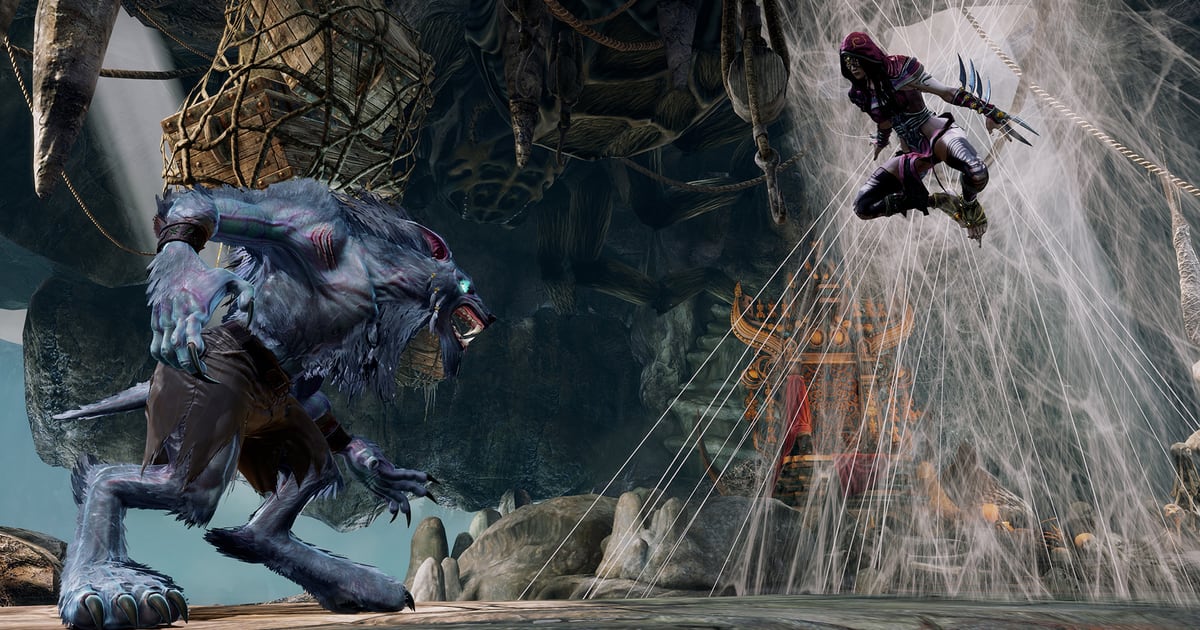
Killer Instinct is the one long-running fighting game whose combo system is built on an openable counter, and that single design decision generates a vocabulary that does not transfer cleanly from anything else. Players arrive from Street Fighter or from 2XKO, hear “breaker” used as a verb, assume it means the same thing as a Burst, and then lose a round to a counter breaker.
This site already covers Killer Instinct twice, in passing: the rollback glossary uses it as a netcode case study, and the 2XKO tag-team analysis name-checks Combo Breaker as an ancestor of Dynamic Save. Neither defines a term in the game’s own vocabulary. This piece does that, and nothing else: sixteen terms, what the documentation says each one does, and the specific way each is misused by people who learned a different fighter first.
What this covers: sixteen terms from Killer Instinct’s combo system — opener, auto-double, linker, manual, ender, KV meter, ender level, combo breaker, lockout, counter breaker, shadow meter, shadow move, shadow counter, instinct, ultra combo and Ultimate — each defined against official or developer-endorsed material. Why it matters: the terms are relational. “Breaker” is not a defensive resource like a Burst; it is a timed read against a specific attack strength, and the counter-read to it is a 4-second lockout. Getting the relationship wrong costs matches. Who should care: players arriving from 2XKO, Street Fighter 6 or Guilty Gear -STRIVE- who have been told KI’s system is “just parries”, and anyone returning to a game whose last patch was in May 2024.
The terms in one table
The official site states the design intent plainly: while “there’s a lot that sets KI apart from other fighting games, KI’s signature mechanic is the Combo Breaker system, which allows for you to escape your opponent’s Combos with proper timing and execution.” Everything below follows from that sentence.
| Term | What the game means by it | The mistake to avoid |
|---|---|---|
| Opener | A move the designers marked to start the combo sequence. Jumping attacks always qualify, along with almost every special that leaves the opponent grounded. | Treating grounded normals as combo starters. Most are not openers and must be special-cancelled into one; a short list of command normals is the exception. |
| Auto-double | The normal you cancel into from a linker; it hits twice, does more damage and builds KV faster. | Calling it a “chain”. Chained normals do not count as a new move inside this system. |
| Linker | The special move you cancel an auto-double or manual into; linkers carry the strength restriction that decides which manuals you may follow with. | Assuming linkers are the damage. Their job is to keep the sequence alive between normals. |
| Manual | A normal performed with link timing instead of cancel timing — one hit, delayed, much harder to break. | Assuming manuals are optional flair. The strength of the linker before it caps which manual you can use. |
| Ender | A special move executed with HP or HK during a combo that cashes out the white (recoverable) damage. | Assuming an ender always ends the combo. Launcher and wall-splat enders are designed to allow follow-ups. |
| KV meter | “Knockdown Value” — the red bar under the combo counter. At 100 or higher the next non-ender normal or special causes a blow out. | Watching the combo counter instead of the red bar. Light attacks build KV fast, heavies build it slowly, shadow moves build none. |
| Ender level | The four green bars under the KV meter. It scales whatever property your ender applies; a shadow ender adds one level, so level 5 is reachable. | Cashing out at level 1 because the combo looked long. Ender level tracks white life, not hit count. |
| Combo breaker | Pressing the punch and kick of the same strength as the attack hitting you, during the breakable part of a combo. Restores 50% of your white life. | Calling it free. A wrong strength or wrong timing is a lockout, and the attacker can punish the attempt. |
| Lockout | The state after a failed break attempt: no breaking for 3 seconds or until the combo ends, with an L, M or H icon or a white clock showing which failure you made. | Reading the icon as decoration. It prints the strength you should have pressed. |
| Counter breaker | The attacker’s answer: MP+MK mid-combo enters a punishable counter pose. If the defender breaks into it, they eat a blast plus a 4-second purple lockout. | Attempting it on reaction. It only works as a prediction, and it is never safe. |
| Shadow meter | The purple bar holding two stocks, spent on shadow moves and shadow counters. Fulgore and Omen are the two characters with a use that needs the full bar. | Hoarding it. With a two-stock cap the game expects you to spend constantly. |
| Shadow move | A special performed with two punches or two kicks instead of one; it freezes the screen on activation and adds properties such as invincibility, speed or range. | Assuming it is unbreakable. Shadow linkers are broken by hitting three of their hits in rhythm. |
| Shadow counter | MP+MK while in block stun, costing one stock: a parry state that fires a predetermined shadow move if an attack lands. | Using it as a universal reversal. Startup differs per character and the parry state is punishable when it whiffs. |
| Instinct | The yellow bar under the health bar, filled by taking damage and landing combo breakers, spent with HP+HK for a 15-second character-specific mode. | Treating it as a super. Activation has 0 recovery frames, resets KV to 0, and mostly buys safety and screen freeze, not damage. |
| Ultra combo | A character-specific motion with three punches or three kicks, available only once the opponent’s second life bar is at 15% or less (danger state). Unbreakable; ends the match. | Expecting to break it. You cannot — the character is already KOed. |
| Ultimate | An upgraded finisher available to 16 of the 29 characters, on your first life bar only, triggered during the opening moments of an ultra. | Assuming it is universal. It is not, and it is unavailable if you extend into a second ultra. |
The combo sequence, in the game’s words
Killer Instinct’s combo is not a string you memorise; it is a structure you alternate inside. The developer-endorsed guide by Infil — linked directly from the official How to Play page as “widely known as the most comprehensive Killer Instinct guide” — puts the philosophy first: “Combos are designed to be a constant two-way interaction in Killer Instinct; they are, effectively, a prolonged mixup that favors the offensive player.”
That two-way framing is why the vocabulary is dense. An opener is the gateway: the move that switches the match from neutral into the combo state, after which “any normal or special move you execute behaves differently until the combo ends.” From there the attacker alternates normals and specials — auto-doubles or manuals on one side, linkers on the other — until the KV meter or an ender closes the sequence. Openers are also the reason the first hits of a combo are safe: the guide notes that “the beginning of your combo, up to your opener, is not breakable.”
Three wrinkles matter more than they look:
- Manuals carry a restriction. After a linker of a given strength you may only follow with a manual of the same strength or lower, so heavy linkers — easier to break — are what unlock the full set of options.
- Not everything is breakable. Projectiles are not, apart from Maya’s dagger toss used as a linker; enders are not, except when an opener is cancelled straight into one.
- The 3-Move Rule exists for characters who can chain several grounded normals before a special. Three distinct attacks in, the sequence becomes breakable. Chained normals and rekka-style specials count as one move, so it “turns up extremely rarely in normal Killer Instinct play.”
Breakers, lockouts and the counter-read
A combo breaker is an input, not a resource: press the punch and kick matching the strength of the attack that is hitting you. It works on auto-doubles, manuals, linkers and post-opener juggles. It does no damage, but it returns half your white life — and it cannot whiff or be blocked, which is why it feels so different from a Burst.
Failing is where the vocabulary gets specific. A wrong strength produces a strength lockout, marked with a blue L, yellow M or red H that tells you the strength you should have used. A correct strength at the wrong time produces a timing lockout, marked with a white clock. Either way you cannot break for 3 seconds. The attacker’s counter is the counter breaker: MP+MK stops the combo, and if the defender breaks into the pose they take a blast, the combo restarts at 0 KV, and they receive a purple lockout lasting 4 seconds — one second longer than a normal lockout.
Breaking a shadow linker is its own skill. You must parry three of its hits in rhythm with any strength, and the announcer counts them out — “1, 2, 3!” — which also tells the attacker you are trying, and therefore that a counter breaker is available to them.
The two meters, and what instinct actually buys
Shadow meter and instinct are easy to confuse because both are bars and both change the combo rules. They are not the same kind of resource.
Shadow meter is spending money on both sides. Two stocks, no more, except for Fulgore and Omen; one stock buys a shadow move, which announces itself with a screen freeze, and one stock buys a shadow counter, which converts block stun into a parry. Blocked moves build more meter than hits; whiffs and combo breakers build none.
Instinct is a comeback gauge with a 15-second clock. It fills by taking damage and by landing combo breakers — the guide’s practical read is that you will earn at least two gauges a match, and that your first arrives no later than roughly 30% health remaining on your first bar. Activation has 0 recovery frames, freezes the screen like a shadow move, resets the KV meter to 0, and — the part newcomers skip — lets you cancel any grounded non-throw move that hits or is blocked. That cancellation, not the character-specific buff, is what most instinct is spent on.
Ultras, Ultimates and the danger-state condition
The ultra combo is the piece of KI vocabulary everyone has heard and almost nobody defines correctly. It is “nothing more than a specific ender” available only in danger state — the opponent’s second life bar at 15% or less. It is unbreakable, because the character is KOed and unresponsive, which means cancelling an opener straight into an ultra is a legitimate way to deny a break attempt.
Two variants sit alongside it. Stage ultras trigger on specific stages at specific positions and knock the opponent into a hazard. Ultimates are a separate finisher for 16 of the 29 characters, require your first life bar, and are entered during the opening moments of an ultra; the official store listing describes them more cautiously as “All released Ultimate Finishers (for a limited selection of Fighters).”
What the official record does and does not say
Two limits are worth stating rather than papering over.
First, the domain killerinstinct.com — listed as the official site in this cluster’s own brief — now serves a parked page from a hosting company, not a game reference. The live official material is on ultra-combo.com under a Microsoft copyright line, and that is what this piece cites.
Second, Microsoft and Iron Galaxy have not published a written, frame-by-frame system document. The in-game Dojo is described by the store as teaching “all the core mechanics for Killer Instinct and Combo Breaker Training to master the art of breaking”, but its contents are not reproduced as text anywhere official. Definitions above that are not direct quotes from the official site come from Infil’s guide, which the official site endorses by name — authoritative but secondary. Where the guide gives a per-character number (shadow counter startup, for instance), this piece leaves the number out rather than restate it unverified.
Version state: what is actually live
Killer Instinct is not a live-service game with a cadence. The base game is free to play with a free weekly rotating fighter; the Anniversary Edition — 29 fighters, all premium content — released on 28 November 2023. The patch record since is short.
| Patch | Date | What it did |
|---|---|---|
| 3.9.30917.1.290283 | 17 May 2023 | Migrated legacy services to PlayFab; quality-of-life only, “no new content or tuning changes”. Steam ranked points bug fixed. |
| 3.11.08 | 22 Nov 2023 | Anniversary build: UI remaster, DX12 renderer on Xbox, native 4K/60 on Series X and 1440p/60 on Series S, new online services, balance updates, reduced unlock costs. |
| 3.11.11 | 15 Dec 2023 | Dropped-input fix, Pro Stars award bug, VS screen and stability fixes. The 3.11 page also carries the first tuning pass since 3.9.13 on 16 Aug 2018. |
| 3.11.14 | 29 Feb 2024 | FSR 2 anti-aliasing, GTAO ambient occlusion, fighter material and lighting adjustments, upscaled cinematics on Series S|X. |
| 3.11.15 | 29 Mar 2024 | Ranked Crossplay between Steam and Xbox/Windows, a blocking system, character level cap raised from 50 to 65, 87 additional remix colours. |
| 3.11.16 | 9 Apr 2024 | Colour and menu-option fixes. |
| 3.11.18 | 14 May 2024 | Mira retro accessory texture fix, plus an Xbox One crash fix tied to the accessories menu. |
That last row is the honest headline for anyone deciding whether to learn the game in 2026. The final patch touches textures, not numbers; the last gameplay tuning is 3.11.15 in March 2024, where Hisako’s Influence lost damage across all four strengths (heavy from 60 to 39) and gained whiff recovery, and Thunder’s Sammamish got five frames back on landing. Before that, the 2023 pass was the first since August 2018.
A glossary of this game is therefore unusually stable by fighting-game standards — which is the one advantage of arriving late.