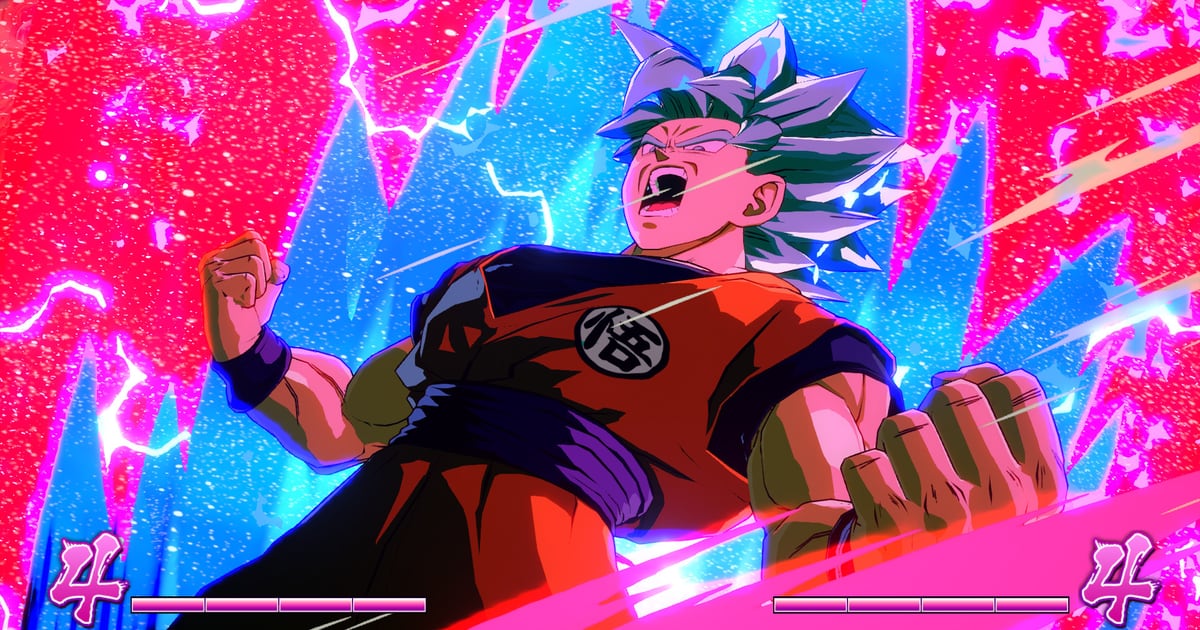
Tag fighters get described in FighterZ’s vocabulary even when they are not FighterZ. When Riot’s team explains two assist actions per champion, or a Marvel Tōkon guide talks about team synergy, the comparison point is a game that launched in January 2018 with 21 characters, Unreal-powered anime shading and the delay-based netcode the genre was trying to leave behind.
That is not the 2026 build. FighterZ has a rollback implementation, a full-roster rebalance, three follow-up patches and a Dragon Ball Daima character on the roster. This is the site’s first piece dedicated to it. The rollback explainer covers prediction mechanics in general and the 2XKO tag breakdown covers assist architecture in general; neither answers what the FighterZ client actually does on your platform, what the last twelve months of patches changed, or what a complete roster costs in October 2026.
What this covers: the February 2024 rollback rollout and the platforms it skipped, the 1.40 → 1.50 balance cycle, the 45-character roster and its 21 paid slots, and what the game still receives this month. Why it matters: FighterZ’s rollback update did not ship everywhere, and the PC build now runs two separate matchmaking pools that do not mix. Those two facts decide whether the game is playable for you before any tier list does. Who should care: anyone choosing a tag fighter in 2026, returning players picking a platform version to buy, and people who left in 2018–2022 and want to know what the patch record says now.
Where the game stands in October 2026
| Item | State as of late October 2026 | Where it is stated |
|---|---|---|
| Latest balance patch | Ver. 1.50, 21 April 2026 | Bandai Namco patch notes |
| Rollback netcode | PS5, Xbox Series X|S and PC only; PS4, Xbox One and Switch remain delay-based | Bandai Namco rollback notice, 28 February 2024 |
| Cross-play | None between platforms | same notice |
| Roster | 45 playable characters: 21 base, 3 unlockable, 21 DLC | Wikipedia roster summary, checked against Steam’s DLC list |
| DLC structure | FighterZ Pass (8), Pass 2 (6), Pass 3 (5), Android 21 (Lab Coat) stand-alone, DAIMA Pack (1) | Steam DLC list; Bandai Namco Europe |
| Newest character | Goku (SS4, DAIMA) | Steam store page for the DAIMA Pack |
| Live-ops | Weekly scheduled maintenance plus rotating events, notices posted through 26 October 2026 | Official Japanese notice board |
| Competitive circuit | World Tour 2024/2025 documented; Masters Showdown scheduled for Dragon Ball Games Battle Hour 2026, 18–19 April, Los Angeles | Bandai Namco Europe |
Rollback arrived in February 2024 — on three of six platforms
The Steam version ran a public rollback beta from 30 November to 11 December 2023, announced on 26 November 2023 and restricted to Steam. Bandai Namco published the finished notice on 28 February 2024, and one sentence in it does most of the work:
The update is currently available for the PS5, Xbox Series X|S, and PC versions of the game, while the PS4, Xbox One, and Switch versions remain on the delay-based netcode system.
The same notice states that there is “no cross-play support between the different platforms,” so a PS5 player and a Switch player cannot meet at all — not with rollback, and not with delay. The current-generation versions launched on 29 February 2024 per Bandai Namco Europe, with free upgrades for PlayStation 4 and Xbox One owners and, in the publisher’s description, “visual enhancements” plus rollback for online play.
Two further limits matter more than they look. First, the PC build lets you choose between rollback and delay-based netcode, and the choice “will also affect the matchmaking”: rollback players are not matched with delay-based players. A single platform therefore hosts two populations that cannot see each other. Second, rollback is not compatible with every mode — Circle Party Match, the six-player mode, and Party Battle, the three-player co-op mode, are both locked to delay-based netcode even on PS5 and Xbox Series.
The upgrade path carries its own trap. After moving from PS4 to PS5 you “will not be able to play online with PlayStation 4 users anymore, only with PlayStation 5 version players,” and save data transfers from PS4 to PS5 but never back. The Xbox upgrade is one-way in the same manner, and the game does not support Smart Delivery.
What that means before you buy
If you are on Switch, PS4 or Xbox One, you are on the 2018 networking stack and in a separate pool from everyone on current hardware. If you are on PS5, Xbox Series X|S or PC, you get rollback — but on PC you have to pick it deliberately and stay there, because the alternative toggle puts you in the other queue.
For a game with no cross-play, that also means the platform your friends own is the only platform that matters. There is no purchase decision here that fixes a split group.
Four patches in twelve months: the balance cycle restarted
The most recent patch Bandai Namco’s own site lists is Ver. 1.50, dated 21 April 2026. Behind it sits the patch that restarted the cycle.
| Patch | Date | System mechanics touched | Characters named |
|---|---|---|---|
| 1.40 | 11 October 2025 | Ki Charge, Dragon Rush, Z Reflect, Vanish, Sparking Blast, High Jump, Z Assist (A-Type, B-Type), Z Change, Guard Cancel Change, Limit-Breaking Power, Boot Camp Mode | base cast through to Android 21 (Lab Coat) |
| 1.41 | 30 October 2025 | Z Assist (A-Type, B-Type) cooldown | 8 |
| 1.42 | 5 December 2025 | jumping unique attack after a Simple Dash input | 14 |
| 1.50 | 21 April 2026 | Limit Breaking Power Ki-gauge autofill | 7 |
Patch 1.40 is the outlier. Its page on the publisher’s European site is marked as a 28-minute read, against “less than 1 min to read” on the notices around it, and it prints adjustments for the base cast, both Super Saiyan Saiyans (Goku and Vegeta) and Android 21 (Lab Coat) — the newest DLC character on the roster at the time — in one document. Among the system-level entries: Z Assist and Z Change both had their reuse cooldowns cut, Z Reflect gained a special screen freeze that allows a Vanish, Sparking Blast had its blockstun reduced, and Limit-Breaking Power had the Ki gauge fill over time while active.
The three patches after it are narrower and read like maintenance. Yet 19 distinct characters are named across 1.41, 1.42 and 1.50, and only two appear in all three:
| Character | 1.41 | 1.42 | 1.50 |
|---|---|---|---|
| Vegeta (Super Saiyan) | yes | yes | yes |
| Videl | yes | yes | yes |
| Goku (GT) | — | yes | yes |
| Krillin | — | yes | yes |
| Goku (Ultra Instinct) | yes | yes | — |
| Gohan (Teen) | yes | yes | — |
| Yamcha | yes | yes | — |
| Zamasu (Fused) | yes | yes | — |
The rest of the 1.41–1.50 set is Hit and Goku Black in 1.41; Frieza, Gotenks, Android 21, Janemba, Kefla and Master Roshi in 1.42; Goku (Super Saiyan), Android 17 and Jiren in 1.50.
Read that as attention, not as a tier list. A patch line can be a bug fix, a hitbox nudge, a damage-proration change or a nerf — 1.41’s Videl entry makes her Moonsault Kick easier to land in the corner, while the same patch limits Goku (Ultra Instinct)‘s Unrestrained Will to once per Z Combo. What the record documents is which characters the developers are still watching, and it says Android 21 (Lab Coat) got changes in the same pass as the base cast. That is not what maintenance mode looks like.
The roster is 45 characters, and 21 of them are paid
The arithmetic is simple once you have both halves. Wikipedia’s summary puts the base roster at 21 playable characters, with 3 further characters unlockable through play and 21 added as paid DLC, for a total of 45. Steam’s DLC list for the game names exactly 21 character packs, and Bandai Namco Europe’s DLC pages list the passes at 8, 6 and 5 characters.
| Pack | Characters | Who |
|---|---|---|
| FighterZ Pass | 8 | Bardock, Broly, Zamasu (Fused), Vegito (SSGSS), Cooler, Android 17, Goku, Vegeta |
| FighterZ Pass 2 | 6 | Jiren, Videl, Goku (GT), Janemba, Gogeta (SSGSS), Broly (DBS) |
| FighterZ Pass 3 | 5 | Kefla, Goku (Ultra Instinct), Master Roshi, Super Baby 2, Gogeta (SS4) |
| Android 21 (Lab Coat) | 1 | stand-alone; the Steam listing dates it 23 February 2022 |
| DAIMA Pack | 1 | Goku (SS4, DAIMA) |
That grouping is not a guess about release order: Bandai Namco’s own 8-million-units-sold notice from November 2021 lists the then-available DLC characters in pass-sized blocks — Bardock, Broly, Zamasu (Fused) and Vegito (SSGSS), then Goku, Vegeta, Cooler and Android 17, then Jiren, Videl, Goku (GT), Janemba, Gogeta (SSGSS) and Broly (DBS), then Kefla, Goku (Ultra Instinct), Master Roshi, Super Baby 2 and Gogeta (SS4). Android 21 (Lab Coat) arrived in 2022, after that notice, and Goku (SS4, DAIMA) in 2026.
For a starting player the practical consequence is that “the roster” is three purchases deep. Twenty-one base characters plus three unlockables is a full 3v3 game on its own; the passes are fixed bundles you buy when the character you want lives in one.
Goku (SS4, DAIMA) and what the announcement does not say
Bandai Namco Europe announced the character on 13 October 2025 as coming in “Spring 2026,” alongside a new balance patch and a separate competitive announcement: the DRAGON BALL FighterZ Masters Showdown, scheduled for 18 and 19 April at Dragon Ball Games Battle Hour 2026 in Los Angeles.
The Steam announcement that ran the week of release is short enough to quote in full: “Goku (SS4, DAIMA) storms FighterZ on 22 April with Wild Dash, a new mechanic branching into four devastating techniques.” The DAIMA Pack’s store page dates the pack itself to 21 April 2026 and lists its contents as the playable character, six alternative colours, lobby avatars for Goku (SS4, DAIMA), Vegeta (SS3) and Panzy, three Z Stamps including Majin Duu and Majin Kuu, and one player card header.
Wild Dash is the only mechanic identifier in that text, so it is the only one this piece will name. The “four devastating techniques” are shown in the accompanying trailer rather than listed in the announcement, and inventing names for them would be exactly the kind of error that reads like knowledge. Note also that this is a new slot rather than a rename: the roster already carries Goku (GT) and Gogeta (SS4) as separate DLC characters.
Is a 2018 game a sensible place to start in 2026?
Four things argue yes. Rollback is present on the three platforms anyone would buy today, and it is the same architecture the genre now treats as a baseline. The game is still patched, with 1.50 in April 2026 and a rebalance cycle that began in October 2025. The competitive ladder is not theoretical: Bandai Namco Europe documents a World Tour 2024/2025 structure with Power+, Power and Tenkaichi offline events, an Online Challenge across six regions, and a Last Chance Qualifier feeding the finals; the Masters Showdown was scheduled for Games Battle Hour on 18–19 April 2026. And the servers are visibly maintained — the official Japanese notice board carries weekly scheduled maintenance notices, a ranked-and-casual reward campaign starting 28 October 2026, a Fighters Cup round nine fixture on 21 October, a Ranked Match Challenge running 14–21 October, and a Party Battle co-op event on 7 October.
Three things argue for caution. The roster is not one purchase. Cross-play does not exist, so your platform is your community. And the PC netcode toggle splits an already moderate population across two queues.
There is also a service-history detail worth knowing before you troubleshoot anything yourself. On 3 April 2026 the publisher told Steam and Windows users hitting launch errors or online-match errors to delete the contents of %AppData%\EasyAntiCheat\183, noting that the files are auto-generated and that deleting them does not touch save data or settings. Eleven days later, on 14 April 2026, the Steam announcement was withdrawn: server-side fixes shipped during emergency maintenance on Thursday 9 April 2026, and the manual deletion was no longer necessary. The support loop worked, but it moved — a fix announced as a client-side workaround was solved on the server.
A practical start-up order
- Pick the platform that gets rollback. PS5, Xbox Series X|S or PC. A PS4, Xbox One or Switch purchase lands you on delay-based netcode in a separate pool.
- On PC, choose rollback once and stay. The toggle determines your matchmaking pool, and the pools do not mix.
- Learn the base 24 before buying a pass. Twenty-one characters plus three unlockables is a complete game; add a pass when a specific character is the reason.
- Treat Z Assist as a separate decision per character. The patch notes name an A-Type and a B-Type assist, and both had their reuse cooldowns retuned in 1.40 and again, three weeks later, in 1.41 — team-building advice older than October 2025 may be pricing a cooldown that no longer exists.
- Date every guide you read. Ver. 1.50 is the latest patch Bandai Namco lists as of this writing; anything written before October 2025 predates the rebalance.
None of this makes FighterZ the right first fighting game. It makes it a legible one: the publisher still publishes patch notes, the platform split is documented rather than rumoured, and the roster arithmetic can be checked against the store.