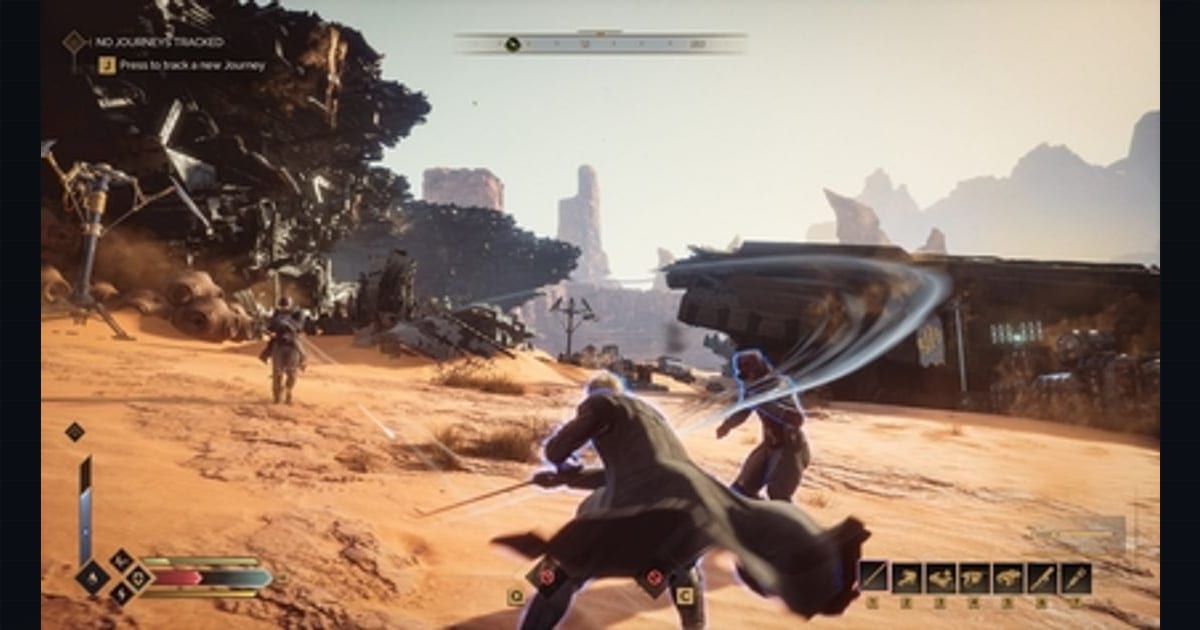
Funcom’s Dune: Awakening launched for Windows on June 10, 2025, with early access beginning June 5 for Deluxe and Ultimate Edition purchasers. The survival MMOMMO. Massively Multiplayer Online — a game that hosts very large numbers of players together in one shared, persistent world. sold one million copies within two weeks of its PC release. PlayStation 5 and Xbox Series X/S versions are scheduled for September 22, 2026.
Setting & Narrative
The game is set in an alternate Dune timeline where Paul Atreides was never born. Lady Jessica obeyed the Bene Gesserit and gave birth to a daughter, Ariste. Her loyalty earned her training as a Truthsayer, allowing her to expose Dr. Wellington Yueh’s treachery and prevent the events of the original novel. House Atreides survives under Duke Leto’s leadership and enters a protracted War of Assassins with House Harkonnen on Arrakis. The Fremen have vanished following a Sardaukar purge ordered by Emperor Shaddam IV.
Players control an undercover Bene Gesserit agent tasked with finding the Fremen and waking “the Sleeper.”
Survival & Progression Mechanics
Players create a custom avatar, select a background, and choose a mentor who determines their starting ability. A Bene Gesserit mentor, for example, teaches the use of “the Voice” to taunt enemies. Core survival systems require managing thirst and maintaining stillsuits. Arrakis presents environmental hazards including sandstorms, quicksand, heat stroke during daytime exploration, and hostile Sardaukar patrols at night.
Players scavenge resources to craft items and build shelters, with outpost construction requiring tax payments to the Emperor. Spice harvesting and transport is a competitive activity central to the game’s economy. Players also become addicted to spice, unlocking related powers as they progress.
Sandworms pose a constant threat. Players must minimize noise to avoid attracting them. Thumpers can draw sandworms to the player’s advantage, but they cannot be summoned at will. Items and vehicles consumed by sandworms are permanently lost, though general progress is retained on defeat.
Multiplayer Structure
The game progresses through four phases: Survive, Protect, Expand, and Control. Players advance from an ordinary survivor to a guild leader. After the starting area, players access the Overland, using ornithopters from a top-down view to travel between locations.
Players can join House Atreides or House Harkonnen for factionfaction. An in-game group or nation players can align with or fight against, with its own goals and reputation system.-specific quests. The Deep Deserts zone supports hundreds of players in a primarily PvP environment, with weekly Coriolis storms reshaping the map and revealing new points of interest. Underground ecology labs function as dungeon content for solo or group play. The endgame involves guilds using influence at the Landsraad to make decisions affecting the game world.
Development & Post-Launch Content
Funcom developed Dune: Awakening using Unreal EngineUnreal Engine. A widely-used commercial game engine from Epic Games; powers many large-studio (AAA) games. UE5 is the current generation. 5, with NUKKLEAR co-developing vehicular gameplay. The first content update, Chapter 2, and its accompanying DLC, The Lost Harvest, released on September 9, 2025, expanding the player’s origin story and adding a Dicycle ground vehicle.
Why It Matters: The Survival-MMO That Treats Arrakis as a System, Not a Backdrop
Most licensed survival games treat their setting as scenery — a skin laid over a familiar loop of gather, craft, build, repeat. Dune: Awakening is notable because it inverts that relationship: Arrakis is the ruleset. Thirst, stillsuit maintenance, the day/night hazard swap (heat stroke by daylight, Sardaukar patrols after dark), and the permanent-loss economy imposed by sandworms are not optional flavor; they are the central pressure that shapes every other decision a player makes. Spice addiction isn’t a debuff to be cleansed — it’s a progression path that trades long-term cost for short-term power, mirroring the central tension of Herbert’s novels rather than borrowing their iconography.
That framing matters for the genre. Survival MMOs have spent a decade iterating on the Ark / Rust formula, and the field has been desperate for a hook that re-introduces consequence without simply escalating grind. Funcom’s bet is that a setting whose entire dramatic engine is scarcity is the ideal substrate for survival design — and the one-million-copies-in-two-weeks result suggests the audience was ready for a survival game where the world pushes back harder than the other players do.
The Take: A PvP Endgame That Solves the “Zerg Problem” With Weather
The most strategically interesting design choice in Dune: Awakening is the weekly Coriolis storm that reshapes the Deep Deserts map and surfaces new points of interest. Persistent-world PvP MMOs have a chronic failure mode: established guilds fortify the best real estate, new content calcifies around the winners, and the gap between incumbents and challengers becomes structural. The storm is, in effect, a forced map wipe on a cadence — not of player progress, but of territorial advantage. Fortifications, spice fields, and POI control reset on a weekly tick, which means dominance is something you defend rather than something you bank.
This is a meaningful evolution of the survival-PVP loop. Where Rust relies on server wipes that erase everything and EVE Online relies on player-driven conflict to redistribute territory, Dune: Awakening externalizes the reset to an in-fiction environmental event. It sidesteps the player-hostility of full wipes while still denying the static-endgame problem that kills most persistent PvP MMOs within a year. Whether the cadence holds up under live population pressure is the open question — too frequent and investment feels pointless, too rare and the map freezes — but as a structural answer to a known genre failure, it’s one of the more thoughtful designs in recent memory.
What It Signals: The “Engine-Heavy Licensed MMO” Is Now Viable
Unreal Engine 5 with a co-development partner dedicated specifically to vehicular gameplay (NUKKLEAR) is a signal about how mid-budget MMOs are being built now. Dune: Awakening is not a single studio pouring years into a monolithic engine — it’s Funcom owning the survival-and-narrative core while outsourcing a vertically specialized subsystem (ornithopters, the Dicycle, ground-vehicle physics) to a team built for exactly that. That division of labor is how you ship a UE5 persistent-world game at this scope without a AAA budget, and it’s likely to become the default model for licensed MMOs that need to look expensive without being expensive.
The console delay to September 2026 — roughly fifteen months after the PC launch — also signals something the industry has stopped pretending isn’t true: simultaneous PC/console MMO launches are a risk not worth taking for a persistent-world game that still needs post-launch stabilization. One million PC copies in two weeks gave Funcom both the revenue and the live telemetry to tune the experience before the console audience arrives. For a genre where server economy, PvP balance, and content cadence all need weeks of real population to stress-test, staggering the platforms is the conservative and correct call.
Context: Where It Sits in the Survival-MMO Field
Dune: Awakening arrives at a moment when the survival-MMO category is consolidating around two poles — the player-driven emergentemergent. Behavior that wasn't explicitly designed but arises from simpler rules interacting — player-run economies, cartels, surprise tactics.-sandbox pole (Rust, EVE) and the narrative-progression pole (Once Human, Palia). Funcom’s game is an explicit attempt to occupy the middle: a licensed IP with a real authored narrative and faction structure, grafted onto a survival core that retains meaningful loss and environmental hostility. The four-phase progression (Survive → Protect → Expand → Control) is essentially a guided on-ramp from solo survival into guild-scale political endgame, and the Landsraad influence system is the mechanism that converts the survival grind into MMO stakes.
That hybrid is the thing to watch. If the Landsraad endgame genuinely makes guild decisions reshape the shared world — and the post-launch content cadence holds — Dune: Awakening becomes the reference implementation for how to build a survival MMO with a license that earns its canon rather than renting it. If the political layer stays cosmetic, it’s a very good survival game with an unusually strong setting. Either outcome is a win for a genre that has spent too long confusing “more content” with “more meaning.”