EverRail Build Guide: Managing Power and Passengers on the Ever-Moving Train
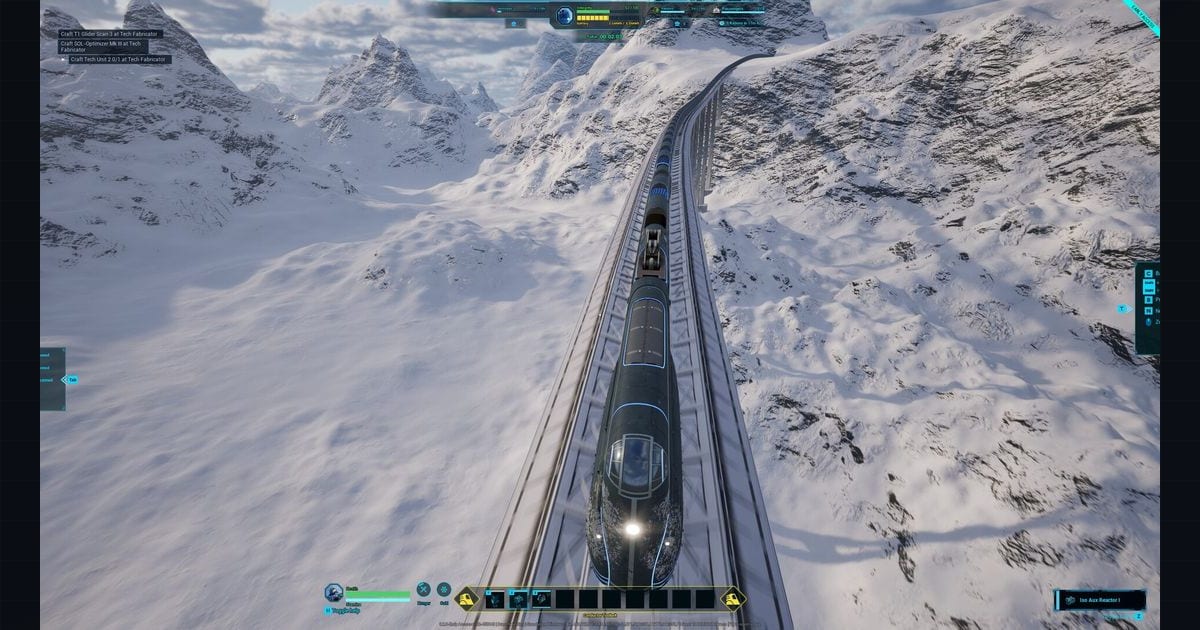
In a crowded survival genre, few premises are as immediately legible as a train that must keep moving to survive. EverRail turns that idea into the central rule of the entire game: the train’s battery recharges while moving and drains when stationary. Lose power, and the journey ends. Every decision in EverRail, from how long to scavenge, to when to fight, to how far to push into the frozen wilderness, flows from that single constraint. Layered on top of it are passenger rescue, modular train expansion, and a procedurally generated world, which together create a survival loop that feels both urgent and rewarding.
The Core Loop: Move or Freeze
At the heart of EverRail is its defining gameplay loop. Your train is not merely transportation; it is your base, your shelter, and the literal vehicle of your survival. The battery system operates on a simple but strict principle: motion generates power, stillness consumes it. When the train moves, on-board systems slowly recharge the battery. When you stop to explore, scavenge, or engage in combat, the battery drains at a steady rate. If the battery reaches zero, the train loses power, lights go out, and the cold begins closing in.
This mechanic fundamentally shapes how you approach every aspect of the game. Unlike traditional survival games where you can establish a permanent base and venture out on expeditions, EverRail requires you to bring your base with you. Every expedition must be carefully timed. You need enough battery reserve to return to the train before power runs out, and you cannot afford to linger at any single location, since the cost of idleness is measured in dwindling energy reserves.
The “move or freeze” rule extends to combat as well. Engaging enemies often requires you to stop or slow down, creating a tactical dilemma: do you risk combat to secure valuable resources, or do you flee to preserve momentum? This constant evaluation creates a satisfying sense of risk versus reward that runs through every hour of gameplay.
Power Management: The Lifeblood of Your Refuge
Effective power management is the cornerstone of success in EverRail. Several systems interact to determine your train’s energy status, and the Early Access build introduces hunger, stamina, and cold mechanics that further pressure how long you can stay outside the train.
Battery Capacity and Consumption
The train starts with a moderate battery capacity that can be upgraded through crafting and exploration. Consumption scales with speed and active subsystems; faster movement drains power more quickly, while a slower pace conserves energy. Active systems aboard the train, including lighting, heating, and defensive turrets, draw power when turned on. Managing these subsystems is crucial; turning off non-essential lights during daylight hours can save significant power over time.
Hunger, Stamina, and Cold
The Early Access release added hunger, stamina, and cold systems, and the team has said this trio is the foundation for deeper survival pressure as the game grows. Passengers now rely on shared ration supplies, so food production and ration management have become core concerns, on par with battery management. New consumables, recipes, and exosuit upgrades give players additional ways to prepare before leaving the train.
Power Generation and Crafting Upgrades
While motion is the primary power source, EverRail ties energy production, battery charge, heat, and life support to train upgrades as well as movement. Players can craft new weapons, armor, tools, gliders, and essential machinery, and expand and upgrade the train as they push farther along the tracks. Crafting stations, storage buildings, and train modules can be added or swapped over time, giving you direct control over which subsystems consume power and how efficiently the train runs.
Passenger Rescue: Expanding Your Society
While power management keeps your train running, passenger rescue provides the human element that drives progression and narrative. Scattered across the frozen exomoon of Inara are abandoned facilities, crashed vehicles, and points of interest containing survivors. Each rescued passenger adds to your train’s population, and that population serves several purposes, according to the developer.
A Death-Triggered Respawn Loop
When your character dies, another passenger on the train steps forward and takes your place. As long as survivors remain, your journey continues. This means every rescued passenger is also a future respawn, and that relationship makes rescue both a progression goal and a survival safety net. Each passenger also consumes rations and living space, so growth has to be balanced against your ability to feed and house new arrivals.
Roles in Co-op Play
In cooperative play for up to four players, the developers describe flexible roles rather than rigid passenger classes. Players naturally fall into roles such as driving, glider scouting, crafting, repairs, and passenger management. All players share one train, one energy system, and one set of resources, so coordination matters as much as individual skill. The wiki and community guides highlight Driver, Scout, Quartermaster, and Engineer as emergentemergent. Behavior that wasn't explicitly designed but arises from simpler rules interacting — player-run economies, cartels, surprise tactics. roles, but the official materials emphasize that specialization is player-driven rather than enforced.
Train Expansion: Building Your Rolling Fortress
As you rescue more passengers and gather resources, you will inevitably outgrow your initial train configuration. EverRail encourages continuous expansion through a modular wagon system, and the Early Access launch added new construction pieces, including floor plates, lifts, and stairs that let you build vertically inside the train for the first time.
Wagon Types
The official Steam description mentions attaching hundreds of new wagons to increase storage, boost production, and build out your own logistics. Community guides describe storage wagons, crafting wagons, power wagons, medical wagons, observation wagons, and defensive wagons among the variants in the Early Access build. New buildings added for Early Access include a dedicated Glider Fabricator, a Salvager building that recycles unwanted equipment into valuable resources, and specialized storage buildings for materials and food.
Attaching wagons is a matter of crafting the chassis, adding the modules you want, and connecting it to your train via coupling. However, each wagon adds weight, which affects acceleration and power consumption. Balancing wagon count with locomotive power becomes a long-term optimization puzzle that evolves over the course of a run.
Cosmetic Customization
Beyond functionality, EverRail offers cosmetic options for wagons through the Supporter Edition and DLC packs, including paint schemes, decals, and lighting configurations. While purely visual, these let players personalize their rolling fortress, enhancing the sense of ownership and investment in their survival journey.
Exploration and Resource Gathering
The frozen exomoon of Inara presents a procedurally generated world that the developers say ensures no two playthroughs are identical. Abandoned facilities, deadly anomalies, and survivors waiting to be rescued are scattered across diverse biomes. Effective exploration requires mastering several tools.
On-Foot Expeditions
When you disembark from the train, you become vulnerable but gain access to tight spaces and detailed scavenging. The Early Access build introduces first-person gameplay as the default experience, with third-person still available. Key considerations include:
- Glider Deployment: Your personal glider allows rapid vertical movement and scouting from above. You can manage altitude, tether range, and remaining power to make it back alive.
- Scan Drones: Deployable from your glider, these provide temporary aerial surveillance, revealing resource deposits and threats.
- Cold and Stamina: Inara’s extreme cold and your own stamina meter require proper clothing and preparation; prolonged exposure without the right gear can end a run quickly.
- Hostile Encounters: Robots and anomalies guard valuable locations. Knowing when to fight, flee, or hide is crucial, and the Early Access build added Assault Rifles and Shotguns as new combat options alongside a balance overhaul.
Train-Based Operations
Sometimes it is safer and more efficient to remain aboard the train. Mounted turrets allow you to engage threats while keeping some momentum, and production wagons let you process materials while the train moves, turning travel time into productive time. The developers describe train driving, on-foot exploration, and glider flying as the three pillars of the current Early Access loop.
Challenges and Strategic Depth
EverRail’s design introduces several layers of challenge that reward thoughtful play.
Risk Assessment
Every decision involves weighing immediate gains against long-term sustainability. A rich resource deposit might tempt you to linger, but the power cost of stopping could jeopardize your journey. Rescuing a passenger from a dangerous facility might save a life but deplete ammunition needed for future encounters.
Adaptation to Proceduralprocedural. Generated by rules or algorithms rather than hand-placed — e.g. terrain or quests that the game builds itself. Content
Since the world generates dynamically, memorizing specific locations is impossible. Instead, players learn to read environmental clues and rely on glider scouting and scan drones to plan ahead. The community-named exomoon, Inara, exists in part because players helped refine it during playtests, and that community involvement is set to continue throughout Early Access.
Multiplayer Considerations
EverRail supports single-player and online co-op for up to four players. In co-op, power management becomes a shared responsibility, with players able to specialize in different roles such as driving, scavenging, and crafting. Communication and coordination amplify the strategic depth, as players can cover each other’s weaknesses during expeditions.
Conclusion
EverRail stands out in the survival genre by transforming a simple rule, move to survive, into a wide network of interconnected systems. Power management creates a constant, tangible tension that drives every decision, while passenger rescue and train expansion provide meaningful progression and a sense of building something larger than mere survival. The procedural world ensures that each journey feels fresh, encouraging players to adapt their strategies rather than rely on memorized routes.
For players seeking a survival game where preparation, resource management, and forward planning are as vital as reflexes and combat skill, EverRail delivers a focused and engaging experience. Its core loop of “move or freeze” is more than a gameplay mechanic; it is a philosophy that permeates every aspect of survival on the frozen exomoon, making every kilometer of track hard-earned and every rescued passenger a small victory of its own.