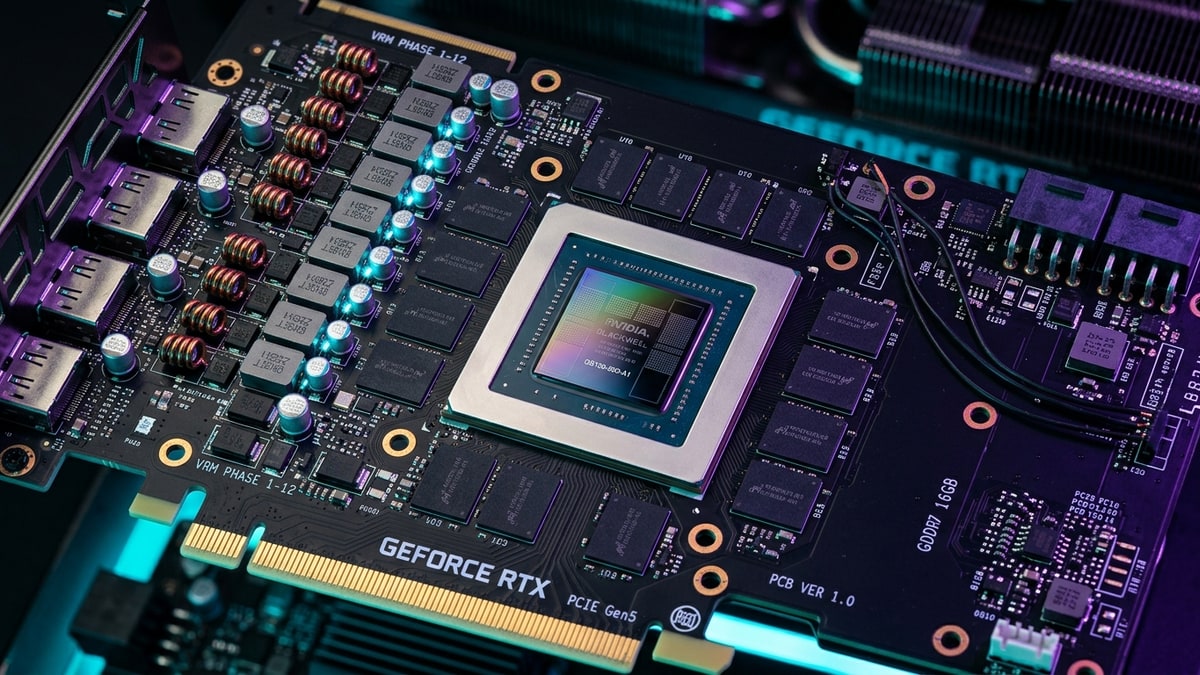
DLSS 4 introduces Multi-Frame Generation (MFG), which generates multiple frames per rendered frame instead of the single interpolated frame that DLSS 3 Frame Generation produces. The pitch is simple: more frames, smoother motion. The cost is latency — every generated frame adds to the input-to-display chain, and that cost compounds.
How Multi-Frame Generation Works
DLSS 3 Frame Generation uses an AI model running on the Optical Flow Accelerator to predict and generate one intermediate frame between two rendered frames. DLSS 4 Multi-Frame Generation extends this: it can generate 2 or 3 frames per rendered frame, using the Transformer-based DLSS model on the RTX 50 series’ new Tensor Cores. The model analyzes motion vectors, depth buffers, and optical flow to predict what the intermediate frames should look like.
The practical effect: at 30fps base, MFG x2 can output 90fps; MFG x3 can output 120fps. At 60fps base, x2 outputs 180fps and x3 outputs 240fps. The frames look smoother in motion — but they are all predictions, and each one adds latency.
The Latency Problem
Every generated frame adds latency. The reason is structural: to generate an intermediate frame, the system needs the previous rendered frame and the current rendered frame as inputs. It then predicts what happened between them. This means the generated frame is always “behind” — it is showing you what the system thinks should have appeared between two frames that have already been rendered.
With DLSS 3 Frame Generation (x1), this adds roughly 15-30ms of latency depending on the base frame rate. With MFG x2, it adds more — roughly double the interpolation window. With MFG x3, even more. The higher the multiplier, the more latency stacks up, because the system needs more rendered frames as input before it can generate its batch.
This is why MFG does not lower input latency — it increases it. The frames look smoother but feel less responsive. A 240fps MFG x3 stream from an 80fps base does not feel like native 240fps; it feels like 80fps with smoother motion.
How Reflex Compensates
NVIDIA Reflex is the countermeasure. Reflex reduces the render queue — the gap between when the CPU submits a frame and when the GPUGPU. Graphics Processing Unit — the chip that renders the game's visuals; the main driver of framerate and image quality. starts rendering it — by keeping the CPU and GPU in sync. Without Reflex, the CPU races ahead, filling the render queue, which adds latency. Reflex forces the CPU to wait for the GPU, reducing the queue to near zero.
With Reflex enabled, the base frame rate drops slightly (typically 5-10%), but input latency drops by a much larger margin. The net effect: Reflex + MFG can produce a playable latency window even at high multipliers, as long as the base fpsframerate. How many images (frames) the game shows per second; higher = smoother motion. 60 fps is a common target. is high enough.
The key tradeoff: MFG x3 from a 40fps base will feel sluggish even with Reflex. MFG x2 from an 80fps base with Reflex will feel responsive. The multiplier is only as good as the base — a low base fps with a high multiplier produces high latency that Reflex cannot fully compensate for.
Artifact Cases
Generated frames are predictions, and predictions fail. The known artifact categories:
- UI ghosting: frame generation can blur or double-render UI elements that move independently of the 3D scene (crosshairs, minimaps, text). NVIDIA has improved this with DLSS 4’s Transformer model, but it is not fully solved.
- Disocclusion artifacts: when an object moves to reveal something behind it that was not in the previous frame, the generated frame may not have the data to predict it correctly, producing a smear or flash.
- Fast motion blurring: at very high angular velocities (fast mouse flicks), the optical flow analysis can fail to keep up, producing soft or smeared frames.
These are the same categories as DLSS 3, but MFG makes them more visible because there are more generated frames in the stream. The Transformer model in DLSS 4 is better at handling these cases than the CNN model in DLSS 3, but it is not perfect.
What It Means for Players
For competitive esports: MFG is not useful. The added latency, even with Reflex, makes the game feel less responsive than native. The visual smoothness does not compensate for the input lag in a game where reaction time matters.
For single-player AAA at high refresh: MFG is genuinely useful. A 120fps MFG x2 stream from a 60fps base, with Reflex, feels smooth and responsive enough for most players. The visual benefit is clear: motion is more fluid, and the latency, while measurable, is within the range most players tolerate.
For RTX 5070/5080/5090 owners: MFG is a feature you should test per-game. Some games handle it well (Cyberpunk 2077, Alan Wake 2). Others produce visible artifacts (games with heavy particle effects or fast camera movement). The answer is not universal — it is per-title.