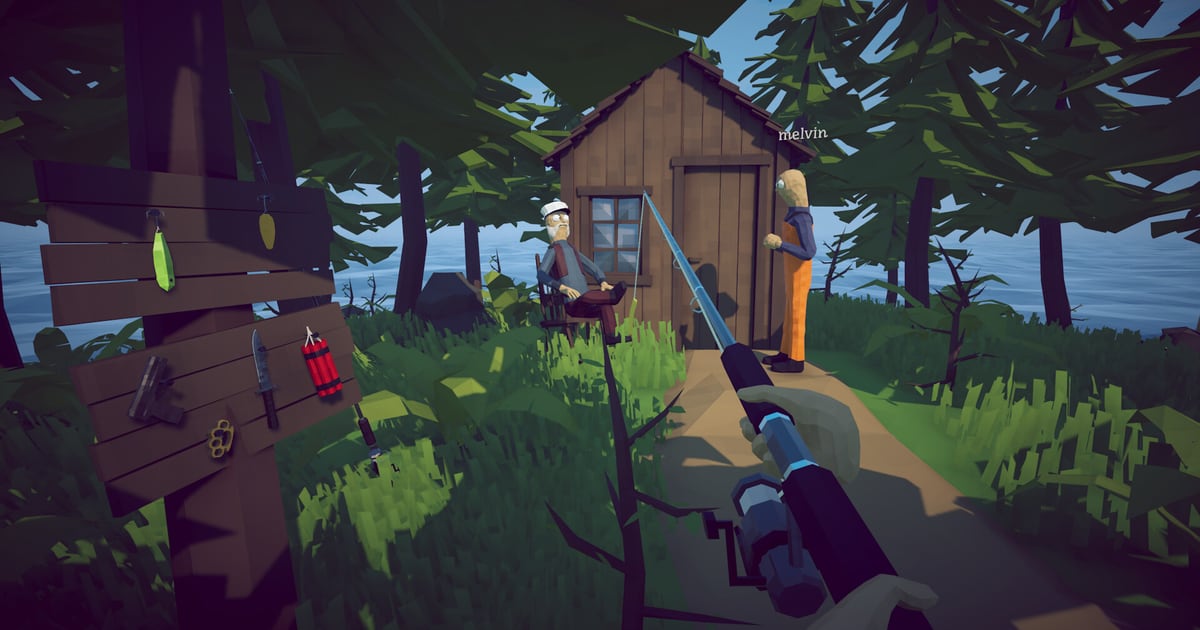
How to Fish does not need a guide to explain itself. It needs one to explain what it is. The Steam listing sells it as “a 1-4 player physics based fishing simulator”; the popular user tags file it under Shooter, First-Person and Physics; the genre rows on the same page say Action, Casual, Indie and Simulation; and the developers’ own bullet list opens with “Fish fish, kill fish, sell fish”. Every one of those descriptions is accurate, which is the problem: a player who reads “relaxing little fishing game” and one who reads “Shooter” are both being told the truth about a game doing both at once.
This is the site’s first How to Fish piece, and there was no fishing-game coverage here to build on. So instead of a news blurb, this is a primer on the loop the store page actually describes, the numbers behind the game’s first ten weeks, and a grounded list of what to do in the first hour — with a clear line between what Dazed Games has documented and what only a press outlet or a patch bullet implies.
What this covers: the six-step loop printed on the Steam page, the review and chart numbers as of late October 2026, and a first-hour plan assembled only from developer patch notes and hands-on coverage. Why it matters: the game is a $7.99 co-op title whose store copy still advertises 1-4 players, several of its quality-of-life rules exist only inside numbered patch notes, and there is no developer wiki — so the rules a new player needs are scattered across ten announcements. Who should care: anyone who bought it during the ten-million wave and bounced off the first boss, plus groups deciding whether the game is a solo or a two-player purchase.
The loop, in the store page’s own words
The listing’s “What you do in the game” block is six bullets long and unusually literal. Read in order, it is a complete progression design:
| Store bullet | What it commits the game to |
|---|---|
| “Fish fish, kill fish, sell fish” | Fish are not scenery; they are hostiles with a sell price |
| “Start off with no gear or weapons, earn money to buy better gear and weapons and stuff” | A hard zero-state, with money as the only progression currency |
| “Complete quests and fight bosses to progress to new islands, where there are more dangerous creatures and better gear” | Islands are chapters, gated by bosses, and they scale drops against danger |
| “Try to collect the rare variant of all the different fish” | A collection layer stapled to the combat layer |
| “Hit trick shots for more money” | Skill expression pays out in the same currency as survival |
| “Gamble for even more money” | A deliberate bypass around the grind, with the house’s edge unknown |
Two things matter in that block. There is no separate economy: combat, collection, skill and gambling all pay in the same money, so a good trick shot and a good boss kill are competing strategies rather than parallel ones. And “kill fish” arrives before “sell fish”, which tells you the fight comes first. GamingOnLinux, playing it at launch, puts the opening in exactly that order: “Starting off on a tiny barren island with nothing, you have to fish and then fight your catch to earn monies to get the keys to a little boat to continue exploring and earning more.”
The rare-variant hunt has a name in the patch notes even though the store page never uses it. Patch 1.1.3 adds bait names to the fishipedia for fish you have already killed, and states the purpose is “to make it easier to hunt for drip creatures”; 1.0.11 fixes “drip parrotfish not being cooked”; the September plush campaign pitched a “Drip Gar”. The collectible tier the store page calls “the rare variant of all the different fish” is the drip tier in the game’s own vocabulary.
Why the hook travelled
Three numbers explain the shape of this launch better than any argument about comedy.
The first is concurrency. Rock Paper Shotgun reported that the game “racked up around 340,000 concurrent players at launch over the weekend” of 22-23 August, and offered a comparison in the same paragraph: Call of Duty: Modern Warfare 4’s free beta launched the same weekend and drew “around 115,000”.
The second is price. The appdetails endpoint returns a final price of $7.99 with no discount running. At that price a four-player group is making a $32 decision, not a $280 one. The category list backs the same reading: Single-player, Multi-player, Co-op, Online Co-op, Full controller support, Save Anytime, Family Sharing. Nothing in that list describes a commitment.
The third is reception quality, which is where the “it is just a joke” theory weakens. The store page shows 12,230 reviews in the last 30 days at 94% positive, and 29,406 English-language reviews at 95% (Overwhelmingly Positive); the appdetails payload separately reports 76,455 total recommendations. Joke games do not hold 94% across a month of reviews. GamingOnLinux gave it 4/5 at launch and singled out one mechanic — “one of the funniest revive mechanics in a game”, in which a standing teammate “can run over and pick you up and slap you in the face a few times to bring you back to life” — and noted a seagull flying off with a downed player’s body. The comedy is not the premise; it is the failure states.
What the studio did with the attention is also visible. On 12 October 2026, Dazed Games posted an announcement titled “10 MILLION FISHERMEN WITHIN 2 MONTHS” thanking “all the 10 MILLION PLAYERS who played our relaxing little fishing game”, and adding that the team is “working on a bigger content update, porting to consoles and bugfixes in the coming months”. The signatures are two first names, Carl-Vilhelm and Melvin; the store page states no team size, so treat any headcount claim as unconfirmed. Twelve days earlier the studio opened Makeship petitions for a Drip Gar plush and a Fisherman plush.
What ten million does and does not tell you
This is the part where the headline and the evidence diverge.
Dazed Games’ own post counts players, not copies. The ten-million-copies framing comes from PlayGround.ru’s report of the milestone, which states that sales reached 10 million copies less than two months after release, that the game passed one million within two days of the 20 August launch, and that the Steam rating stood at 95% across roughly 70,000 user reviews at the time of the announcement. Those are the outlet’s figures, attributed to the developers. Whether “players” and “copies” are the same quantity here is not something either source resolves — a Family Sharing install is a player, not a sale — so this article treats ten million as a claimed player count and does not convert it.
The chart picture is cleaner, because Steam publishes it weekly:
| Measure | Reading | Source |
|---|---|---|
| Global Top Sellers rank, week of 20 Oct 2026 | 73 | Steam Top Sellers chart |
| Rank the previous week | 30 | same chart payload |
| Consecutive weeks on the Top 100 | 9 | same chart payload |
| Concurrent players when checked for this piece | 9,736 | Steam player-count endpoint |
| Reviews, last 30 days | 12,230 at 94% positive | Steam store page |
| English reviews, lifetime | 29,406 at 95% positive | Steam store page |
| Price | $7.99, no discount | Steam appdetails API |
| Release | 20 August 2026, Windows | Steam store page and appdetails |
Read together, those rows describe a game that peaked hard and settled into a long tail: rank 30 to 73 in a week is a decline, but nine consecutive weeks inside the global Top 100 at full price is not a flash in the pan.
The first hour, in order
Everything below comes from developer patch notes or hands-on coverage, and each line names which.
1. Set the difficulty before you leave the main menu. Patch 1.0.9 added a difficulty selector available both in the main menu and in-game, keeping the old behaviour as the default and adding two options. Easy gives all creatures 25% less health and 50% less damage; Hard gives them 25% more health and 25% more damage. If the first boss is where you quit, this is the cheapest fix available.
2. Assume you will not win the first boss on the first attempt. GamingOnLinux’s launch piece is explicit: “The first one especially when you’re just learning the ropes and you only have the most basic weapons like the Knife and Knuckle Dusters — took us a good few attempts to actually do it.” You begin with no gear at all, per the store page, so the first boss is a gear check you have not yet passed. The same piece describes the Piranha boss as flopping around and spewing smaller Piranha — one big body plus adds.
3. Bring a second person if you have one. The revive GamingOnLinux describes requires that “one player is still up during a boss fight” — a downed player is revived by a teammate, not by themselves. Single-player is a listed Steam category, so solo is supported, but the documented revive loop is a co-op mechanic. Playing alone, treat every boss attempt as no-retry.
4. Carry an item once before you try to sell it. Patch 1.0.11 lists under fixes: “Fixed so that items need to have been held once before selling.” If you pick something up, put it down, and then find you cannot sell it, this is the rule you are hitting.
5. Kill each fish once, then read the fishipedia. Patch 1.1.3 added exactly one thing: “Now displays name of bait to catch the fish in the fishipedia (shown after you’ve killed it once)”. The game will not tell you which bait catches what until after you have already caught it, so expect to waste bait early.
6. Do not buy the iron sight. Patch 1.0.11 removed the iron sight as a purchasable item with a blunt explanation: players “only ever bought them by mistake, removing their expensive attachments”. The same patch says you can no longer downgrade from suppressor to compensator, and patch 1.1.2 then added the option to downgrade back to ironsight — worth knowing before you spend on either.
7. Respect your own explosives. Patch 1.0.11 states: “You will now die from your own explosives even with friendly fire disabled.” A community comment under GamingOnLinux’s update piece describes the failure this punishes — a group piling dynamite for an alpha strike on a boss, then someone firing into the pile while teammates were still standing in it.
8. Check the radar for mini islands. The Islet Update (1.1.0) added “multiple mini islands” alongside a new weapon, a new mini-boss, more creatures, a new bait, a new NPC, an outfit and achievements, and adjusted “the distance between each island”. Patch 1.1.2 then “increased size of mini island dots on the radar” and raised new-bait spawns on one of them from 2 to 3 — the difference between finding a side island and sailing past it.
9. Do not assume the store copy has caught up. The short description still reads “1-4 player”, while Rock Paper Shotgun’s 24 August report describes an update that added “eight player lobbies and private invite-only lobbies”, plus in-game session-type switching (with a restart required), axis inversion and a minimum locked FPSframerate. How many images (frames) the game shows per second; higher = smoother motion. 60 fps is a common target. dropped from 50 to 30. The game’s real player ceiling is above what the shop page claims.
10. Saves are cheap, so use them. Patch 1.0.6 moved saving to the Save, Main Menu and Quit buttons while keeping a one-minute autosave. Patch 1.0.11 added corruption checks and backups, and 1.0.12 moved save files to Steam Cloud — with the caveat that you must “play and exit How to Fish on the pc you’ve saved them on once to upload them to the cloud”. Moving between machines, log into the old one first.
Where the money should go in week one
The patch history doubles as a balance ledger, and it is the closest thing this game has to a buying guide.
| What changed | Patch | What it means for a first playthrough |
|---|---|---|
| Difficulty selector added (Easy: creatures -25% health, -50% damage) | 1.0.9 | Free difficulty adjustment; the cheapest way past the first boss |
| Iron sight removed from the shop as a purchase | 1.0.11 | Do not chase optics early; the attachment cost was the trap |
| Wishbone upgrade pricing adjusted | 1.1.2 | Upgrade pricing has moved at least once, so any guide quoting a figure predates it |
| Anglerfish nerfed “since it was too annoying with a lot of health” | 1.0.10 | Health sponges were the specific complaint the studio acted on |
What is not documented
No developer wiki, knowledge base or design write-up exists for this game as far as the fetched sources show — every rule above comes from a Steam announcement written in bullet points, or from a journalist who played it.
Boss names in circulation are press vocabulary. Rock Paper Shotgun names the Pufferfish and the Whale in a balance context; GamingOnLinux names a Piranha boss; a reader comment under that site’s coverage calls a tuna “itself a mini-boss” and names an albatross boss. The developer notes name anglerfish, tuna, piranha and, in one fix, “the new mini-boss” without a proper noun. None of those are official labels.
Console versions are planned and nothing more. The 12 October announcement says the team will be “porting to consoles”, and PlayGround.ru states that specific platforms and release dates had not been disclosed. Any article that names a console and a window is ahead of its sources.
The recommended system requirements are missing from what the store page served. The requirements block returned a Windows minimum only — Windows 10+, Intel Core i5-5257U or AMD Ryzen 3 1200, 8 GB RAM, GeForce GTX 1050 or AMD RX 460, broadband, 1 GB storage — with no populated recommended panel. Steam Deck Verified and GeForce Now availability both landed in patch 1.0.11, so the Verified badge is the safer signal than the spec sheet.
If you want the same treatment of a fresher indie launch, this site’s Moon Sweepers systems primer does the equivalent job for a game six days old, and the R.E.P.O. extraction guide covers the co-op-horror neighbour with the same physics-comedy instincts.