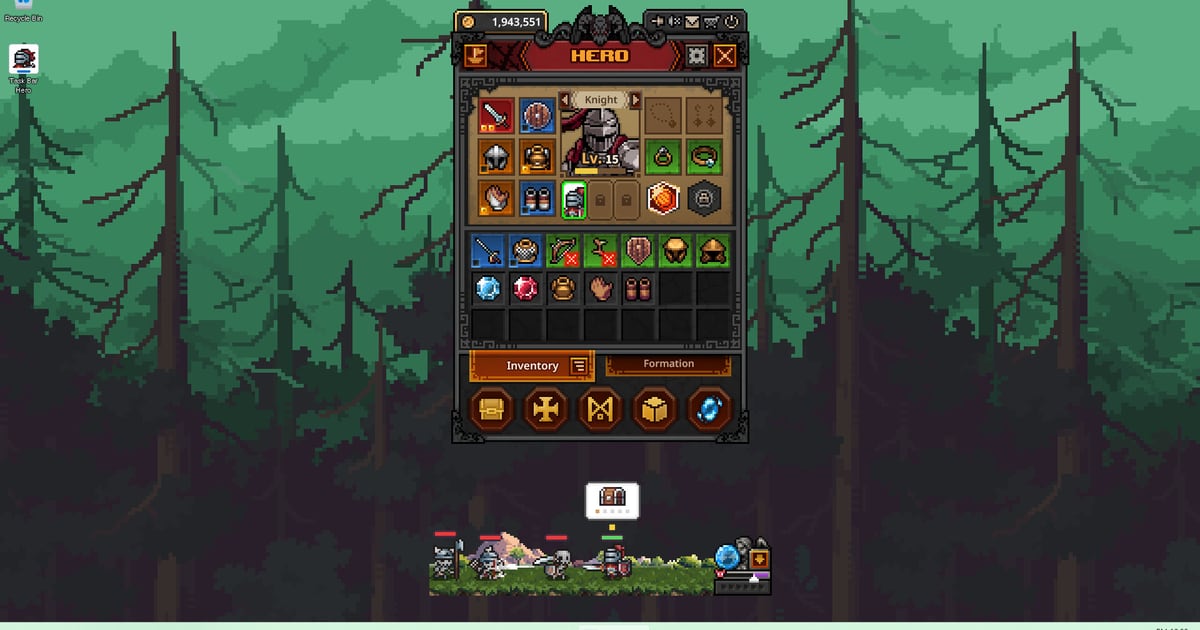
TBH: Task Bar Hero is a free pixel idle RPGRPG. Role-Playing Game — a game built around character progression, story, and player choices. that runs in a strip on the Windows taskbar. You leave it open, a party of heroes clears stages without input, and loot arrives on timers. Nugem Studio and Tesseract Studio released it on Steam on May 27, 2026, and five months later Steam’s Most Played chart still carried it at rank 23 with 61,164 players in game on October 29. This site covered its DLC shelf in TBH: Task Bar Hero DLC: Which Packs Change a Run, so this is the primer on the rest: the loop as the store page and forty patch posts describe it, the offline payout as far as it is written down, and the systems that are not there.
The temptation with a 61k idle game is to describe a meta nobody published. This rests on the Steam listing, Valve’s appdetails data for app 3678970, the post history from July 2 to October 27, the studio’s own site, and one player guide — Killdozer’s TBH Encyclopedia, updated October 28 — used only where the official notes are silent.
What this covers: the loop the store page and patch notes describe, the four clocks that set its pace, what the offline reward pays and what it does not, and why no prestige or rebirth system is documented in five months of posts. Why it matters: 61,164 concurrents on a free game whose entire interface is a taskbar strip is a strange enough shape that the loop deserves description rather than a tier list. The record also shows what the studio spent five months fixing — saves, servers and chest rates — which is the real signal about whether to start now. Who should care: anyone deciding whether to leave a free idler running all day, players who want to know if closing the window costs them progress, and anyone reading the chart who wants to know what is holding 61k players.
What the store page actually promises
The listing is unusually specific, which makes it a useful spine. It sells “a full hack-and-slash RPG experience packed into a tiny window,” a party assembled from classes, items and skills, a “Cube System” for adding and customising item stats, and “3 Acts and 4 difficulty tiers.” The bullet list gives the counts: 500+ unique items, 50+ monster types, 50+ unlockable achievements, items “freely tradeable on the Steam Market,” and a ten-step rarity ladder from Common to Cosmic.
The promise that matters most is one sentence: “Just leave it running on your screen — your pixel heroes will automatically gather loot and grow stronger on their own.” That is the design in a line; the patch notes are the plumbing underneath.
| Store claim | What the post history shows underneath | Where it is confirmed |
|---|---|---|
| “3 Acts and 4 difficulty tiers” | The notes name Nightmare, Hell and Torment above the default; with Normal that is the four | 1.02.00, 1.3.0 |
| Party of heroes, classes, builds | Six classes have their own skill lists; priest, hunter and slayer have their own class packs | 1.02.00, 1.3.0, DLC listing |
| “Cube System” | A levelled station with named recipes: Alchemy, Synthesis, Crafting, Decoration, Engraving, Inscription, Removal, Offering, Attunement, Corrosion | 1.02.00, 1.3.0 |
| “Freely tradeable” | Market access was restricted and reopened; cheaters were sanctioned 20,406 accounts at a time | 1.01.00, 6 Jul post |
Two classification notes. The app’s Steam genres are Casual, Indie, RPG and Free To Play, and its ranked user tags open with Idler, Trading, Free to Play, Pixel Graphics and Desktop Companion; Incremental and Auto Battler sit lower on the same list. And there is no Early Access banner on the page: an ordinary listing with a fixed release date of May 27, 2026, patched weekly since. A 1.0 launch with live-service surgery, not a beta sold as one.
The loop, told as four clocks
Read the changelogs in order and the game resolves into timers. The fighting is automatic; what a player manages is when the timers may run.
The chest clock. Chests are rate-limited by a “minimum acquisition cooldown,” and the numbers are published. Version 1.02.03, under its own heading “Plaguelands Balance Adjustments”, cut the Nightmare minimum for Plaguelands normal chests from 5 minutes to 4, and stage-boss chests from 8 minutes to 6 on Nightmare and 8 to 7 on Hell and Torment. Version 1.3.0 cut again: Hell and Torment Plaguelands common chests 5 minutes to 4, stage chests 7 minutes to 6, plus normal-region common chests at Region Level 15 and beyond 4 minutes to 3 and stage chests 6 to 5. The same notes also raised drop chances — Plaguelands Nightmare common chests to 1.75 times the previous rate, Hell common chests to 2.5 times, Torment common chests to 3 times, Torment stage chests to 1.66 times. When a studio spends consecutive patches tuning minutes-per-chest, minutes are the currency.
The stage clock. Each difficulty runs its own stage list, and clearing an Act boss promotes you to the next. Version 1.3.0 made that happen “even if repeat mode is on,” which says two things: repeat mode exists, and players were parking on a cleared boss and quietly not advancing. The player guide splits push stages from farm stages, and notes that after a clear the game sends you to the next stage automatically “even if you fail it” — which is why pushing is something to do with the game open in front of you.
The Contamination clock. The Plaguelands, added in 1.02.00, is gated by a resource. Entering from a normal area needs at least 30 Contamination, consumed “while you stay in the Plaguelands”; at zero you are returned to a normal area. It recharges over time, and the notes say so explicitly — “whether you are online or offline.” You can also buy Contamination by corroding items in the Cube, with one limit: items “more than 21 levels above your Cube level” cannot be used in that recipe. Higher Plague Intensity means stronger monsters and better chests, and clearing a lower tier qualifies you for the next.
The offline clock. Separate section, because this is where idle games hide their real rules and where this one documents the least.
Offline earnings: what is written down
The official record confirms the feature exists and confirms almost none of its parameters. Version 1.3.0 refers to the “Offline Reward window shown at game start” and to the “Offline Reward UI,” and its bug-fix list carries the most informative line in the history: “Fixed an issue where the Region Level penalty was not applied to Offline Reward EXP.” That is an official statement that offline payouts are EXP, reduced by the region you were farming.
Version 1.00.26 adds a detail from the other end of the curve: it fixed a display error in “the EXP reward value … when receiving Offline Rewards after reaching Level 101.”
| Resource | Accrues while the game is closed? | Basis |
|---|---|---|
| EXP | Yes, paid through the Offline Reward window, reduced by a Region Level penalty | 1.3.0 notes |
| Gold | The player guide says rune upgrades grant offline gold; the official notes name only EXP | Killdozer guide |
| Chests, drops, materials | No documented offline stream; the guide states “offline progress does not replace chest farming” | Killdozer guide |
| Contamination | Yes — “recharges over time, whether you are online or offline” | 1.02.00 notes |
Three things are in no source at all: the accrual rate, the cap on banked offline time, and the size of the Region Level penalty. Those absences are worth stating rather than filling in, because the difference between a four-hour cap and an uncapped bank decides whether closing the game is a strategy or a mistake. The guide’s framing is the honest summary: two kinds of progress with different jobs, and only one produces gear.
Where prestige would sit — and why it is not there
The obvious question for an idle game five months into its life is what resets. The answer from five months of posts is that there is no prestige, rebirth, transcendence or ascension layer in the store copy, the July roadmap, the August dev note, the October and November plans, or any patch note through 1.3.2. Killdozer’s guide indexes thirty-odd sections from first hero to Halloween — rune tree, cube operations, alchemy, relic assembly, Plaguelands farming — and contains no reset mechanic either.
Four systems occupy that structural slot instead, and all four persist:
- The difficulty ladder. Normal to Nightmare to Hell to Torment, promoted by first-clearing each Act boss, with a gear-quality band on each step.
- Cube level. A station level that gates what you may process — the Corrosion recipe refuses items more than 21 levels above it — so it reads as a second, slower character level.
- The Rune Tree. Persistent unlocks that include automation itself: chest auto-opening and offline rewards are both rune upgrades per the guide, alongside storage and combat nodes.
- Relics. Added in 1.3.0, party-wide, gated behind a first Plaguelands clear: “the Relic UI becomes available once you have cleared the Plaguelands at least once.”
The nearest thing to a reset is gear churn, which the guide states plainly: “All of your current gear will be replaced as you progress.” A player re-farms the same slots at a higher band rather than restarting an account.
A seasonal layer is planned and undefined. The August dev note says the studio is “working to bring you the Season 1 update as soon as possible after the September update,” and the September 30 post concedes the slip: “the Q3 and Q4 schedule in the development roadmap we shared in July has been delayed.” Dated instead is November — four new dungeons, new skills, a max level increase and a new difficulty. Until then the endgame is Plague Intensity and Cosmic gear. The site’s Deskrawl idle-ARPG roadmap is the useful comparison: a paid desktop-strip ARPGARPG. Action RPG — an RPG with real-time combat rather than turn-based fights. that shipped with a Paragon layer at cap.
What a taskbar strip changes about the decisions
The form factor is not a gimmick, because the loot clock pays out per minute the window is open. Three consequences follow.
Two rune priorities compete, and only one is automation. Chest auto-opening and offline rewards are both Rune Tree upgrades. On a fresh account you cannot buy both early, and the guide frames the choice by how you play: prioritise automation if you leave the game running for long periods, and treat offline nodes as a mixed bag whose value depends on how well the party performs. In a game pitched as “leave it running,” that is the first real build decision, and it is about your schedule, not your damage.
It is still an online game. The July roadmap gives the reason: “Due to the way TBH: Task Bar Hero is structured, gameplay data must be saved to the cloud.” The studio asked players to close the game normally, because force-closing before a cloud save could lose data, and promised server-side backups. A July support post still points players at %USERPROFILE%\AppData\LocalLow\TesseractStudio\TaskBarHero for backup files, and the store page requires broadband. Version 1.3.0 loosened one part: the game now runs when the Steam connection is unstable, but the Trade Ship and Mailbox stop working. Smaller conveniences arrive the same way: 1.3.1 fixed “Screen Layout – Auto” so the UI repositions at either monitor edge.
Inventory is the friction they sell. The DLC list includes a 3 Stash Pack and, from October 21, a Material Stash Pack. Priest, Hunter and Slayer each have a class pack too, though only two of them are sold separately — the Priest pack is free DLC — and 1.3.0’s bug list mentions equipment dropping “even with the DLC disabled,” which suggests those packs gate access rather than only cosmetics. The Hunter pack lists at $4.99 and was 25% off in the publisher sale running October 21 to November 4; the 3 Stash Pack lists at $2.99, the Material Stash Pack at $4.99 (10% off in the same sale) and the Supporter Pack at $3.99. The base game is free.
The market is why those grades matter. Version 1.01.00 reopened trading for Celestial, Divine and Cosmic materials and equipment, after the July roadmap explained that “the top three item grades” had been restricted at reopening to stabilise the Market, with restrictions to be lifted within July. The studio also sanctioned 20,406 accounts on July 6 for creating items abnormally or using illegal programs. An idle game with a real-money item economy generates exactly that enforcement load.
What 61,164 concurrent players measures
Three numbers describe the audience, and they disagree in instructive ways. Steam’s Most Played chart, read on October 29, ranked the game 23rd at 61,164 players in game, with a peak of 74,650 that day. The chart API’s weekly rollup for October 27 put it at rank 61 with a peak of 75,055 — a different ordering because the rollup ranks a different metric, not a different game. A current-players query during this piece returned 59,307. The studio’s own site advertises an all-time peak of 546,130.
What none of that measures is retention or money. The review line is the counterweight: English reviews sit at Mixed, 62% of 8,745 positive, and recent reviews at Mixed, 57% of 1,315 positive in the last 30 days. A game can hold 61k concurrents and still be losing the argument with the people who write about it. The July and September posts are a catalogue of why: outages, item disappearances and rollbacks, compensation mail some players could not claim, and updates behind schedule.
Where the evidence stops
- No prestige, rebirth or ascension mechanic is documented in any source, and none appears in a guide that indexes the whole game.
- Offline rates are unpublished. The window exists, EXP is confirmed, the Region Level penalty is confirmed; the rate, cap and penalty size are not.
- Offline gold is guide-sourced only. The studio’s notes name EXP; the guide’s claim that rune upgrades add offline gold is unconfirmed.
- Plague Intensity tiers are uncapped in the prose. No source says how many there are.
- Season 1 has no date and no mechanics. Announced, delayed, otherwise undefined.
- Sales are unknown. No unit figure has been published, and concurrency is not revenue on a free game.
What a player can act on now is narrower than the chart number suggests. The party fights on its own, loot is metered in minutes, the offline payout is EXP with a penalty attached, two of six classes and extra storage are paid, and the long-run ladder is difficulty tiers and item grades rather than a reset. Whether that is enough to leave a strip running all day is the only question this genre ever asks.