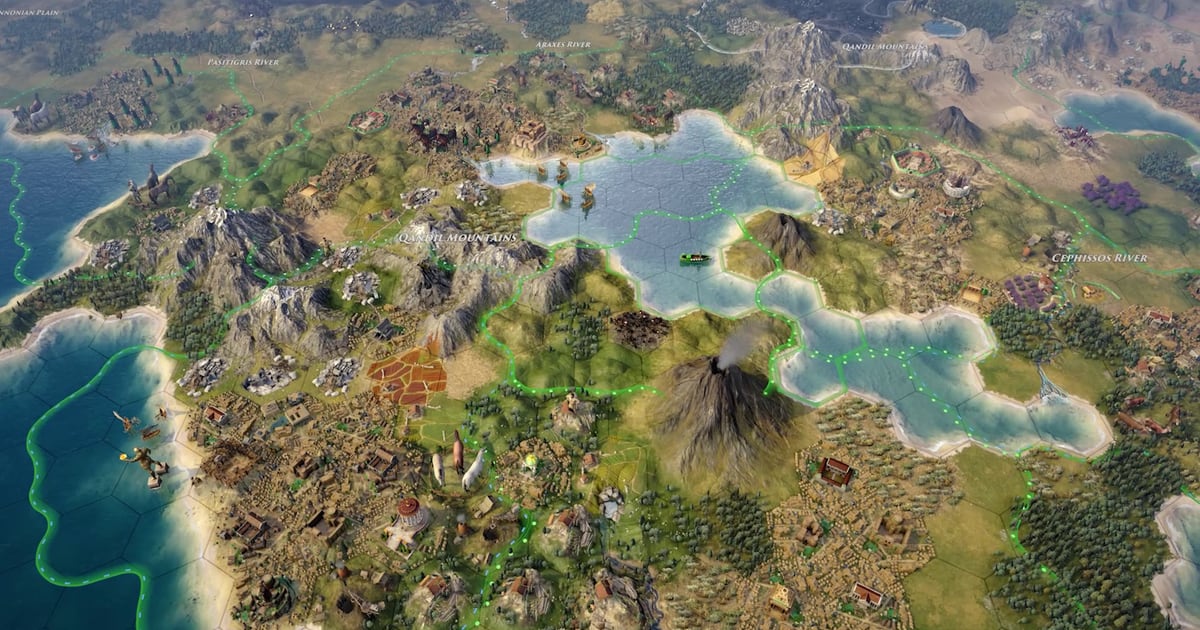
Designed by Soren Johnson (lead designer of Civilization IV), Old World breaks the foundational rule of turn-based 4X4X. eXplore, eXpand, eXploit, eXterminate — a grand-strategy subgenre about building a civilization over a long arc. strategy. In classic 4X games, every unit on the board moves once per turn. In Old World, unit actions are governed by a shared national pool of Orders. A lone chariot can move ten times in a single turn if you are willing to spend the resources, while unneeded scouts sit idle.
What this covers: Orders generation math, Forced March mechanics, Worker efficiency priority, and military flank concentration. Why it matters: Winning wars in Old World is dictated not by raw unit numbers, but by whether your Orders pool allows you to maneuver and strike in a single concentrated blitz. Who should pick this: 4X veterans struggling to adapt to constrained action economies across sprawling ancient empires.
How the Orders Economy Operates
At the start of each year, your empire generates an Orders pool based on your ruler’s legitimacy, dynastic laws, and military infrastructure:
| Source of Orders | Value Generated | Scalability Factor | Strategic Focus |
|---|---|---|---|
| Ruler Legitimacy | +0.1 Orders per point | Earned through events, cognomens, and wonders | Keep rulers accomplishing historical deeds |
| Garrisons, Strongholds & Citadels | +0.5 Order each per year | Flat output per military building; no specialist scaling | Essential defense infrastructure in every city |
| Ruler Archetype (Orator / Schemer) | +2 Orders per year per Friendly city (Orator); +2 Orders per year per war (Schemer) | Groom heirs toward Orders-granting archetypes | Diplomatic dynasties and wartime schemers |
| Laws (Serfdom, Monotheism, Divine Rule, Elites) | Serfdom +5 Orders/yr; Monotheism +1 Order in state-religion cities; Divine Rule +1 Order per Pagan Religion; Elites +2 Orders/yr at Legendary culture | Permanent national policies | Trade upkeep and opinion costs for higher action volume |
If you run out of Orders during a critical wartime turn, you can purchase an additional Order for a flat 100 Training — a one-off purchase that does not increase your annual production. A Schemer ruler can instead buy Orders with Legitimacy, and late-game empires running the Coin Debasement law can buy and sell Orders with money.
A Table of Order Sinks
Every Orders decision is a trade against another use of the same pool. The costs below are drawn from the official Units and Hints pages:
| Action | Cost | Notes |
|---|---|---|
| Move one tile | 1 Order | Terrain surcharges can add extra movement points |
| Attack | 1 or more Orders | A unit can attack repeatedly while Orders remain |
| Worker improvement turn | 1 Order | Farms, quarries, roads, and wood chops all consume a turn |
| Forced March | 100 Training, then 2 Orders per extra tile | The only way to move a unit that is already Fatigued |
| Heal 5 HP | 1 Order plus the unit’s remaining movement | Units also regain 1 HP per turn inside your borders |
| Attach or replace a General | 100 Training | Also consumes the unit’s remaining movement |
| Buy an extra Order | 100 Training, flat | Does not raise annual production |
Where the Idea Came From
The Orders pool is a direct answer to what lead designer Soren Johnson calls every-unit-moves (EUM): the convention that each piece on the board acts once per turn. His designer notes argue EUM mostly creates the illusion of choice — there is rarely a reason not to fire another archer or build another mine, so the decision goes rote as an empire grows and players automate their Workers precisely because the choice is boring.
The replacement came from an unlikely place: the limited-action “energy” systems of 2010-era Facebook social games that Johnson saw while working alongside other former Civilization designers. The designer notes say he wanted the strategic multiplier, not the microtransactions, and that Old World’s first prototype tested the idea in multiplayer to see whether guns-or-butter decisions would appear every turn. They did — every tactical situation gained hundreds of possible approaches depending on which units received the Orders.
The open question was whether a single unit should move without limit. Johnson wanted that freedom, but the team disagreed, and an internal mod that capped each unit at three moves appeared during the debate. The compromise became the fatigue system: three moves, then an extension paid for in Training and doubled Orders.
Forced March: Trading Training for Distance
Normally, a unit can move multiple tiles until its baseline stamina is exhausted for the turn. However, units can execute a Forced March:
- Costs 2 Orders per additional tile moved.
- Costs a one-time 100 Training — and nothing beyond that: the march deals no damage to the unit.
- This allows you to rush distant elite cavalry reinforcements across an entire continent to relieve a besieged capital in a single turn, arriving fatigued but in time to break the siegesiege. A timed, large-scale attack on a settlement — attackers try to destroy it, defenders try to hold it. lines.
The Three-Move Fatigue Limit
The cap is a price rather than a wall. Once a unit has spent 3 Orders moving it becomes Fatigued, and the official Units page states that a Fatigued unit “can only move again on the current turn through a Forced March.” A handful of units bend the limit: Scouts and Camel Archers carry +1 Fatigue Limit, while tribal mercenaries that cannot earn XP run at -2.
Two interface shortcuts make the system manageable. Holding Ctrl and clicking orders a direct Force March past the normal fatigue range, and holding Shift while issuing a move queues a multi-turn destination so the unit advances to the edge of its range each turn and resumes automatically.
Terrain, ZOC, and the Movement You Don’t See
An Order nominally buys one hex of movement, but terrain adds surcharges. Hills, Sand, crossing a River, Scrub, and Trees each add an extra movement point, while Rivers and Roads inside your own territory cost only two-thirds of a movement point. Troops fighting on hills and forest edges therefore spend noticeably more Orders to reposition than troops on open ground.
| Terrain or rule | Effect on Orders or defense |
|---|---|
| Hills, Sand, River crossing, Scrub, Trees | +1 movement point |
| River or Road inside owned territory | Two-thirds of a movement point |
| Friendly Road | Extends the Trade Network and cuts the Orders cost of moving troops |
| Zone of Control (melee and ranged infantry) | Blocks enemy units from moving through the ring |
| Mounted units | Ignore enemy ZOC |
| Fortify | +5% Defense per turn to a +25% cap; each adjacent attack removes 5% |
| Ranged unit on a Hill | +1 Range unless the target also stands on a Hill |
Roads earn their cost twice over. The official Hints page notes they help units move farther per Order, especially through difficult terrain, and also extend your Trade Network. In the designer notes Johnson writes that the multiplayer teams who won were often not the ones spending the most Orders on kills, but the ones who connected their frontline to their core with Roads to cut the Orders cost of moving troops.
Zones of Control complete the picture. Melee and ranged infantry project a ZOC that stops enemy movement, so a line of cheap infantry can pin a stronger force while you spend Orders elsewhere; mounted units ignore that ring entirely, which is what makes them the flanking force. Melee infantry can also Fortify for a stacking defensive bonus, though every adjacent attack chips the bonus back down.
Worker Prioritization: The Idle Worker Doctrine
The biggest trap for players transitioning from Civilization is keeping all workers moving and developing tiles every single turn:
- In Old World, moving a worker across hills to build an irrelevant farm expends 2 to 3 Orders that could have been used to kill two enemy archers on the frontline.
- Group your workers in tight clusters around dedicated urban development hubs. If a worker has completed their farm or quarry, let them sit completely idle without spending valuable Orders to re-position them until a major civic project is required.
Concentrated Alpha Strikes
Because units can attack multiple times if Orders allow, victory on the battlefield belongs to concentrated focus fire:
- Rather than spreading light damage across five enemy spearmen, spend 6 Orders to cycle two archers and a heavy horseman to eliminate a single enemy unit entirely.
- Dead units deal zero retaliation damage and generate free Legitimacy for your dynasty.
Healing, Generals, and the XP Budget
Orders do more than move armies. Every unit has 20 HP, regains 1 HP each turn it ends inside your borders, and can be topped up for 5 HP at the cost of 1 Order plus its remaining movement — which means healing effectively ends that unit’s turn.
Generals cost 100 Training to attach or replace and also consume the unit’s remaining movement. They must come from the same family as the unit, with the nation’s Leader as the exception, must be younger than 50, and retire at 60; if the unit is attacked, the attached General has a 1% chance of being injured.
Experience is the other currency that trades against Orders. A unit gains 10 XP each time it fights, needs 100 multiplied by its level to advance, can only level once per year, and caps at level 5. Training can be spent to fill the missing XP, so an impatient empire can buy its way toward a promotion. Each level offers a pick from four permanent bonuses, including Combat for Strength, Strike for attack, Guard for defense, and Focus for critical chance.
The Stockpile Ceilings That Feed Orders
Two caps quietly convert surplus resources into Orders. Training stockpiles stop at 2000, and anything above that is converted into Orders; Civics stockpiles cap at 2000 and convert the excess into Science. Because both Forced March and emergency Order purchases run on Training, an empire that lets its Training overflow is effectively buying free movement.
The Hints page frames the whole system as a scaling problem: “Growing your number of Orders should be a priority. The more territory and Units that you control, the more Orders your Nation will need to function.” That is why the table above leans on laws such as Serfdom and Elites — a nation that expands faster than its Orders pool fields an army it cannot afford to move.