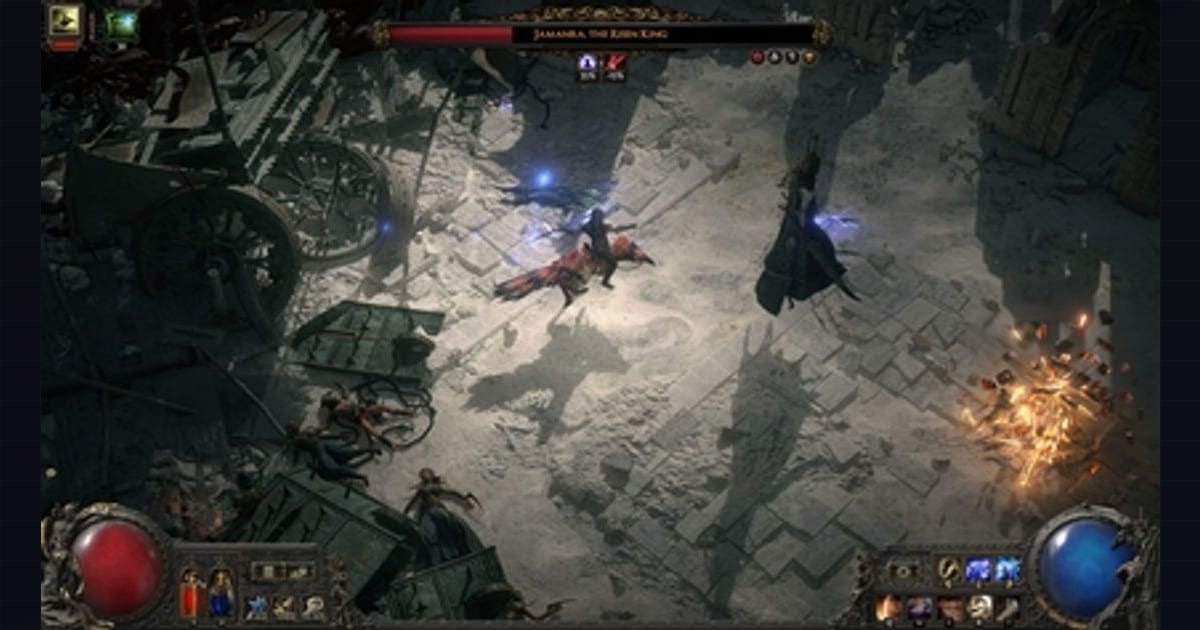
Grinding Gear Games has detailed major engine overhauls powering Path of Exile 2, emphasizing the separation of equipment sockets from item links. Every skill gem now features up to 5 support sockets built directly into the gem menu UI, removing the RNG friction of armor link crafting.
What changed: Skill gem sockets decouple from gear links; WASD movement, dodge roll, and weapon auto-swap confirmed. Why it matters: The six-link RNG gate disappears, flattening gear valuation and lowering new-player entry cost. Who should care: ARPGARPG. Action RPG — an RPG with real-time combat rather than turn-based fights. players weighing PoE2’s Q4 2026 Early Access against Last Epoch and Diablo IV.
Core System Overhauls
- Decoupled Sockets: Gear items now govern raw attributes, defense, and affixes. Gem sockets are managed independently per skill gem.
- Dodge Roll & WASD Movement: Optional WASD movement keys and universal iframe dodge rolling allow tactical positioning during complex boss encounter patterns.
- Weapon Swapping Engine: Dual-weapon sets auto-swap dynamically based on assigned skill hotkeys, enabling seamless melee/range hybrid builds.
Campaign & Endgame Scope
| Scope Element | Count | Notes |
|---|---|---|
| Campaign acts | 6 | Distinct acts |
| Endgame maps | 100 | Announced for the Early Access build |
| Boss encounters | 100+ | Designed with dynamic phase transition mechanics |
Why the Socket Decoupling Matters
The single most consequential change in this batch is not the headline count of bosses or maps — it is the surgical excision of link sockets from the loot table. In the original Path of Exile, six-link armor was a functional ceiling on build viability: a five-link was playable, a four-link was a stopgap, and the gap between a 6L chest and a 5L chest was often the difference between farming red maps and being stuck in yellows. By moving that capacity onto the gem itself (up to 5 supports per skill, surfaced in the gem UI), GGG is removing an entire class of RNG gate that had nothing to do with player skill and everything to do with drop luck.
This is a quieter change than it looks, because it also rewrites the economic substrate. Link-quality was one of the few rolls that survived the inflation-resistant crafting systems of PoE1; it acted as a deflationary sink via Fuses and a price floor on endgame gear. With the floor gone, the value of an item now collapses to its affix roll, its item level, and its base type — a flatter, more legible valuation curve. For the trade economy that means less variance per slot and, probably, tighter spreads; for SSF players it means the moment a build “comes online” is no longer gated behind a six-link drop you may never see.
WASD and the Action RPGRPG. Role-Playing Game — a game built around character progression, story, and player choices. Control Question
WASD movement in an isometric action RPG is a genre fault line, and GGG has chosen the pragmatic option: make it optional, keep click-to-move as default, layer a universal iframe dodge roll on top of both. The interesting part is what that dodge roll implies for encounter design. If every player has a guaranteed defensive button with consistent iframes, the boss pattern language can get meaningfully more aggressive — the designers no longer have to assume the median player can only walk out of telegraphs. That is the same logic that let Monster Hunter scale its combat cadence around the wirefall/silkbind escape, and it is the precondition for the “100+ boss encounters with dynamic phase transitions” claim further up the page.
The risk is the inverse: a universal dodge roll flattens class identity if it is the optimal answer to every mechanic. GGG’s history suggests they will tax it — stamina, cooldown, or a movement-impairing recovery state — so that positioning and gear-based mitigation stay relevant. Watch for whether the roll shares a resource with the weapon-swap system, because if it does, the hybrid-build fantasy and the defensive button become a single budget the player has to manage.
The Take
Read together, these three systems describe a deliberate unbundling of PoE1’s most opaque coupling. Sockets are no longer a property of armor; movement is no longer bound to a single input modality; weapon identity is no longer a single committed choice per build. Each of those was a load-bearing constraint in the original game, and each was also a constraint that punished new players disproportionately — the player who did not know to chase a six-link, or to bind movement to click, or to commit to one weapon class. Path of Exile 2 is, in effect, lowering the entry cost on three of the systems that made PoE1 feel impenetrable, while leaving the depth (the gem support graph, the affix crafting, the boss pattern density) intact.
That is a sound strategy for an Early Access launch in Q4 2026, when the audience GGG needs to capture is not the hardcore PoE1 migrant — that audience is already locked in — but the Last Epoch / Diablo IV player who bounced off PoE1’s cliff of unexplained systems. The decoupled sockets in particular are a competitive positioning move as much as a design one: they remove the single most-cited reason a returning ARPG player quits PoE within the first week.
What the Boss Count Signals
A stated scope of “over 100 boss encounters with dynamic phase transition mechanics” is a production claim as much as a design one, and it deserves a skeptical read. Phase-transition boss design is expensive — each phase is effectively a separate encounter authored against the same health bar, and animation rigging for transitions does not amortize the way trash-mob work does. If GGG is committing to that volume at Early Access, one of two things is true: either a large share of those encounters are reskinned phase-sets sharing rigging, or the studio has invested heavily in a modular boss-authoring pipeline that lets designers compose phases from a shared behavior library.
The recommended spec — an RTX 4070 and a Ryzen 7 7800X3D — hints at which. That is a notably single-thread-favorable CPU pairing, and the 7800X3D’s strength is exactly the kind of bursty, cache-friendly logic that a behavior-tree-driven boss system leans on. The hardware ask is consistent with a game that intends to run a lot of concurrent, granular AI state rather than pure GPUGPU. Graphics Processing Unit — the chip that renders the game's visuals; the main driver of framerate and image quality.-bound rendering throughput. Players building for the recommended tier should treat the X3D cache as the actual bottleneck, not the 4070.
Context
The headline number here — 100 endgame maps — is smaller than PoE1’s atlas at its mature state, and that is the correct framing. This is an Early Access build targeting a Q4 2026 window; the comparable figure to watch is not PoE1’s peak atlas size but PoE1’s launch endgame, against which 100 maps is already generous. The decoupled-socket and WASD systems are the load-bearing changes for long-term retention; the map and boss counts are the launch-day surface area. Both matter, but they matter on different timelines — sockets and movement are the systems that decide whether players stay through the first league, and the boss/map volume is what makes that first league worth staying for.
With Early Access targeted for Q4 2026, the next signals to watch are league-one details and how heavily the universal dodge roll is taxed relative to the weapon-swap budget. If the 100-map endgame and phase-transition boss pipeline hold to that window, the first league will be the real test of the decoupling bet.
Next read
- For the broader field PoE2 is launching into, see ARPG Primer 2026 — Path of Exile 2, Diablo IV, Last Epoch, and Titan Quest II Compared.
- For how league-start economies differ across the genre, see ARPG League-Start Economy Primers Compared.
- All our Path of Exile 2 reports live on the Path of Exile 2 coverage hub.