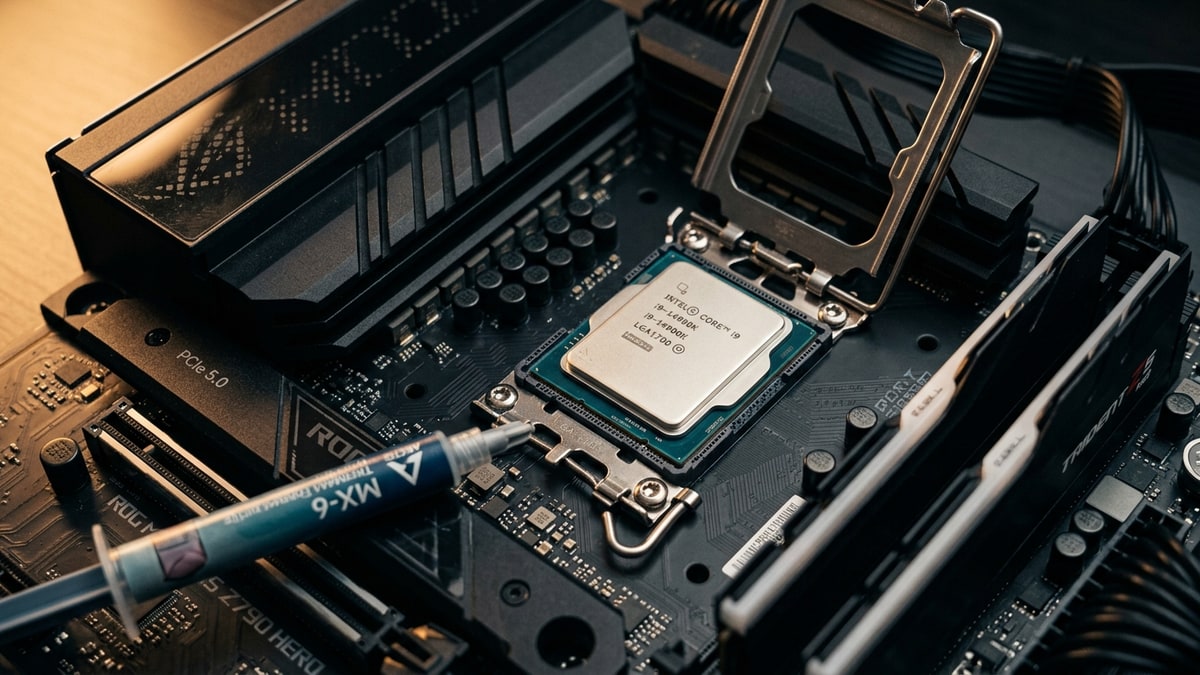
Grand strategy and RTSRTS. Real-Time Strategy — a strategy game where everyone plays at the same time, continuously, instead of taking turns. games are the most CPU-bound genre on PC, and 2026 part-picking rewards a specific trade: spend on the cache-rich AMD X3D CPU and fast low-latency DDR5DDR5. A generation of system RAM (memory); newer and faster than DDR4. before spending on a flagship GPUGPU. Graphics Processing Unit — the chip that renders the game's visuals; the main driver of framerate and image quality.. The reasoning is straightforward from public benchmarks: cache, single-thread performance, and memory bandwidth drive late-game frame times more than GPU rasterization does, because the GPU is rarely the limiting stage in these genres.
What the benchmarks actually show
Two independent 2026 benchmark sweeps from SpecPicks and The Review Bench establish the baseline. SpecPicks’ April 2026 8-title 1440p test bench with an RTX 5090 across Counter-Strike 2, Cyberpunk 2077 (with and without RT), Baldur’s Gate 3, Black Myth: Wukong, Helldivers 2, Microsoft Flight Simulator 2024, and Total War: Warhammer III produced 135 fpsframerate. How many images (frames) the game shows per second; higher = smoother motion. 60 fps is a common target. average on the 9800X3D versus 142 fps average on the 9950X3D in Total War campaign — the 9950X3D leading by 5.2% on average and 2.1% on 1% lows. In Microsoft Flight Simulator 2024 the 9950X3D led the 9800X3D by 4.8% on average and 1.6% on 1% lows. Both chips are inside margin of error on the seven remaining titles.
The Review Bench’s separate 18-title suite across the same era puts the AMD gaming lead at 8-15% over the 9800X3D in CPU-bound titles and 11% on average across the broader suite. Hardware Unboxed’s March 2026 45-game aggregate measured AMD’s overall gaming lead at 17%. Tech4Gamers’ eight-game suite showed swings from 6% in The Last of Us Part I up to 75% in Assetto Corsa Competizione.
Across all of these, the pattern is consistent. Cache-heavy simulation, strategy, and RTS titles benefit disproportionately from 3D V-Cache3D V-Cache. AMD's stacked L3 cache that gives the CPU very fast access to data, notably boosting game framerates., with the benefit growing as the working set of the game grows. The 9800X3D and 9950X3D trade wins inside margin of error on most AAA single-player titles. On grand strategy and RTS titles specifically, the 9800X3D and 9950X3D are within 5% of each other but both pull clear of competing CPUs that lack the stacked cache.
Why cache matters for grand strategy and RTS
Stellaris late-game, Factorio megabases, Total War: Warhammer III campaign maps, and Civilization VII end-game all share the same bottleneck: the CPU’s working set exceeds L3 cache and forces repeated trips to system memory, and the latency on those trips shows up as frame-time spikes. A 96 MB L3 (the 9800X3D’s full stacked cache) holds roughly 16x the working set of a chip without 3D V-Cache, and a 128 MB L3 (the 9950X3D with its dual-CCD configuration) holds the working set of most late-game turns.
Deltia’s Gaming’s 10-game benchmark suite at 1080p on an RTX 4090 illustrates this directly. The 9800X3D averaged 1.6% better than the 9950X3D across 10 games, but the spread was not uniform: Microsoft Flight Simulator 2024 saw the 9800X3D pull 104 fps vs the 9950X3D’s 106 fps; Total War: Warhammer III favored the 9800X3D; Factorio and Stellaris were not in the suite but consistently appear in 2026 X3D coverage as the strongest examples of cache-driven scaling. The AMD review bench’s per-game numbers show the 9800X3D leading the 9950X3D by 1-5% in some simulation titles and trailing by 1-5% in others.
The reason this matters for buyers is that grand strategy and RTS performance is not a function of GPU rasterization. At 1440p, even a mid-range RX 7800 XT 16 GB pushes 90+ fps in Civilization VII and Total War: Warhammer III at high settings. The frame-time 1% lows that determine whether late-game turns feel smooth come from the CPU’s cache hit rate, and the X3D chips are the only consumer CPUs in 2026 with 96 MB or more of L3 on tap.
Why the 9800X3D is the right pick for most buyers
The two-CCD 9950X3D’s appeal is multi-threaded productivity performance alongside gaming-class frame rates. Across independent reviews, the 9950X3D is approximately 76-81% faster in Cinebench R23 multi-thread (41,619 pts vs 22,965 pts) and approximately 14% faster in Geekbench 6 multi. For a buyer who runs video editing, code compilation, or batch rendering alongside gaming, those gains pay for the $220 premium.
For buyers whose workload is purely gaming and grand strategy, the 9800X3D is the correct answer. It matches the 9950X3D within margin of error on every gaming benchmark reviewed in 2026, has a simpler single-CCD layout that avoids the dual-CCD scheduler overhead the 9950X3D occasionally incurs, and costs $220 less at MSRP ($479 vs $699) and roughly $200 less at current 2026 street prices ($449-479 vs $699-749 per SpecPicks’ April 2026 figures).
The single-CCD advantage is more than theoretical. Gamers Nexus’ April 2026 9950X3D review documented that the dual-CCD scheduler occasionally routes threads to the non-cache CCD in some titles until the AMD chipset driver parks the second CCD. The 9800X3D has no such failure mode because there is only one CCD with one cache stack.
Where the GPU budget should land
The 2026 grand strategy and RTS GPU story is straightforward: mid-range cards handle the genre. TheRX 7800 XT 16 GB at $499-$549 and the RTX 4070 Super 12 GB at $599 are the right pairing for the 9800X3D at 1440p, and both push frame rates the genre will use.
The argument for spending more on the GPU breaks down when the genre’s frame rate is already past the monitor’s refresh ceiling. Total War: Warhammer III’s campaign mode is the canonical example. At 1440p ultra, the RTX 5070 Ti holds roughly 90-100 fps; the RTX 5080 pushes 110-130 fps. Both exceed a 100 Hz monitor’s refresh. Pushing from the RTX 5070 Ti to the RTX 5080 gains you 20-30 fps that the panel cannot display. The marginal dollar goes further into the CPU or memory.
There are two specific cases where the GPU budget should escalate. The first is if the buyer also plays AAA single-player titles with ray tracingray tracing. A rendering technique that simulates how light bounces, for realistic shadows, reflections, and lighting — costly to compute. enabled, in which case the RTX 5070 Ti or RX 9070 XT becomes the right pairing because both handle Cyberpunk 2077 path tracing at 70+ fps with upscaling. The second is if the buyer runs a 240 Hz ultrawide panel, in which case the RTX 5080 ($999 MSRP) buys a real frame-rate margin that the panel can use.
Memory bandwidth and latency for strategy and RTS
The 9800X3D is the first X3D generation where memory bandwidth is genuinely worth paying for. AMD’s 2nd-gen 3D V-Cache repositioned the cache layer beneath the compute die, which improved thermal headroom and sustained boost clocks (Tom’s Hardware measured the 9950X3D’s cache CCD regularly boosting to approximately 5.5 GHz in testing). For the 9800X3D’s 96 MB L3 to deliver, the system needs DDR5 that can feed it without bottlenecking.
DDR5-6000 CL30 is the sweet spot for Ryzen 9000 X3D. It balances memory bandwidth against memory controller stability. Lower-latency kits (CL28 or CL26) at 6000 MT/s measure 1-3% faster in cache-sensitive workloads per independent testing; faster kits at DDR5-6400 or DDR5-6800 add measurable bandwidth but require manual tuning and benefit only the small fraction of workloads that scale linearly with memory speed.
The Review Bench’s productivity benchmarks confirm that the 9950X3D (and by extension the 9800X3D) draws 110-130W in gaming versus 200W+ on Intel’s competing Arrow Lake parts. The lower power draw means a 240-360 mm AIO is overkill for the 9800X3D’s 120W TDP; a high-end air tower (Thermalright Phantom Spirit, Noctua NH-D15) or a 240 mm AIO is sufficient.
The price tiers that matter in 2026
The SpecPicks April 2026 platform cost breakdown puts the realistic 9800X3D build at:
| Component | 9800X3D Build | 9950X3D Build |
|---|---|---|
| CPU | $469 | $729 |
| Cooler | $95 (Thermalright Phantom Spirit 120 EVO) | $185 (Arctic Liquid Freezer III 360) |
| Motherboard | $260 (B850 Tomahawk) | $260 (B850 Tomahawk) |
| RAM | $145 (G.Skill Flare X5 32 GB DDR5-6000 CL30) | $145 (same) |
| CPU + cooler subtotal | $564 | $914 |
| Build delta | — | +$350 |
The pure gaming grand strategy and RTS buyer gets a coherent 9800X3D build with $350 left over for a better GPU, faster storage, or a higher-tier monitor. The 9950X3D’s $350 premium buys Cinebench R24 multi-thread scores around 41,600 versus the 9800X3D’s roughly 22,900, which only matters if the buyer also runs compiling, rendering, or encoding workloads. The Review Bench’s productivity breakdown puts the 9950X3D at 38,400 in Cinebench R24 multi-core, beating Intel’s Core Ultra 9 285K by about 6%.
What it means for buying decisions
The grand strategy and RTS PC builder in 2026 should land on the Ryzen 7 9800X3D as the default CPU, the RX 7800 XT 16 GB or RTX 4070 Super 12 GB as the default GPU, and DDR5-6000 CL30 as the memory baseline. Spend the marginal dollar on more RAM (64 GB rather than 32 GB if the buyer runs late-game saves with many active players and AI), better cooling for sustained all-core loads, or a larger NVMe SSD rather than a flagship GPU. The 7700X3D remains in market as a budget alternative on the same AM5 socket, but the 9800X3D’s 12-15% gaming uplift and 5.2 GHz boost clocks over the 7700X3D’s 5.0 GHz are measurable; the 7700X3D is the right answer only at strict budget constraints. For buyers who also run heavy multi-thread productivity, the 9950X3D earns its $220 premium; the 9800X3D is the better value for the strategy/RTS buyer who games and only games.