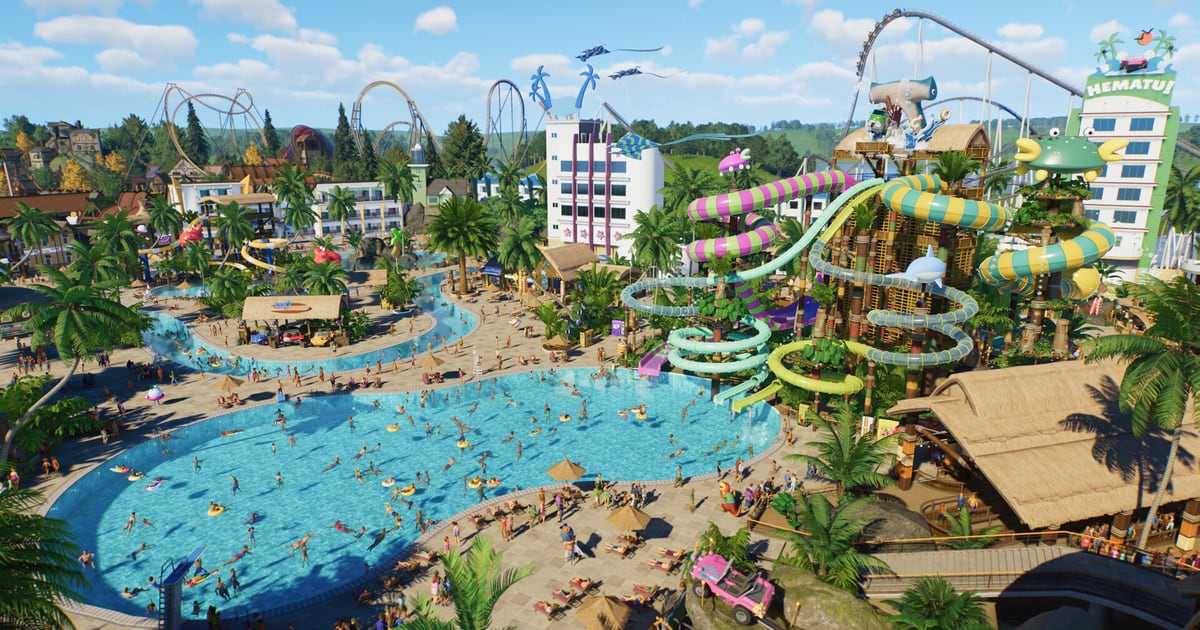
Frontier Developments expands the amusement park genre in Planet Coaster 2 by introducing comprehensive water park creation. Beyond standard steel hyper-coasters, managers must now build and operate interconnected aquatic resorts featuring custom lazy rivers, high-speed body flumes, wave pools, and intricate life-support mechanics including water filtration, lifeguard staffing, and sun protection.
What this covers: Flume hydraulic drop speeds, raft friction coefficients, pool water filtration capacity, lifeguard sightlines, and sunscreen guest amenities. Why it matters: Unlike standard dry rides, pools get dirty without a steady supply of clean, filtered water — keeping guests enjoying the water takes active pumping infrastructure. Who should pick this: Theme park designers expanding from traditional rollercoasters into massive multi-pool water resort complexes.
The Water Filtration and Power Network
Every body of water in Planet Coaster 2 requires dedicated utility backing. Water does not stay clean on its own; hundreds of guests swimming throughout the day cause water turbidity and hygiene levels to plummet.
| Utility / Structure | What It Does | Range & Requirements | What Happens Without It |
|---|---|---|---|
| Water Pumps | Produce the clean water that keeps pools and flumes from getting dirty | Require power and Mechanic maintenance; feed Filters through Water Pipes | Pools and flumes get dirty; a neglected pump carries a Condition Penalty and provides less water |
| Filters | Clean everything within range using water from your pumps | Supply range shown when placing; connected to pumps with Water Pipes | Pools and flumes within range stay dirty |
| Pool Heaters | Keep each pool at the right temperature for guests | Added per pool; cold weather can otherwise freeze the water over | Guests will not enter pools that are too cold or frozen |
| Lifeguard Chairs & Posts | Lifeguard Points that keep pool areas safe | Each lifeguard watches a cone of vision around their Chair or Post | Pool Area Safety drops, and low-safety areas see far more panicking guests |
| Changing Rooms | Where guests change into swimwear before using pools and flumes | Guests buy Pool Passes at Guest Services first; rooms get dirty and need janitors | Guests cannot use pools or flumes at all |
Keep Generators, Water Pumps and Filters in good condition with Mechanic servicing: their condition deteriorates with use, and a utility in poor condition carries a Condition Penalty that throttles its output. Thunderstorms add another hazard — lightning can strike rides, generators and water pumps, causing them to break down — so mind the forecast when you plan a full-day schedule.
Water is only half of a functioning utility system: pumps cannot run without power, so a water park is really two overlapping networks, each with its own buildings, ranges and failure states.
| Utility | Role | Range & Requirements | Limits |
|---|---|---|---|
| Generators & Solar Panels | Produce the power that rides and facilities draw on | Must be linked to a Distributor with a Power Cable; Solar Panels need direct sunlight | Unserviced generators decline in Condition, take a Condition Penalty and can shut down |
| Distributors | Push generator power to everything nearby | Visible supply range when placing; available and in-use power shown on the info panel | Anything outside the range simply stays unpowered |
| Power Cables | Tie generators and distributors into a grid | Can be split into several separate grids across one park | An over-drawn network cannot power everything in range |
| Water Pipes | Connect Water Pumps and Wells to Filters | Same grid logic as power cables, for clean water | A pipe run that skips a Filter starves it |
| Water Towers & Underground Wells | Researched upgrades on the Water Pump | Provide more clean water than a pump, at a higher build cost | Higher power requirement than a standard pump |
Your park entrance supplies a small amount of both power and water so a new park is not dead on arrival, but Update 8 cut that regional power from 120 units to 60, which pushes early parks to build their own Generator sooner. Solar Panels are the cheap route on paper and the weather-dependent route in practice: full efficiency on clear sunny days, noticeably reduced in overcast or rainy conditions, and no output at all if the panel sits indoors, under a shelter or in shade. The Utilities heatmaps — Power Supply, Water Supply and Water Cleanliness — are the fastest way to see which flumes and pools are actually covered.
Custom Flume Engineering: Speed and Splashdowns
When engineering custom flumes and tube slides, managing guest g-forces and velocity at splashdown is critical:
- Drop Banking: Never construct sharp flat turns directly after steep vertical drops. Flumes are built piece by piece, with the pitch and angle of every section adjustable as you place it — use that control to smooth out transitions after steep drops, because every section you shape feeds the Excitement, Fear and Nausea ratings guests judge the ride by.
- Splashdown Runout Sections: Every flume needs an end piece so riders arrive safely at the end — either a pool or a special end piece. Dropping a guest onto the hard ground or another object will cause them to leave the park unhappy.
- Raft and Multi-Person Flumes: Body, raft, mat and tube flumes all carry the same Excitement, Fear and Nausea rating system as your coasters. Test every flume before opening — the test run shows whether the slide is functional and produces its ratings — then connect an entrance to your paths and give the flume a supply of clean water before it opens with an auto-hired Ride Attendant.
Guest Comfort: Sunscreen and Shaded Loungers
Guests in aquatic areas face unique comfort mechanics:
- Suncream at Guest Services: Guests walking around in swimwear in direct sunlight suffer sunburns over time — and sunburnt guests leave the park early. Suncream is sold at the Guest Services facility, and since a guest’s suncream runs out over time, they must return to reapply and repurchase, so keep a Guest Services building within reach of your pool decks.
- Shade Structures and Umbrellas: Line pool deck areas with umbrellas and cabanas. Shelter protects lounging guests from direct sunlight as well as rain — the game’s Shade heatmap highlights exactly which deck spots are covered.
Pool Building Tools, Depth and Prestige
Pools borrow the path-building language, so designers who already understand paths adapt fast. Three tools cover most layouts:
| Tool | Best for | Notes |
|---|---|---|
| Line Builder | Rows of pools and lazy rivers | Straight or curve line styles |
| Draw Tool | Asymmetric and organic pool shapes | Freehand drawing |
| Stamp Builder | Quickly dropping regular shapes | Square, hexagon, octagon and pentagon stamps |
Every pool then exposes Line Style, Edge Type (infinity or pathed) and Depth (swimming, diving, shallow or wading). After placement, the Rounding Tool smooths harsh corners, the Customise Brush repaints tiles and edging, and the Edit Tool lifts or repositions individual boards.
Depth is worth more than looks. Pool Prestige measures overall quality and drives how much guests want a dip, climbing with pool size and occupancy and gaining a boost from scenery, extras, wave machines, water jets and attached flumes. The Prestige tab breaks that score down by category, and a Scenery Brush pass around the deck is the quickest way to move it; higher prestige supports more guests and higher prices.
Wave Pools, Lazy Rivers and Safety Coverage
Wave pools need a flat wall on at least one side, which makes the Stamp Builder the easy starting point. Place a Wave Machine from Pool Extras — four lengths exist for different pool sizes — but remember the machine’s length does not set how far waves travel: the size of the pool does, so a large lagoon wants several machines working together.
Lazy rivers are a Line Builder job. Toggle jets on in the pool’s Customise Extras menu and adjust their rotation and repetition, or place individual Lazy River Jets from Pool Machines along both banks — jets snap to the correct height and direction automatically. A Splash Emporium lets guests buy lilos and pool rings for the drift, and ladders plus Lifeguard Points finish the build.
Safety is a measured stat rather than an assumption. Pool Area Safety holds at 100% while a lifeguard is assigned to a Chair or Post and starts dropping the moment that point is left empty, and each guard only covers the cone of vision around their station. Poorly covered water produces far more panicking guests, and since lifeguards wade in to help panicking swimmers, coverage is what keeps the Panic need stable. The Pool Overall Safety tab shows both a percentage and a heatmap of exactly what your guards can see.
Cold Snaps, Thunderstorms and Shade
Update 8 turned weather from a visual filter into a management system.
- Cold: guests gained a Warmth need. Electrical Heaters keep queues and high-traffic areas warm, sheltered areas hold a degree of warmth, and cold guests drift toward hot food and drink and covered benches. Pools need their own answer — cold snaps can freeze water over, and Pool Heaters keep it at a temperature guests will enter. Closing a pool through the cold and saving the energy is the alternative.
- Thunderstorms: the forecast shows the current day plus the next two, which matters because guests refuse to use pools and flumes once a storm arrives and lightning can strike rides, generators or water pumps and knock them offline. Taller rides are worth closing for the duration.
- Sun and shade: the reworked Sun Cream heatmap tracks each guest’s exposure to direct sunlight and highlights the Guest Services buildings selling suncream, while the Shade heatmap shows which deck and queue spots already block sun, rain and snow. Solar Panels care about the same light.
Sandbox mode can switch particular weather states off entirely, along with the simulation effects behind them — guests getting wet, rides breaking down in storms and pools freezing.
Guest Ailments and Swimwear Logic
Water areas generate their own failure states. Guests who stay soaked, sit in litter or use dirty toilets become Uncomfortable and burn through park fatigue faster; guests who are cold too long or whose suncream runs out join them.
| Ailment | Trigger | Prevention |
|---|---|---|
| Sunburnt | Too long in direct sunlight | Sell suncream and build shelter; suncream runs out, so guests must repurchase and reapply |
| Wet | Unsheltered in rain | Sell umbrellas, build shelter, place Body Dryers |
| Cold | Low temperatures over time | Place heaters; keep hot food and drink on sale |
| Panic | Low pool safety, or high ride Fear | Add Lifeguard Points; lower ride Fear |
| Sick | Nausea pushed too high | Alternate high-Nausea rides with calmer ones; janitors clear the result |
Two rules shape how a water park plays. Guests in swimwear, in a pool, on a flume or riding the WaveSim are exempt from the weather-driven Warmth and Dryness needs, though they still sunburn. And a guest in a pool will leave to satisfy a pressing thirst or hunger need, which is why Update 8 added a grace delay so needs fall more slowly while guests are queued, swimming or riding.
What a Water Park Costs to Run
Update 8 rebalanced maintenance. Servicing a ride, generator or water pump now costs money and restores condition only to 80%; returning an attraction to full condition takes a Refurbishment at a higher price. Service badges no longer freeze wear — they slow it — so pumps and generators still drift toward a Condition Penalty that cuts output, and a utility left unserviced can break down and shut off entirely. Rides and utilities that sit open with no guests accumulate less wear, which makes an idle pool deck cheaper than a busy one.
Mechanics have to be able to reach the equipment, and generators, pumps and rides all appear under the Attractions and Shops sub-menu with a wear rate flagged low, average or high. Two details are worth designing around: water rides such as log flumes do not need water pumps at all, and Mechanic Workshops generate the Research Points that unlock Water Towers, Underground Wells and new attractions in the first place.