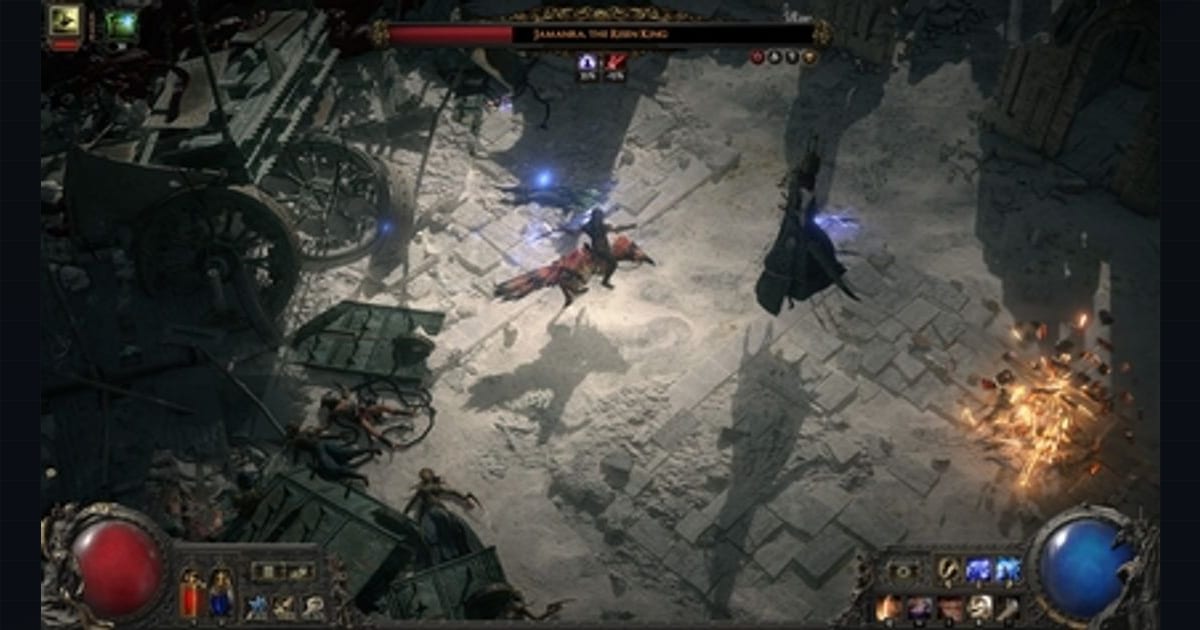
Path of Exile 2’s Content Update 0.3.0, titled The Third Edict, was the largest patch of the game’s Early Access period, pairing a new Act and league with a near-total rebalance of characters, items, and the endgame. If you are returning to Wraeclast or planning a fresh league character, this guide collects what the official patch notes actually changed and what those changes mean in practice.
What changed
The headline content additions are substantial. Act Four continues the story from Act 3, sending players by ship to the Ngamakanui archipelago — eight islands that can be visited in any order, each with its own monsters and bosses. Cruel Difficulty has been removed entirely, replaced by three temporary Interludes, side-story beats intended to carry characters to level 65, where the endgame begins.
The Rise of the Abyssals launched as the game’s first full league, resetting the economy. Fissures appear in zones and drain life force from nearby monsters; killing those monsters wakes the Abyssal, necromantically enhanced enemies you must defeat to close the rift. Closures reveal Abyssal troves, and ancient bones recovered along the way let you imbue items with hidden Desecrated modifiers. At the Well of Souls, discovered in Act Two, you reveal and transform those modifiers by picking one of three options — modest crafting help during the campaign, and access to endgame modifiers that could not previously be crafted. The league also runs in Hardcore and Solo Self-Found variants, and all pre-0.3 characters received a free passive refund because of the scale of the changes.
Alongside the content, Grinding Gear Games described its goal for the patch as increasing build diversity so that far more skills and archetypes remain viable at endgame. The notes that follow that statement are enormous, so the sections below focus on the changes most likely to affect how you build, farm, and level.
How it works
Support gems
The single most consequential system change is the support gem overhaul. The old restriction — one copy of each support per character — is gone. You can use as many duplicates as you like, and many supports now exist in multiple tiers with different stat profiles as you progress. Eleven new support gems were added, and 40 Lineage Supports, stronger variants that only drop in the endgame, joined them. Several straightforward supports were renamed to better describe their function, and a handful of older gems were removed from gemcutting entirely, with existing copies deleted on login.
Two related rules also changed: you can no longer socket multiple copies of the same skill gem into your primary skill sockets, and supports that work on skills “you use yourself” no longer attach to persistent skills, totems, or triggered skills unless explicitly stated.
Defensive baseline
Defense math moved a lot. Evasion now works on all hits except boss skills that flash red, though the formula was adjusted so a given pool evades a smaller share of incoming attacks. Blocking is no longer limited to strikes and projectiles by default — anything without the red unblockable flash can be blocked — but base maximum block chance for players, minions, and monsters dropped to 50%, down from 75%. Raise Shield and Parry now require you to face the enemy rather than the direction of the hit, and monsters build stun substantially faster against players who block or parry. Attribute requirements on both gear and skill gems dropped by roughly a fifth to a quarter at endgame levels.
Ailments and infusions
Fire damage no longer ignites on its own. Instead, it applies Flammability, a stacking debuff that determines your chance to ignite with every fire hit. Shock and chill now last longer against monsters, and weak chills below a 30% magnitude threshold are discarded outright. A new Elemental Infusion mechanic threads through many elemental spells: some skills generate Infusion remnants you pick up, and others consume matching or cross-element infusions for extra effects. Several legacy gems were renamed to avoid colliding with the new mechanic.
League economy and crafting
The crafting ecosystem shifted in several ways that matter for league-start planning:
- New currency tiers. Greater and Perfect versions of Transmutation, Augmentation, Chaos, Regal, and Exalted Orbs now drop from the late campaign and maps, each with minimum modifier levels for what they add.
- Hinekora’s Lock. A new currency that lets you preview the result of the next currency item used on an item.
- Essence rework. Essences now come in four tiers — Lesser, Normal, Greater, and Perfect — and each applies a specific guaranteed modifier based on tier and item type rather than pulling from a tag pool. Seven new essence types were added.
- Pinnacle access. Most pinnacle content now drops Splinters instead of combined key items. You bring splinters to the Realmgate and pick a difficulty with a matching entry cost, which removes the old incentive to sell keys instead of running content. The Arbiter of Ash became a fixed-difficulty fight with infinite portals and rewards matching its old maximum difficulty, and an Uber Arbiter variant requires new Calamity Fragments from fully-maxed Citadel bosses.
- Waystones. Every modifier on a Waystone now carries both a downside and an upside plus additional Waystone drop chance, with weaker downside modifiers to compensate for stacking more of them. Corrupted Waystones cap at eight modifiers.
Ascendancy reworks
Every existing Ascendancy class received changes in 0.3.0. Highlights from the official notes:
- Tactician gained a new Strategic Embankments notable that gives each totem type an aura with a different bonus, removed banner placement limits in exchange for Glory generation, and tripled the damage of the Death from Above command on Supporting Fire.
- Gemling Legionnaire had Advanced Thaumaturgy replaced by the Thaumaturgical Dynamism buff, which passively generates Power, Frenzy, or Endurance charges based on the attribute requirements of your socketed gems. Gem Studded now grants bonuses based on your most numerous gem colour.
- Deadeye traded its old extra-mark notable for Called Shots, causing projectiles to chain to marked enemies plus a meta skill that repeatedly marks enemies past the normal limit, while Eagle Eyes was renamed Bullseye and now stacks Critical Weakness instead of removing accuracy falloff.
- Pathfinder saw all five concoctions reworked, with Poisonous Concoction reborn as Acidic Concoction, a flask throw that consumes poison on the target for a burst of life loss.
- Stormweaver had three notables renamed and redesigned, including Refracted Infusion, which gives a 50% chance to gain a second, different Elemental Infusion when collecting one.
- Warbringer, Smith of Kitava, Witchhunter, Ritualist, Amazon, Invoker, Acolyte of Chayula, Blood Mage, Infernalist, Lich, and Chronomancer all received their own list of notable swaps, renames, and numeric changes — the full list runs to dozens of entries in the official notes.
The passive tree grew as well, with 88 new clusters added across the Warrior, Witch/Sorceress, Mercenary, Ranger/Huntress, and Monk sections, and several keystone changes including the removal of Acrobatics.
Build path
If you are planning a fresh character for this patch, a few lessons fall out of the notes:
- Reroll rather than patch. Because the league reset the economy and a free passive refund was granted to existing characters, the notes themselves strongly encourage starting in the new league. Old builds assembled around the one-support-per-type rule, banner Valour, or the old block ceiling will not translate.
- Expect broader viability, verify with testing. The notes explicitly target build diversity, and the combination of tiered supports, Lineage Supports, and 88 new passive clusters means more archetypes have a path into maps. That is a goal statement, not a guarantee — treat community-tested league starters as the safer first character.
- Craft earlier and more often. The four-tier Essence system and campaign-accessible Well of Souls transformations are designed to make mid-campaign gear crafting more productive than before, so hoarding perfect bases is less necessary than it was at the Early Access launch.
- Movement changed for everyone. Holding the dodge roll button now flows into a sprint with no duration limit on any class, which shortens early campaign time considerably regardless of build.
- Plan for the new endgame economy. Splinter-based pinnacle access means selling “boss keys” is no longer the dominant early currency strategy; running the content yourself at a difficulty you can clear is now the intended loop.
What it means
The Third Edict is less a balance patch than a re-foundation of Path of Exile 2’s systems. Support duplication alone reshuffles nearly every build guide written before the patch, the defensive changes force evasion and block characters to reconsider their ceilings, and the currency, Essence, and pinnacle access changes alter how the early-league economy will price key items. GGG’s stated intent — more viable builds in the endgame — gives players room to experiment, but the sheer volume of renamed, re-tiered, and rebalanced pieces means outdated guides are a real hazard. Read the notes for your chosen Ascendancy line by line before committing to a league starter, and expect rapid post-patch hotfixes as the community finds the outliers.